New location for Cork City Library to transform cultural quarter
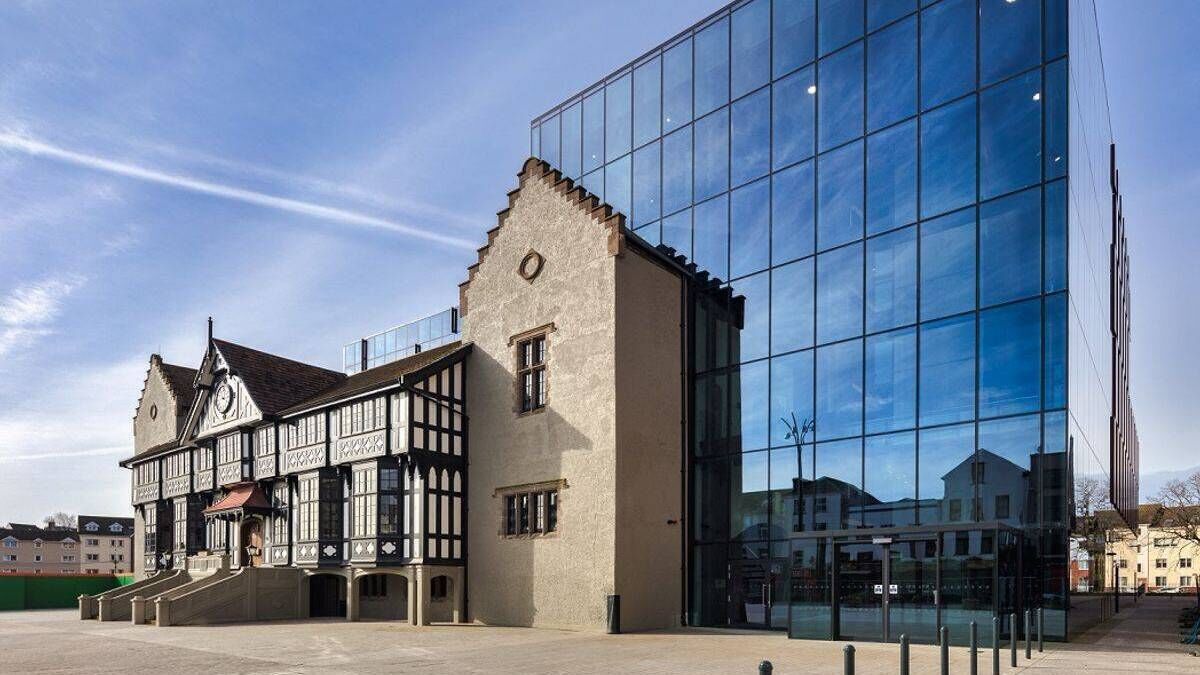
A Cork City Council image showing what the new library might look like. Picture: Cork City Council
Plans for the new city library will not impact plans for the event centre, Cork City Council has confirmed, but questions remain regarding timings, the fit-out costs, and plans for the old building.
The council said that while the new city library will be located in the historic Counting House complex on South Main St, that does not mean that the event centre cannot be co-located there.
Cork City Council announced last week that it had bought the Counting House complex on South Main St for €35m, excluding Vat, from JPDC Ltd, part of the BAM Contractors Limited Group in Ireland.
BAM were awarded the tender for the proposed Cork Event Centre, for the former Beamish & Crawford brewery site on South Main St, more than 10 years ago.
The sod was turned at the site in 2016 by then-taoiseach Enda Kenny, but works never properly began.
The cost of building the centre, originally estimated at €50m, had risen to between €150m and €200m by the end of 2024, when the government announced it would be putting the project back out to tender.
Other developers with other sites were invited to tender for the project, meaning that there is uncertainty about whether the original South Main St site will still be used.
Alternative locations, including the docklands and marina area, have been discussed.
A spokesperson for Cork City Council told The Echo that the former preferred event centre site is separate to the building that the council has recently purchased for the new library.
“The purchase of the Counting House for a new world-class library was a standalone transaction on a specific complex,” they said.
The library acquisition was completed with the support of the Department of Housing, Local Government and Heritage and the Government’s towns and cities regeneration investment fund (formerly the urban regeneration and development fund).
Southern end of the Grand Parade
In 2021, Cork City Council announced that €46.05m of funding would be provided for the Grand Parade Quarter, to help revive the southern end of the Grand Parade.
This included the refurbishment of Bishop Lucey Park, which opened late last year and cost €7m approximately, as well as works on the surrounding streets and new bridges.
Taoiseach Micheál Martin promised at the time that the funding would also be used to “progress plans to develop a new 7,700sq m city library”.
The Counting House complex is just under 7,300sq m, but it is more than three times the size of the current City Library.
As the years progressed, many TDs and councillors had questioned why progress on this part of the project was taking so long, especially given concerns about the condition of the current building.
A city council spokesperson described the existing library as “undersized, inflexible, and in poor condition, with issues such as accessibility constraints, and poor energy performance”.
A preliminary business case, undertaken by consultants EY, examined four potential options, under headings including strategic need, options, costs, risks, and economic performance.
The first option was to refurbish and extend the existing library premises; the second was to pursue a new-build on the existing Grand Parade site; the third was to pursue a new-build on the riverfront car park site next to the existing Grand Parade library, which is not in Cork City Council ownership; and the fourth was the adaptive reuse of the Counting House complex.
The preferred option
A new build was the preferred option for many elected representatives, and of the Cork City Library Action Group, a grassroots campaign established by Cork residents, civic leaders, and advocates in January 2026 to demand the delivery of the new library.
The Social Democrat’s Pádraig Rice, who was involved in the set-up of the library action group, asked in the Dáil last November: “Are we going to get the construction of a new building and not have this shoved into an existing building that does not meet the needs of a library and is not the promised new-build library?”
Council management explained that the Counting House complex was identified as the preferred location following a lengthy process which involved national and international library, architectural, and engineering experts.
Adapting the Counting House complex “emerged as the clear top performer across every major measure”, a spokesperson said, explaining it was the most sustainable option, the cheapest, and offers reduced construction and planning risks.
The spokesperson said the new library will open to the public much sooner than any of the other options considered. The Echo understands it will be around three years before the building is officially open.
After the news that the Counting House was the chosen location and the building had been purchased by the city council, Mr Rice said progress on the project was welcome, but expressed concern there would be enough funding provided for the project: “Data released to me shows that just €24m is left in the pot allocated for the redevelopment of the Grand Parade. After the purchase of the Counting House how much is left to kit-out the library and make it the world class facility we have been promised?
“We can’t be left with a new library that is second rate. This is too important to get wrong,” he said, adding that consultation with people who use the library was very important.
A planning process will be required to adapt the complex, which will involve public consultation and detailed design work which will determine the costs associated with the next stage of the project.
Colette Kelleher, spokesperson for the Cork City Library Action Group said: “I welcome this week’s announcement that there is action at last on the new Cork City Library.
“The group are eager to participate in the public consultation, see the designs for the new library, and seek reassurances that adequate funds are being made available to realise Cork City Council’s stated ambition for a world-class library in Cork.”
The news was broadly welcomed by councillors when it was announced, though several queried what was to happen to the existing library building, saying that funding originally provided to revamp Grand Parade could wind up creating more vacancy on the street if the current library building was not reused.
It will remain in council ownership, and councillors were reassured that the council has “no intention” of letting it remain empty and become derelict, though she said this would be dependent on funding.
Outside of the council chambers, the news of the purchase has also received a positive reaction.
Triskel Arts Centre’s artistic director Tony Sheehan told The Echo: “Triskel Arts Centre has been rooted in South Main Street since 1985, and we’ve always known what this street is truly capable of.
“The Counting House decision is genuinely exciting, not just because of the building, which is extraordinary, but because of what it means for the street as a whole,” Mr Sheehan said.
“This is a street that has had all the essential ingredients for a cultural quarter for years. The addition of the Counting House, alongside the recently redeveloped Plaza, both adjacent to Triskel, creates a remarkable concentration of civic and cultural assets in the heart of the city — a cultural square, in the true European sense, right in the very centre of Cork.”
Several architectural and library experts were involved in the advisory process, including Ruairi Finucane, of project architects, Brock-Finucane.
He said: “Transforming the Counting House into the new Cork City Library creates an architecture that bridges eras — preserving the legacy of tradition while shaping spaces for the city’s future generations.”
Annie Hensley, a principal with fjcstudio, an Australia-based specialist library advisor and the only architectural practice to have won the World Architecture Festival World Building of the Year award twice, was also involved in the process, and said: “The Cork library project will be informed by international best practice, while grounded in the specific cultural, environmental, and urban context of Cork.”
A city council spokesperson said that buildings are being successfully transformed into modern libraries worldwide, including the University of Luxembourg Learning Centre (a former steel industry site) and HTWG Library in Konstanz, Germany (a former slaughter house).
Other examples include Marrickville Library in Sydney and Windsor Public Library in Ontario, formerly an abandoned hospital and fire hall and stable, respectively.







 App?
App?


