Cork to hear about race to save 400-million-year-old Angel Shark
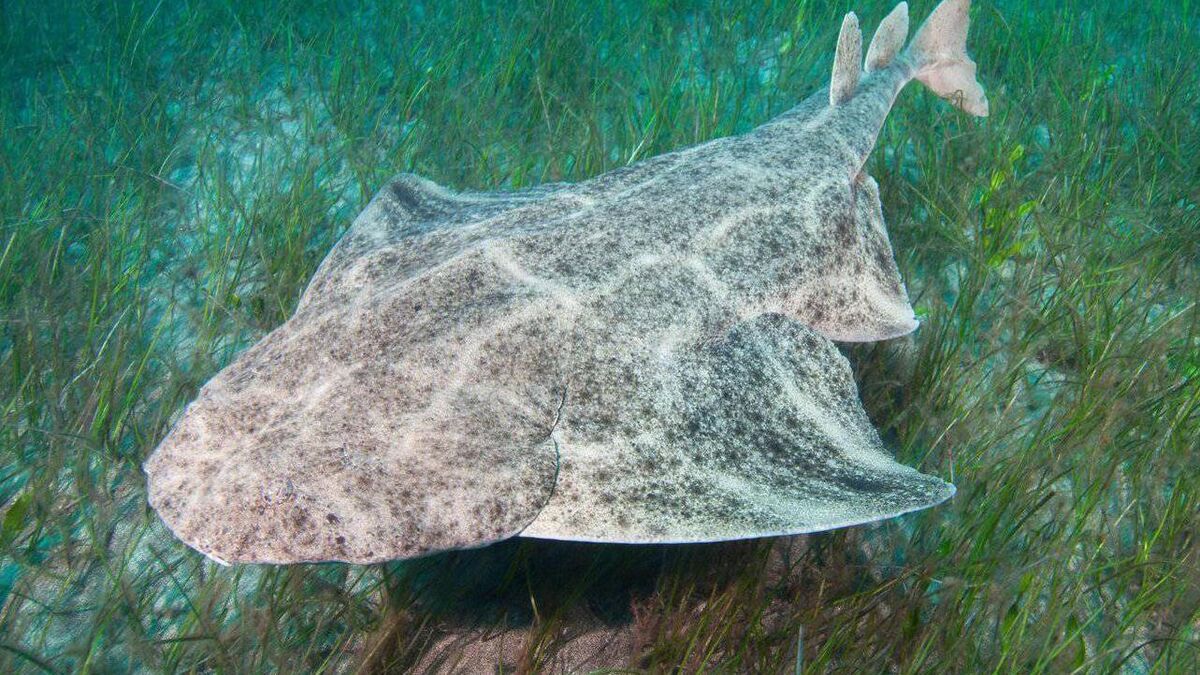
Common Angel Shark swimming over sea grass.
There are species of fish whose origins can be traced back 400 million years, but one of them, once common in Irish waters, is in decline and five Irish organisations are part of an international campaign effort trying to counteract this.
Under the title ‘Searching for Angels,’ the campaign will be discussed at this weekend’s annual Diving Ireland Expo. Louise Overy, who did PhD studies in elasmobranch conservation in the South West at UCC, will outline the latest developments in the ‘Angel Shark Project,’ of which she is one of the leaders.
Attempting to save the species of shark with the special name of ‘Angel’ are University College Cork; the Munster Technological University where Louise is based; the Marine Institute; the National Parks and Wildlife Service and the Irish Elasmobranch Group. They are responding to the declaration by the International Union for the Conservation of Nature (IUCN) that ‘Angel Sharks,’ once widespread in Irish waters and across the North East Atlantic, the Mediterranean and adjoining sea areas, are now a ‘Critically Endangered Species.’ Elasmobranch is a generic name for sharks, skates and rays - carnivorous fish with an evolutionary history dating back at least 400 million years. Elasmobranch species can inhabit marine and freshwater environments.
The Irish Elasmobranch non-profit Group is a member of the European Elasmobranch Association, promoting research, education and conservation. The international movement involving scientists in several nations is hoping to conserve ‘Angel Sharks.’
IEG is leading the campaign in Ireland where they are a protected species which, if caught, must be returned to the water. Recorded in shallow coastal areas and once widespread, the species has “collapsed across the entire range” according to scientific reports.
They grow up to 2.4 metres length and have been found submerged in sandy habitats in coastal waters. Amongst problems which the species encountered, according to the IEG, are “human interaction” causing habitat degradation by beach users, recreational boating users and leisure divers, either intentional or accidental, fishing, pollution, coastal and marine infrastructural development affecting nursery grounds.
That is wide-ranging to the stage where the species is now ranked as the second most threatened of elasmobranchs. Historical records indicate that ‘Angel Sharks’ were once relatively common in Irish waters, with concentrations along the South-West, around to Tralee Bay and up to Clew Bay in County Mayo.
As I occasionally comment on my broadcasts - “there is always something unusual to be found in the sea,” but finding ‘Angel Sharks’ is not going to be easy.
The IEG acknowledges that the chances of encountering an ‘Angel Shark’ in Irish waters these days are low, but is interested in collecting historical and contemporary information on any sightings. Fishermen, coastal and fishing communities, recreational water users, the diving community are being asked to report any nowadays or in the past.
The IEG website (https://irishelasmobranchgroup.wordpress.com/) has a guide to ‘Angel Shark. identification. It is an interesting site at which to read more about sharks in general and their associated species.
International ‘Angel Shark’ Day is June 26.
Divers from all over the country will gather this Saturday and Sunday in the Abbey Court Hotel, Nenagh, Co.Tipperary, for the Diving Ireland Expo.
Cork Port Company and Belfast Harbour Commissioners have signed a 10-year Memorandum of Understanding (MoU).
according to their joint statement.
“Leveraging collective expertise, the aim is to strengthen our roles as key enablers of the regional economy, North and South.”
Four core objectives are listed:
· Offshore Wind Energy - partnership to serve evolving needs of the sectoral supply chain, developing port infrastructure and positioning as critical hubs for Irish Sea projects · Cruise Tourism Expansion - Jointly marketing and improving cruise facilities to drive regional tourism spend · Innovation and Resilience – Identifying and securing joint funding for capital projects, clean shore power solutions and digital hub developments.
· Community and Skills - Aligning existing initiatives on employment and training for younger adults in lesser-served areas, ensuring the maritime economy delivers broad social value.
A rather unusual maritime sport - underwater hockey is developing and is played in Cork every Wednesday from 1945 to 2100 by the Cork Underwater Hockey Club at the Mayfield Sports Complex, I am told. “New members are welcome.” ·
SEASCAPES Podcast at: tommacsweeneymaritimepodcast.ie and on Podcast platforms wherever you go for your Podcast listening. To contact me Email: tommacsweeneymarine@gmail.com










 App?
App?


