General Election 2024: Shifting boundaries and changing faces could have huge impact on Cork's political landscape
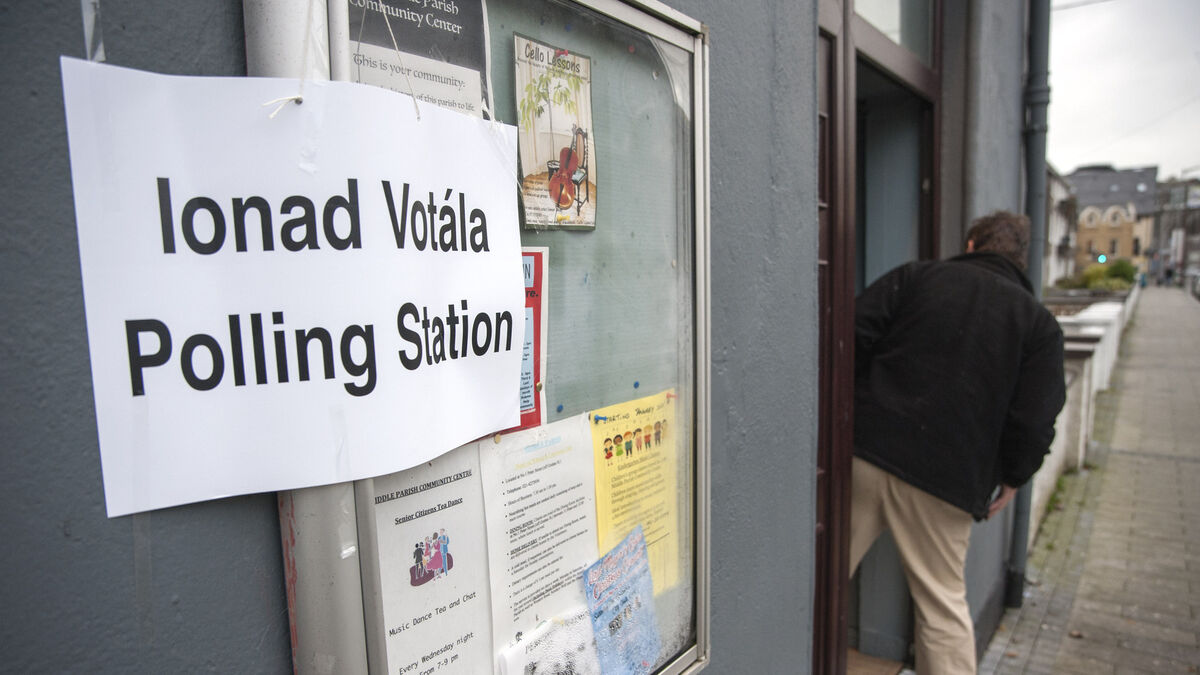
Changes in constituency boundaries could have big implications come polling day. Pic: Daragh Mc Sweeney/Provision
They say all political careers end in failure, but sometimes they end because of bad luck.
In October last year, long-time Labour Party TD Seán Sherlock announced his retirement from politics, following major changes to Cork East in the 2023 Dáil boundary review.
Based in Mallow, he had comfortably held his seat since 2007 — including topping the poll in 2011 and winning the first seat in 2016 — having taken over from his father, Joe Sherlock, who had held the seat, on and off, since 1981.
But, a redrawing of the Dáil constituencies cut up a loyal local base and sent it to the four winds, with Mallow moving to Cork North Central and the areas around Buttevant and Doneraile moving to Cork North West.
A dynasty ended not with a scandal, not by losing the support of the community, but by the indifferent stroke of a civil servant’s pen.
Sherlock was the biggest casualty of the boundary review, but it won’t be until this weekend that we find out how big of a political earthquake the changes will cause.
Overall, Cork will gain two TDs on the last election, for a total of 20.
On the face of it, the big change is that the two city constituencies, Cork South Central and Cork North Central, will each gain a TD and become five-seaters.
That has meant a significant redrawing of the boundary, with Ballincollig and Mallow moving to Cork North Central, Bishopstown Central to Cork South Central, and a number of rural townlands being swapped around.
Why is this happening now? The simple answer is population growth. The Constitution sets out a ratio of one TD for every 20,000 people at a minimum, and for every 30,000 people at a maximum. Cork previously had 18 TDs, but the 2022 census showed a population of 584,156, enough for 19.74 (rounded up to 20) seats in an expanded, 174-seat Dáil.
While few candidates would say no to an extra seat being added to their constituency — who doesn’t want a safety net? — the new areas bring as many problems as they do opportunities for incumbents.
A TD with a strong vote in one area will see that diluted in a much larger area, while those new areas also bring in viable candidates that could push for a seat.
CORK NORTH CENTRAL CHANGES
Cork North Central has experienced a huge shift. While the population of the new constituency is only 10,000 more than the old one, the make-up is very different. By Census 2022 numbers, 22,050 people in Bishopstown were moved to Cork South Central, and 2,997 moved from the Dripsey area to Cork North West, while 20,497 people were moved in from Ballincollig and 14,408 moved in from Mallow.
That means about 25% of the population of the revised Cork North Central are in areas new to the constituency, a massive turnover that changes the game for candidates.
With most of the constituency based around the Cork commuter belt, Mallow sticks out like a sore thumb on the map, and the major parties seem to think so, too. In a future boundary review (due in 2028) Mallow is likely to be the first puzzle piece the Electoral Commission looks at when revising Cork. With the exception of Labour, parties aren’t running anyone out of Mallow, and have been turning their heads towards Ballincollig, instead, which is a much neater fit for the urban-dominated constituency.
Ballincollig has long been a favourite of constituency reviewers trying to satisfy the complex requirements of the Dáil, as set out in the Constitution and associated electoral laws. It’s compact, densely populated, has clear boundaries with neighbouring settlements, and sits at the nexus of four of Cork’s five constituencies.
CORK SOUTH CENTRAL
In the past few elections, it’s been a part of Cork South Central, then Cork North-West, and now Cork North Central. If boundary changes ever required it, it also borders Cork South-West.
To understand just how much it has been swapped around, consider a middle-aged voter who has lived in Ballincollig through the various boundary changes.
At different points in time, they might have cast a ballot for someone from the Lower Harbour in Carrigaline or Passage West, from the Kerry border in Ballyvourney or the Limerick border in Charleville, or a candidate from Ballinlough or Togher on the southside of the city. This Friday, they could be preparing to cast their ballot for a candidate from Gurranabraher or Mallow.
One big difference in this election is that Ballincollig residents have ample opportunity to vote for candidates from the town itself, a rarity in recent elections.
Since Batt O’Keeffe’s retirement from politics in 2011, Ballincollig hasn’t been the base of operations for any TD. While there have been plenty of candidates from the town, none have made a breakthrough.
Because of the scale of the town, it was never ignored, but it’s been a place that successful Fianna Fáil and Fine Gael candidates from elsewhere have targeted for votes and not somewhere from which anyone has been able to build a Dáil base.
This election is different, however, with multiple big-party candidates running people from the town in the hopes of breaking through and gaining that last seat.
When the town was in Cork North West, it was some distance from other population centres, like Macroom and Millstreet, but in Cork North Central a Ballincollig-based candidate can easily expand into Blarney and the north-west of the city.
Fine Gael councillor Garrett Kelleher, Sinn Féin councillor Joe Lynch, and Social Democrat Ciarán McCarthy — who finished just 76 votes short of a council seat in June — Fianna Fáil’s Sandra Murphy Kelleher, and Independent Joseph Peters are all running out of Ballincollig.
Geography isn’t everything, but it does matter. Ballincollig has a mix of homegrown locals who have ‘Up the village’ etched into their hearts, but has also had a massive influx of people with looser ties, who were drawn to the town by the explosion of semi-D estates built in the last few decades.
So, you can expect some curious-looking ballot papers — with a Fine Gael number one and Sinn Féin number two — backing Ballincollig at all costs, but plenty more neutral ballots looking north of the Lee in search of candidates to support.
There might be a little more protectionism in Mallow, which fits much less neatly in the constituency and where voters likely feel wary, having had a local TD for so long. However, the lack of Mallow candidates will force voters outside their comfort zone, with just Labour councillor Eoghan Kenny and Independent Ireland’s Kenneth O’Flynn — a long-serving city councillor — listing their addresses in the area.
Any Mallow voter looking to back the big three of Fine Gael, Fianna Fáil, and Sinn Féin — which should be about 60-70% of them, going by national polls — will have to look towards the city for a candidate.
With so much disruption and an extra seat, it’s really all to play for on the northside, and this is a place that could turn up some real upsets.
Cork South Central also gains a seat, but with far less volatility.
Bringing back Bishopstown and the city areas south of the Lee — where they previously sat, up to 2016 — creates a fairly simple and logical constituency, made up of the city’s southside and the lower harbour area to the south-east.
UPSETS?
With a fifth seat now up for grabs and former tánaiste Simon Coveney, of Fine Gael, retiring, and Fianna Fáil’s Michael McGrath having left for the European Commission, the chances of any upsets on the southside are low.
Polling and history would suggest that you can expect the same result as last time — two Fianna Fáil, one Sinn Féin, and one Fine Gael — with a scrap over the last seat to see if one of the big parties can expand or a small party or Independent can break through.
Parties have had to factor Bishopstown in to their tickets, with Fianna Fáil adding Margaret Keneally and Labour running Wilton-based Laura Harmon.
Senator Jerry Buttimer, a former TD, is also back in the running. He lost his seat when his Bishopstown base moved north in 2016, and will be gunning to get it back, now that it has returned.
Independent Ireland’s Veronica Houlihan is also contesting out of the Model Farm Road area.
Bishopstown’s scale is no guarantee of a seat, though, as was proved in 2016 and 2020, when no-one from the area made a breakthrough in Cork North Central.
A quirk of larger constituencies is that they allow smaller parties to break through, and Cork South Central has proved that before. In the last few elections, where it was a five-seater, either Labour or the Greens held a seat, with Labour having a long history of success well before that.
The centre-left bloc held up in the locals in June, with Labour, the Greens, and the Social Democrats taking five seats across the south side between them, and their parties forming the Progressive Alliance grouping in the city council.
The constituency was no outlier when it came to the rise of Independents in June, either, with four elected across the areas making up the constituency.
Bishopstown will certainly make its presence known, but that new seat is still very much up for grabs.










 App?
App?


