Storm Babet payments: ‘We couldn’t get a penny’ until renovations were completed
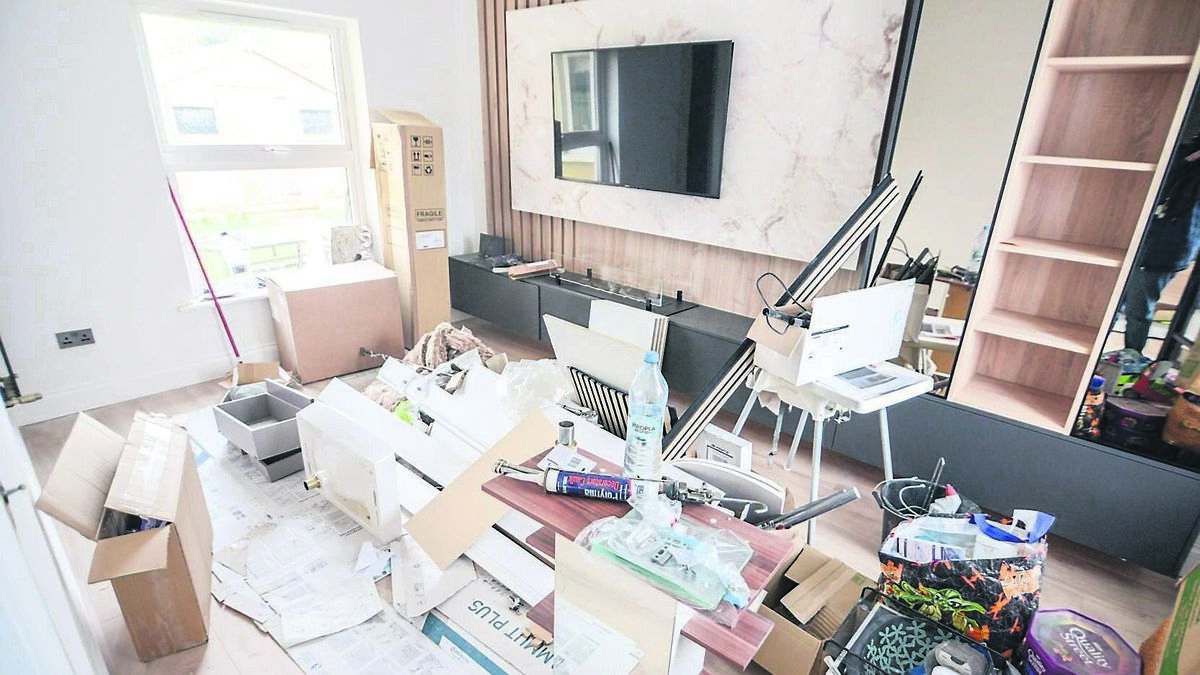
Flood damage to Christian Kyriacou's home in Mogeely in east Cork has caused an almost complete refurbishment of the downstairs of the house. Picture: Cian O'Regan.

Flood damage to Christian Kyriacou's home in Mogeely in east Cork has caused an almost complete refurbishment of the downstairs of the house. Picture: Cian O'Regan.
THE Department of Social Protection has confirmed that it has received 77 claims to date from households for third stage payments to make structural repairs to their homes, arising out of the devastation caused last October by Storm Babet flooding in East Cork.
While there have been 907 payments in total from the humanitarian fund established by Minister Heather Humphreys in the aftermath of Storm Babet, with payments totalling €2.07m, these have mainly been a mix of the first stage payments, an initial allocation of cash to meet immediate costs after the flooding, and second stage payments to pay for the replacement of white goods such as washing machines.
This week, in response to a query from The Echo, the Department of Social Protection has given more detailed information about the third stage payments intended to meet the cost of structural repairs.
Their response follows the delivery last week to Dáil Éireann of a petition containing almost 15,000 signatures of people in the East Cork area, who are calling for an urgent implementation of interim flood relief measures as well, and who are describing as “not fit for purpose” the humanitarian fund set up to compensate homeowners and businesses damaged by flooding and who are unable to get insurance because of the absence of a flood relief scheme.
Householders have given varying estimates as to the cost — anything from €15,000 to, more typically, €65,000-€80,000.
Repairs for which assistance was being sought include replastering and rewiring ground floors, as well as installing new floors.
A householder from Gleann Fia in Mogeely told The Echo that his entire downstairs had been destroyed by the flooding.
“Completely destroyed, everything, walls, electrics, drawers, everything inside the kitchen, absolutely everything, nothing survived,” Christian Kyriacou said.
“We were required to avail of the humanitarian fund to get two quotes, and the lowest possible quotes we could get were €65,000 and €75,000.
“That was just for basic rebuild, no furniture, no anything, a basic kitchen.”
Of the 77 claims received by the department — which involved householders filling complex forms, providing bank statements and pay slips, as well as builders’ estimates — 26 have been paid in full, while a further 34 have received interim payments as works are completed on a phased basis.
“The remaining 17 applications are currently being processed,” a statement from the department said.
After the application is received from the householder, the department “may appoint and get advice from a loss adjuster”.
“The loss adjuster independently assesses the property and the quoted costs of repairs.
“Based on this assessment, they make a recommendation to the department on the amount required to return the house to a habitable condition. This recommended amount is subject to an income test, to establish the capability of the household to meet those costs.
“The amount allowable in any case is not the amount claimed by the person, but rather the amount the officer administering the scheme determines is required to replace essential losses and to make any essential repairs. This decision is made following receipt of the independent report of the loss adjuster and completion of the income test.
“The rate of payment depends on the extent of the damage and the individuals ability to meet the cost of repairs.”
The Mogeely resident who spoke with The Echo said that he had made his application early, and he received an offer in early December in respect of his claim for structural repairs.
“They came back and they offered us €33,000, but they said we couldn’t get a penny of it until we finished all the renovations, handed in our receipts, and got a separate crowd to come in and survey it — that the work was done correctly,” Mr Kyriacou added.
“I told them that was impossible, as how could we start when we had no money and no builder would come in and do everything as it wasn’t enough money to rebuild?
“I asked how did they come to that amount of money.
“I was told on the phone: ‘You can appeal, but you’re not getting any more — this is it.’”
Following further discussion about the issue of getting the work started, he was offered €13,000 — 20% of the original quote of €65,000, and slightly more than a third of the offer of €33,000 — to get the work underway, with the balance to be paid following a satisfactory survey when the work was completed.
“That’s the position we’re in now,
“We have walls, we have timber flooring, the electrics are done, we can’t move, we’re tapped out and now it’s going off my wages.”
There’s no kitchen, hall or bathroom downstairs yet. They have a “partial” sitting room. The family lives upstairs. Mr Kyriacou has spent approximately €35,000 on repairs so far.
The lowest quote for a kitchen he received was €13,000. All he was allowed for a kitchen from the allocation from the department was €3,000. He has also been warned if there’s a recurrence of the flooding, and similar damage again, his house will be irreparably damaged.
Keep up-to-date with the top stories in Cork with our daily newsletter straight to your inbox.
Please click here for our privacy statement.
Have you downloaded your FREE  App?
App?

It's all about Cork!


Add Echolive.ie to your home screen - easy access to Cork news, views, sport and more