Cork poet looks at how a Brendan Behan tribute to Michael Collins became a Greek resistance anthem

Hothouse Flower Liam Ó Maonlaí, whose work features in the TG4 documentary An Buachaill Gealgháireach, which explores how Brendan Behan's tribute to Michael Collins became an anthem of resistance in Greece.
A new TV documentary by Cork poet Theo Dorgan looks at the remarkable untold story of how a song written by Brendan Behan in memory of Michael Collins became a ballad of resistance in Greece.
“’Twas on an August morning, all in the dawning hours, / I went to take the warming air, all in the Mouth of Flowers, / And there I saw a maiden, and mournful was her cry, / ‘Ah what will mend my broken heart, I’ve lost my Laughing Boy’.”
An Buachaill Gealgháireach, a new TG4 documentary, looks at an Irish song called The Laughing Boy, which was written by teenage rebel Brendan Behan in memory of another iconic rebel, Michael Collins - the centenary of whose death is commemorated this year on 22 August.
The song also had an extraordinary afterlife as To Yelasto Paidi, a left-wing anthem of resistance against the dictatorship that ruled Greece in the late 1960s and early 1970s.
Translated by Greek poet Vassilis Rotas, Behan’s words were then set to music by the composer Mikis Theodorakis.
The song remains an enduring and potent cultural force in the heart of Greece today.
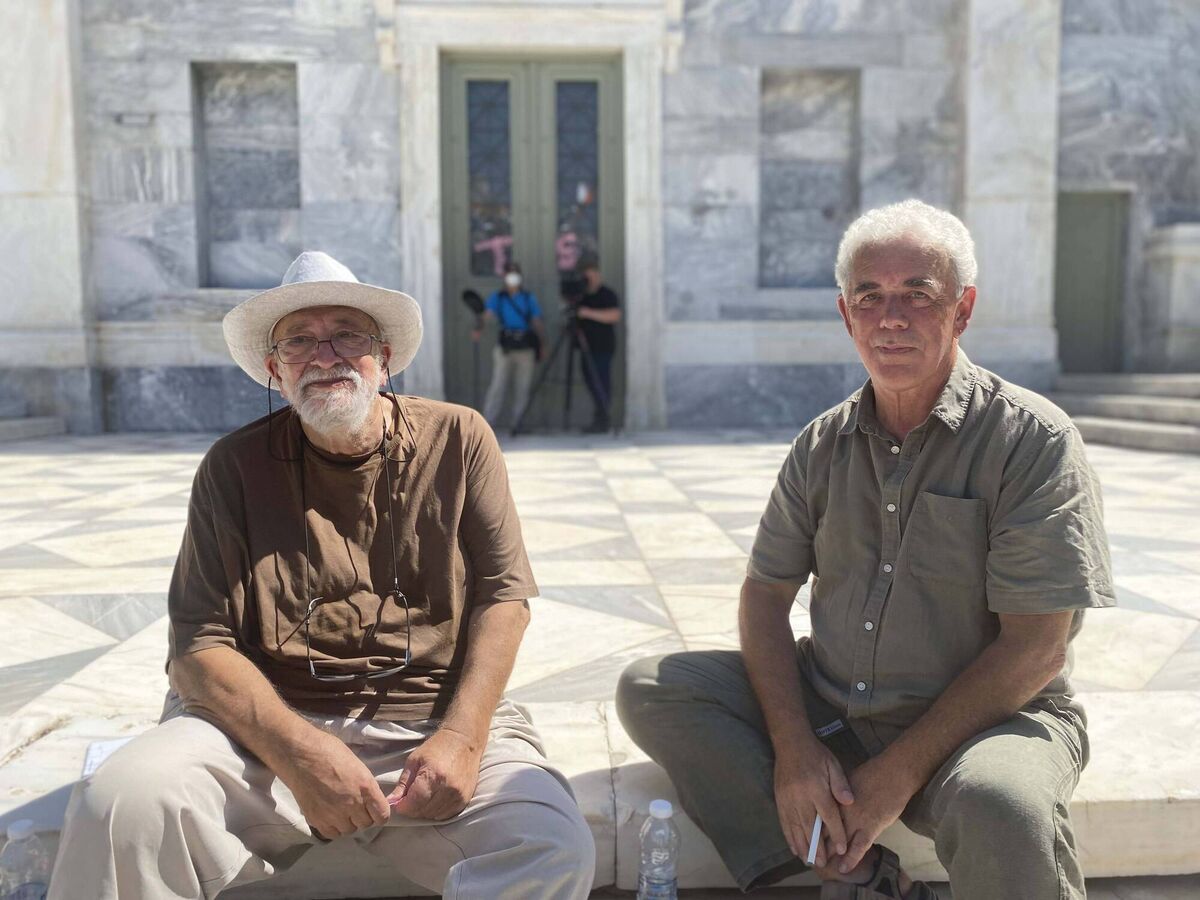
An Buachaill Gealgháireach takes Cork poet Theo Dorgan on an odyssey of his own, as he attempts to uncover the truth of the story behind the song.
He told The Echo that he and his partner, poet Paula Meehan, had been to Greece many times over the years, and he had first heard the story from Kathryn Baird, who runs an Irish Wings festival on the Greek island of Paxos.
“Within about five minutes of Catherine telling me the story, I started to sketch out the idea of the documentary then and there,” Mr Dorgan said.
The story provided the answer to a question which had always baffled him: why is the one Irish writer whose name is known to everyone in Greece not Yeats or Joyce, but Brendan Behan?
“And it’s all because of that song, which Behan had written as a teenager, and I suspect he wrote it to keep in with his ma, he was probably in trouble with his ma, because his mother had a great devotion to Michael Collins,” he said.
Years later, when Behan wrote the play The Hostage, he included his song The Laughing Boy in it, and the play was a smash in London.
“It goes to Paris in 1959 and wins best European play of the year in Paris at a festival, a man called Trivizas in Greece is setting up a radical theatre, he buys the rights to the play, sight unseen, and he commissions Mikis Theodorakis to write the music,” Mr Dorgan said.
The story of how Behan’s song became such an anthem of freedom in Greece is a narrative that interweaves the violent births of both modern Ireland and modern Greece, but these histories are also bound together by something more profound and transcendent - the power of a song.
In the film, Mr Dorgan says both the Irish and Greek versions of the song capture something unique, “some idea, perhaps, of the eternal rebel, some embodiment of revolt against small destiny, tyranny, the forces that tend always and everywhere to diminish if not actually crush our sense of the necessary largeness of life and the imagination.”
Filmed in Ireland, France and Greece, An Buachaill Gealgháireach also features performances from a number of Irish musicians - including Andy Irvine, Donal Lunny, MayKay, Liam Ó Maonlaí and David Power, and well-known musicians and singers from Greece, foremost among them Maria Farantouri, honoured throughout the world as the pre-eminent interpreter of the songs of Theodorakis.





 App?
App?