Books: I lived in Cork city in 1970s... and set my novel in that era
Glasgow-Born Ken Cairnduff reflected on his time on the building sites and in the pubs of Cork when he came to write a novel in later life. He explains how the process came about
Books: I lived in Cork city in 1970s... and set my novel in that era

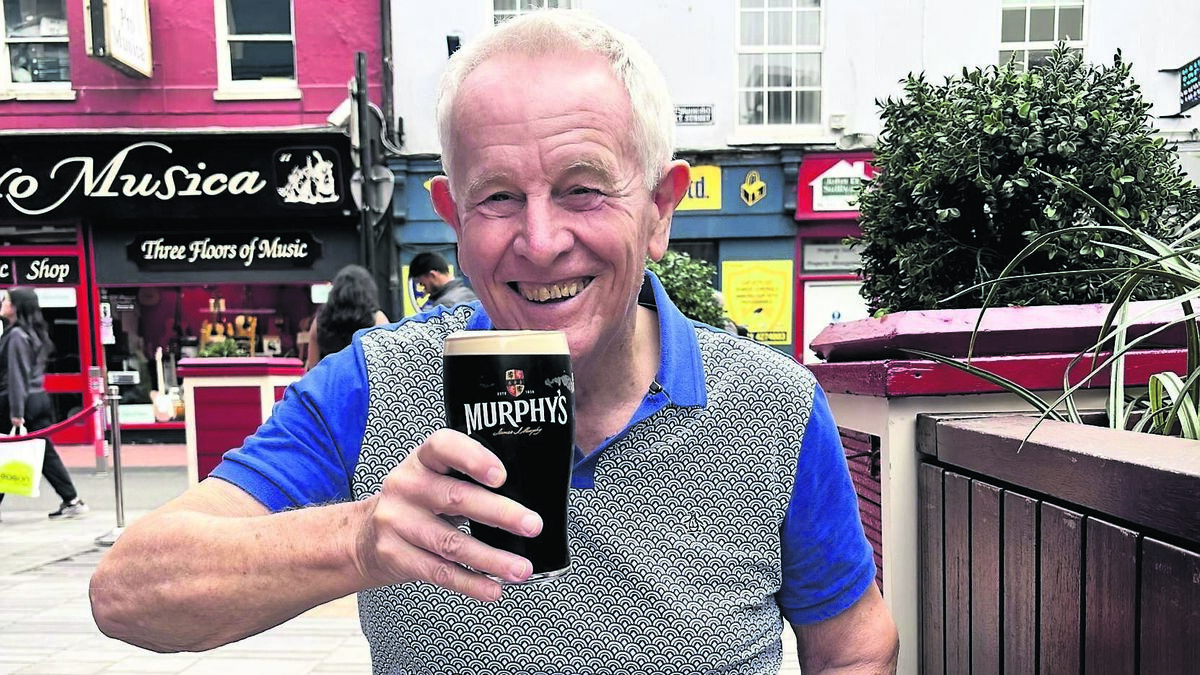
Ken Cairnduff enjoying a pint in Cork city, where he lived for three years. He later set up a successful business in the UK

The late 1970s were a transient time in my life. I travelled to Ireland from the UK on a whim and lived in Cork city for three years.

I loved the city, Ireland, and the laidback but still confident attitude to life. An attitude which still prevails today, all these years later.

Now I have published a novel which is set in Cork in that decade.

Called Straad, it is a darkly humorous story of living, longing, and dying, questioning commitment and desire.

The main character, Straad, is far from being biographical, and the other characters are all fictional, as is the Republican’s Arms pub in the plot (unfortunately).

However, some parts of Straad’s life are similar to my own. Was it Mark Twain who said: Write about what you know?

The location settings in the city and south-west Ireland are real. Grattan Hill, St. Patrick’s Street (as it was then), and the West Coast towns and Kerry mountains.

More importantly, I aimed to capture the culture of Ireland in the 1970s, a time of massive upheaval; the country was shrugging itself free from the weight of England, the Church, and the past, and welcoming the new European world.

These changes are seen mostly through the eyes of immigrants: Straad from Ayrshire (I was born in Glasgow), Mack and Ginger from Yorkshire, and the amoral Joe from deepest Kent.

Even Straad’s 70-odd-year-old gran, Annie, born in the North, but a Glaswegian, offers a fresh perspective of life.

The book starts with a well-oiled Straad celebrating his last day on a building site, and, still carrying his work spade, having ‘one last beer’ in the Arms, where he meets Cláragh.

Later in the story, and back in the pub, he tells the tale of the building site, where, as an outsider, he readied himself for serious hassle, but is made instantly welcome with only gentle ribbing.

I experienced a similar occurrence in my time, unlike other new-boy experiences in Scotland and England. Perhaps just me, or perhaps not.

The Republican’s Arms perhaps best mirrors my time in Ireland. The mythical pub, with its surreal heroine, Cláragh, and her stoic dad, Finn. Its almost uncaring acceptance of all types, from the scruffy, long-haired Straad to the ‘Galway Goddess’ Caoimhe. This is summarised in the scene when they all write haikus and “no-one stares or cares”.

The late 1970s also suited the tale I wanted to share; a modern time with modern morals, but still out of the clutches of mass media communication. A time when people still talked - and listened.

Many not-so-old readers will remember these (unfashionable) times with fondness.

In the book, Ginger and Mack encourage stories from their visitors, stories of high-jinks, or as Cláragh puts it - “tales handed down by word of mouth, from generation to generation, tales of gods and seers. They come from long dark winters, with people of all ages crammed together in one space, huddled for warmth and safety, from the dark unknown. The stories in Mack’s cottage are the dying vestiges of this age”.

It didn’t matter whether true or not in those days; no-one checked Google.

Straad is a dark and challenging book in places. I’ve no pretence at being Claire Keegan or John McGahern, I’ve just tried to tell a complex story simply, without overly ornate language and convoluted sentences. (There is a lot of swearing).

Through the characters’ eyes, the plot touches on abuse, rural poverty, and The Troubles. Straad has a morbid fascination with The Troubles, and flits on their edges in several scenes. He tries to ‘wrap his head around’ the problem, and ends with the conclusion that it is “maybe beyond anyone’s comprehension”.

The darkness of older characters looking back at lost loves strikes a poignant note, without, I hope, being cloying.

There is Finn, the gruff publican, thinking of his dead wife - “you cannot put your arms around a memory, only hold it tenuously with a thought”. And the dying Vasara, day-dreaming of her first love, whom she lost at 17.

When I began the book, I imagined it as Straad’s journey; but Cláragh’s character took on a life of her own, and now the story is perhaps more hers than his. Only the reader can decide.

Their perhaps doomed love affair is the main theme, overshadowed by her private and considerable troubles.

I saw Straad, and the other characters’ journey through their 20-something years, drifting to building businesses and some structure in life, as a kind of metaphor for Ireland. Where a young country and positive attitude make progress more possible than in Britain, and where your heritage is far less important.

I have been in business since those far-off times; perhaps it wouldn’t have happened if I hadn’t cast off my ‘donkey jacket’, way back then.

Mack summed up his adopted land - “Ireland’s the only country in the world where a girl can hitch-hike on her own without being scared. Something to be proud of”. True, in those days.

Mack, the fisherman, and his all-welcoming wife, Ginger, epitomise the contribution of incomers to their adopted land.

I revisited Cork city and West Cork/Kerry with my wife last summer, so much has evolved, but thankfully so much of the culture and attitude remain the same.

Ireland has issues which need addressed, like everywhere, but the freedom and confidence to express yourself, whether in business, or as an 18-year-old girl singing solo in a pub, permeates all. That’s my view, anyway, for what it’s worth.

We, in Scotland, had the chance to walk the same path but unfortunately didn’t take it.

In my mind, the book will be a success if it helps anyone consider their choices in a marginally different light.

Straad aims to give a different slant on the age-old question of what is important in life. Love? Money? Commitment? All in an accessible, darkly humorous story.”

I hope the Cork people enjoy and relate to Straad and Cláragh.

Ken Cairnduff was born in Glasgow. After travelling a great deal both as a child and adult, he returned in 1980 and built a successful retail chain, Au Naturale, which he sold in 2012. He is married with three children.

Straad is out now, price £9.99. See https://troubador.co.uk/bookshop/contemporary/straad
Read More

Books: I fell in love with Sherkin as a child... and set my novel there
Plot twist! Cork author meets book club who love his novel
Books: Cork professor’s debut novel explores our attitude to death

More in this section

My Weekend: 'I feel very fortunate to get to work with my dad' My Weekend: 'I feel very fortunate to get to work with my dad'
Three fabulous family homes on sale right now in Blarney Three fabulous family homes on sale right now in Blarney
TV sport round-up: Cork hurlers and ladies footballers in action TV sport round-up: Cork hurlers and ladies footballers in action

Sponsored Content

Buyer enjoys the convenience of shopping online Raisin Bank: Helping Irish savers find better deposit interest
Heads are turning for pharmacy investment property in the heart of buzzing Charleville Heads are turning for pharmacy investment property in the heart of buzzing Charleville
Charity places available for Cork City Marathon Charity places available for Cork City Marathon
Contact Us Cookie Policy Privacy Policy Terms and Conditions

© Examiner Echo Group Limited

Add Echolive.ie to your home screen - easy access to Cork news, views, sport and more