Cork woman shares story of 'unpredictability of life with lupus'
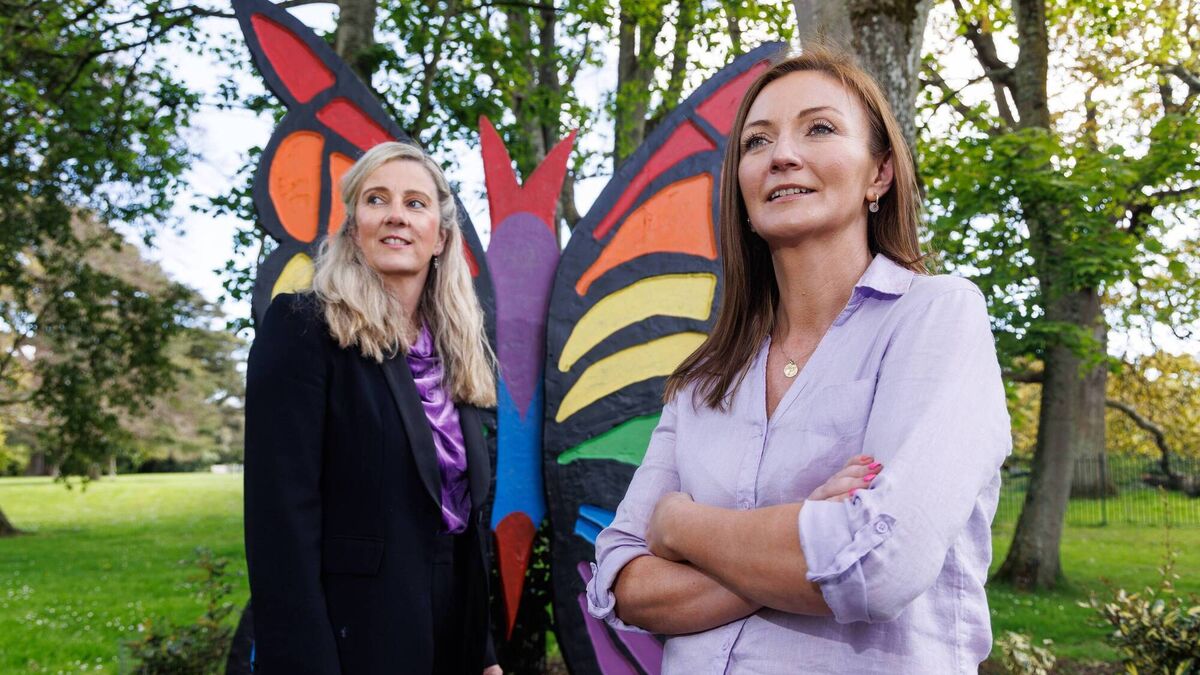
Ruth Levins, right, from Drogheda who lives with lupus and Arthritis Ireland chief executive Gráinne O’Leary, launching a new lupus awareness campaign from Arthritis Ireland and AstraZeneca Ireland. Picture credit: Damien Eagers / Julien Behal
CORK woman Kate Sweeney was young when she was first diagnosed with lupus. She had only just turned 18.
“For me, I had been overlooked for a long time by GPs,” she said. “I was a teenager going through hormonal changes, tiredness, brain fog. I had stomach issues. Nobody thought that much of it.”
The condition is complicated by this in-built invisibility, meaning that it is often overlooked and misunderstood.
“People don’t realise the level of tiredness. It’s a different type of tiredness. I feel totally drained. I’m a qualified pre-school teacher, but I’ve been out of work since September,” said Kate.
It has been so difficult to explain to people. More awareness would help.
“I am only 24. How many people my age are out of work! I wake up and won’t know when the pain will start.”
Kate added: “I look fine. It is an invisible illness and that makes it hard. A flare can come out of nowhere. Stress plays a part, and the sun is an immense pressure. My joints will get so sore.
“The unpredictably is incredibly hard to take. I can’t work. I can’t book a holiday, really, the number of holidays I’ve cancelled…”
Kate, from Ballincollig, said her condition was suspected by her GP once a set of bloods came back as abnormal.
“I was in the private system at the time, so it was expensive to get to the bottom of what was happening to me. For years, it has been trial and error. I was doing my Leaving Cert when I found out. It really was an incredibly tough time in my life.
“It was only when I got referred to Professor Grainne Murphy that things started to change. She just went to the end of the earth to find out what was wrong. I went into her care last September.”
Kate, as she puts it, has been ‘tipping away’ on medications for years. She has also spent years experiencing massive flares, frequenting the Accident and Emergency department, with stays in hospital too.
Awareness
Others, including Kate’s own doctor, Professor Gráinne Murphy, are now seeking to help by raising awareness in the community.
A campaign, a joint initiative by Arthritis Ireland and AstraZeneca, was launched recently to coincide with World Lupus Day in May.
Arthritis Ireland conducted a survey to understand the impact of lupus on patients beforehand, and the results were shared on the day.
“Professor Murphy makes a huge difference,” says Kate. “She will always check in on me if I’m in hospital.
Her passion to find an answer is insane. It is a hard diagnosis to live with as there are so many symptoms.
"I have stomach issues, a butterfly rash across my face, problems with my kidneys, my liver.
“But two people will never have the same symptoms; it is such a massive spectrum.”
Prof Murphy is a consultant rheumatologist in Cork University Hospital/ University College Cork and an expert in lupus treatment. She is keen to improve the situation for all sufferers.
“I have always had a special interest in SLE (known as lupus) and developed it further through a fellowship in a Lupus Centre in the United Kingdom, where I consolidated my interest,” said Professor Murphy.
“When I returned, I came to the lupus clinic here in the CUH where I have excellent colleagues in rheumatology but also many other specialities relevant to patients with Lupus.”
The clinic incorporates other specialities because lupus is a complex condition that can affect many organs in the body, including the kidneys, joints, skin and brain. It is an auto-immune disease, which means the body is attacking itself, but that attack can come in a variety of forms, explains the specialist.
“Some people will have a rash, a butterfly rash is one of the most common experienced; other will have severe joint pain or intense, debilitating fatigue. Inflammation can impact internal organs – that might be the brain or the lining of the lungs, or the heart. There is simply no way of predicting how the condition will manifest from patient to patient. Every patient will have a different story.”
Professor Murphy explains that the condition is most commonly diagnosed in women between the ages of 15 and 45.
Women are nine times more likely to get it than men in that age category. When younger, the condition can also be more severe .
The treatment required is as various as the different presentations of the illness in patients, she explains.
“It is very individualised. Some patients will need aggressive therapy and others will need a less intensive therapy. New drugs being developed might help but we have limited access to them in Ireland. Some medications have been approved in the US or other countries within the EU and the UK but have not become accessible to us yet.”
This is what Professor Murphy wishes to fight against: the inequity that exists between patients.
“This is a condition that affects (mostly) women in their most productive years. They must have access to appropriate medications.”
The lack of awareness of the condition is a huge problem, she argues.
“That’s why it can take some people a long time to arrive at a diagnosis. Symptoms can seem vague, and there is no one test for lupus. There is a blood test that can be positive but this can also be positive in many healthy individuals; the patient needs to see a specialist for a clinical diagnosis.”
Access to Medication
“We don’t have exact numbers on the prevalence of lupus,” the professor added. “We estimate that it will occur in 25 people in every 100,000. That translates to somewhere between 1,200 and 1,500 diagnosed patients in Ireland.”
The professor says there is also a significant unmet need when it comes to lupus treatment – there have far fewer new therapies approved than for other autoimmune conditions that we treat, such as rheumatoid arthritis. The aim of this campaign is to spread awareness so that people recognise lupus symptoms, and to prompt research into new treatments.
“There are also serious risks associated with lupus. People are much more likely to have a cardiovascular event, be it a heart attack or a stroke, if they have lupus. It can be complicating in pregnancy and can also lead to serious organ damage if left untreated. I am a huge advocate for enhancing access to new therapies, especially for those patients who have found no relief in previous therapies,” she concludes.
Into the Future
Kate Sweeney continues to navigate her diagnosis.
“Sometimes the pain is so severe I can’t cope. Paracetamol doesn’t come close, and I can’t take Nurofen due to my kidney inflammation.”
Thankfully, and with the help of Professor Murphy, Kate reports feeling massively improved.
“Like I said, it has been trial and error but I’m on what is like a chemo treatment at the moment. Nothing else was doing what Professor Murphy wanted. We thought about going to Germany to get an immunotherapy.
“I don’t want to be on all this medication.” She adds. “It might affect my fertility. We don’t really know. I suppose that’s a stress in the back of my head. Having that stress puts me in jeopardy of having another flare. It’s hard to balance it all.”







 App?
App?


