Play in Cork helps children to explore migration
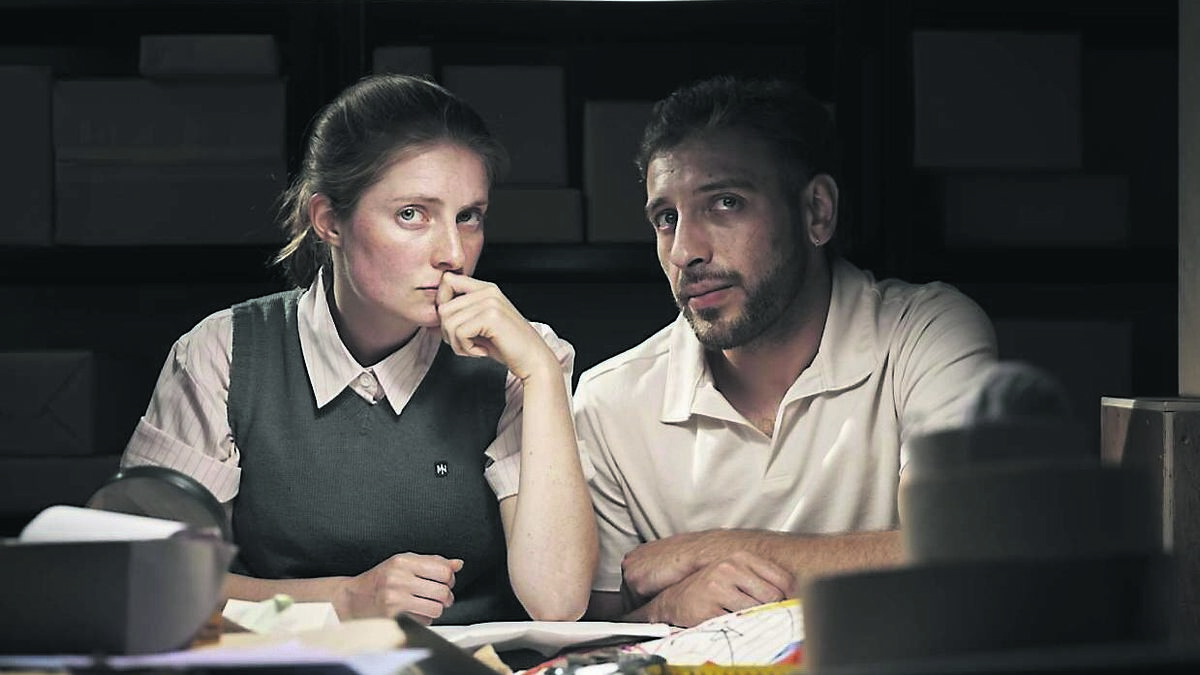
Mary-Lou McCarthy and Curtis-Lee Ashqar in The Dead Letter Office. Picture: Ros Kavanagh.
AN established actor, Mary Lou McCarthy has always harboured an ambition to write.
Now, thanks to a commission from the Civic Theatre in Dublin’s Tallaght, the Summerhill North native is looking forward to the debut of her play, The Dead Letter Office, at Graffiti Theatre in Cork city from October 19-22.
The production is in association with the Civic’s ‘Ready, Steady SHOW!’ programme and the Everyman.
Tackling migration and belonging in an imaginative way, the play is well suited to Graffiti Theatre’s stage in Blackpool with its audiences of young people. Aimed at children aged 9+, it is timely as primary school numbers are growing as a result of Ukrainian children, Syrian children and others seeking refuge and asylum.
Mary Lou, who spent some time in Cork during the pandemic before moving to Louisburgh in Mayo where her partner has family connections, says the play is targeted at primary schools but it’s also a great show for families.
“With its themes around displacement, it could help families to have conversations with young people,” said Mary Lou.
“Children at the moment are experiencing migration, whether they’ve moved here from another country or have invited new people into their class. It’s touching all of us.
“We have created an educational resource pack which we’ve sent to schools, helping children to explore migration and even curation because there’s a lot about museums in the play.”
Mary Lou says children are “really accepting when we let them be. From doing workshops in schools in Mayo, it’s wonderful to see how schools and teachers are helping to integrate students from different countries.
“I think theatre and drama can do a really beautiful job of opening up conversations and creating a safe space and a dynamic space. Children have a great capacity for play and for being open. We’re supporting that with the play. It shows that we’re all people and it’s about accepting people for who they are.”
When Mary Lou was developing the play with a primary school in Tallaght, she asked the children what was missing from it.
“It was the darker stuff. The children really felt we could go there and talk about the darker elements of migration when you’re a refugee. That impacted the next draft of the play for me.”
She adds that it’s really important the arts can enable conversations and that communities can help people to unpick issues.
The play is full of mysteries to be solved and has already excited audiences at developmental workshops with children, many of whom had never experienced live performance before. It uses the familiar world of postal arrivals and deliveries to explore why people are sometimes forced to travel across the world in search of a new home.
The story begins in the basement of a rural Irish post office where a lonely letter detective Elizabeth, sorts, redirects and investigates packages and letters that have lost their way. A huge box contains a man who has posted himself from Syria along with precious artefacts from the museum he worked at. The audience learns about his culture and explores our place in the world.
When Elizabeth opens the enormous box, she is faced with the most difficult mystery of her career and forced to make life-changing decisions. It is just days before the closure of her beloved Dead Letter Office as people don’t send many letters anymore.
“The play touches on the closure of rural post offices. For me, living in a rural community now, the post office is very important. Older audience members will get a sense of nostalgia around writing letters and telegrams. The play carries a big message about the importance of the written word and how that should be kept alive. Letters are important and are so much more interesting than email.”
Mary Lou got the commission to write the play while she was living in London, before the pandemic.
“I just wanted to write and work as an actor but projects were being postponed and cancelled. I remember being in Hackney when I got the call from the Civic.
"I burst into tears and thought, I can finally go home and start my practice as a writer. At that stage, I was doing a writing course at the National Theatre in London.
“I came back to Ireland and participated in a programme with Graffiti Theatre on writing for young audiences. I did it online for six months. It was a really good grounding in playwriting for young people. I worked with Veronica Coburn, a fantastic dramaturge who is an expert in making work for young people.”
At the time, Mary Lou was living in Dublin.
“I always wanted to live in the countryside by the sea but I felt that as an actor, that wasn’t possible as you needed to be in a city like Dublin. But with everything closed, I felt I should do what I always wanted to do. I moved to Louisburgh.
“And when things opened up, I found things much easier than I had imagined. I can still go to Dublin for auditions and voiceovers. My partner, Micheal Gallen, has family in Mayo and Westport. I had been living in the west of Ireland initially for two months. Now I’m there two years and it’s home for me. I speak Irish so I wanted to be close to Galway. We speak Irish a lot. Michael is a composer so our house is full of theatre and music.”
Louisburgh gives Mary Lou what she missed in London.
“The rewards of rural living outweigh things like being close to lots of shops and cafes.
" We have a really close community. We were very quickly embedded in it. There’s a sense of knowing all your neighbours and helping people out.”
Mary has started working on a new project for next year with Westport Town Hall. She also works with the Linen Hall in Castlebar.
Mary Lou played Tessa Holloway for two and a half years on Fair City before the character was killed off.
“It was such a great grounding. In soaps, you work so quickly, learning lines. The last thing I was in that came out recently was a feature film called Wolf.”
The actor and writer went to Colaiste an Phiarsaigh in Glanmire, an Irish language speaking school. While at primary school, Mary Lou struggled with maths and English.
“I was taken out of class and had to get extra help. I hated English and couldn’t spell.
“I remember this teacher, Miss Cooney, who did drama with us. It opened things up for me. You could pretend to be someone else. I thought it was wonderful and it was how I could communicate. Playing someone else is so freeing.
“I went on to study drama and theatre studies - and English - at UCC. After that, I got work on Aifric, a comic drama on TG4. I worked as an actor in Cork for many years before moving to Dublin.”
Mary Lou says she is looking forward to seeing how Cork audiences will react to The Dead Letter Office.
“We’re also working with an olfactory device that creates smells. We’re working with the department of electronic engineering at Dublin City University to see how we can use smell and light in the space and how it will impact the performance.
“A device releases smells into the audience of things like apples and dusty old books. A laboratory in France is creating the smells.”
The idea is that the smells will support the story. It all sounds exciting and different, and a new departure for Mary Lou.






 App?
App?


