Everything you need to know about the solar eclipse: Where to get glasses and where best to see it in Cork
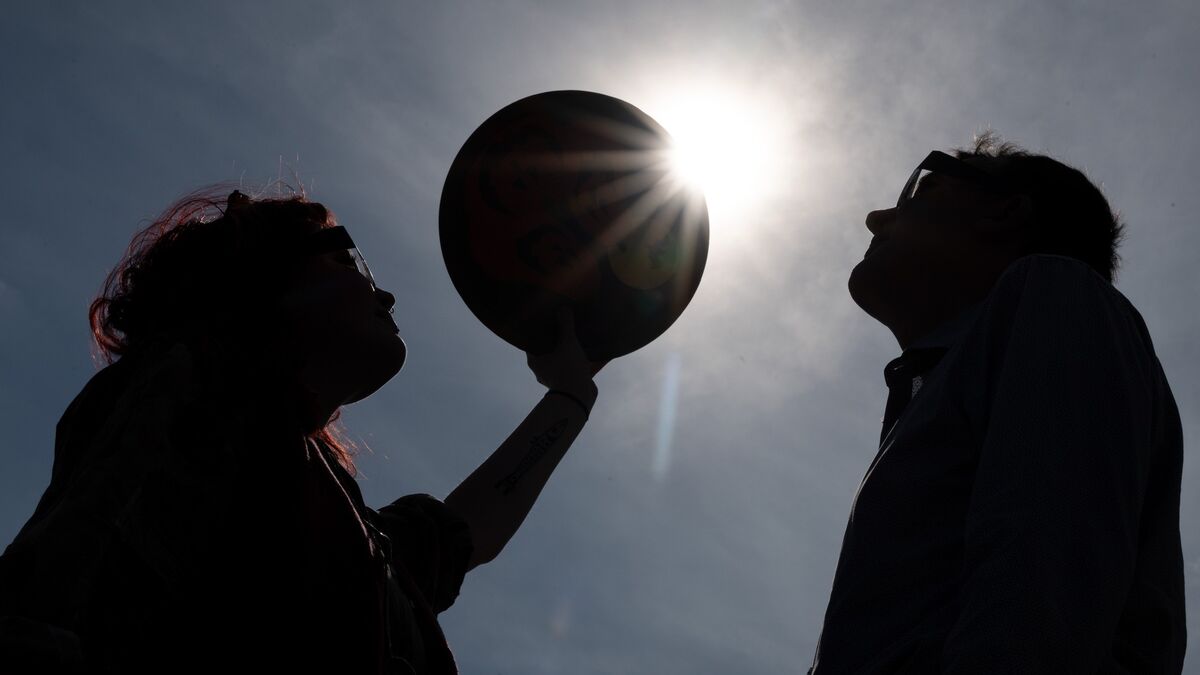
Caoimhe Lyons, a Mathematical Sciences and Physics graduate and Science Facilitator at MTU Blackrock Castle Observatory and Dr Niall Smith, Head of Research at Munster Technological University and Head of MTU Blackrock Castle Observatory. Picture: Darragh Kane
On Wednesday, millions of people across Europe, the Arctic and the North Atlantic will witness one of the decade’s greatest natural spectacles — a total solar eclipse. Here’s what you need to know about viewing the eclipse from Ireland.
A solar eclipse is a celestial event that occurs when the moon passes between Earth and the sun, obscuring the view of the sun from a small part of Earth, totally or partially.
On Earth, people can experience solar and lunar eclipses when Earth, the moon, and the sun line up.
In a total eclipse, the disk of the sun is fully obscured by the moon. In partial and annular eclipses, only part of the sun is obscured. Unlike a lunar eclipse, which may be viewed from anywhere on the night side of Earth, a solar eclipse can only be viewed from a relatively small area of the world.
On August 12, a solar eclipse, visible across parts of Europe, will take place. People in Ireland will have the opportunity to see more than 90% of the sun being obscured by the moon, with some areas of the country, including the west and southwest, seeing the sun being nearly completely obscured at 97%.
While Ireland will experience several modest partial eclipses in the coming decades, nothing of this scale will be seen again for generations – until 2090.
Cork is expected to be among the best places in the country to view the eclipse, as the moon’s shadow tracks from Greenland and Iceland before looping around to the South-West of Ireland and northern Spain.
The phenomenon, which will see 97% of the sun blocked by the moon, will bring about a noticeable reduction in daylight on Wednesday. The eclipse will begin at 6.15pm, will reach maximum at 7.13pm and will end at 8.08pm.
If you’re in Cork, MTU Blackrock Castle Observatory will be hosting viewing events at Tramore Valley Park, and Bell’s Field from 6pm to 8.30pm.
Seachurch in Ballycotton will also host a viewing event during which customers can order food and enjoy the view of the eclipse over the water.
Elsewhere, Dunsink and Armagh observatories will be holding events, as will Maynooth University and the Irish Astronomical Society, which will run a public event in Dublin's Phoenix Park.
People are being warned not to look directly at the sun without the right protection. Those viewing from home are urged to only attempt to view the eclipse with the right equipment.
It is recommended that people use eclipse glasses which are specifically designed for viewing the eclipse. People are also advised to ensure the glasses are from a reputable source, as counterfeit versions that offer no real protection are a genuine risk to eyesight.
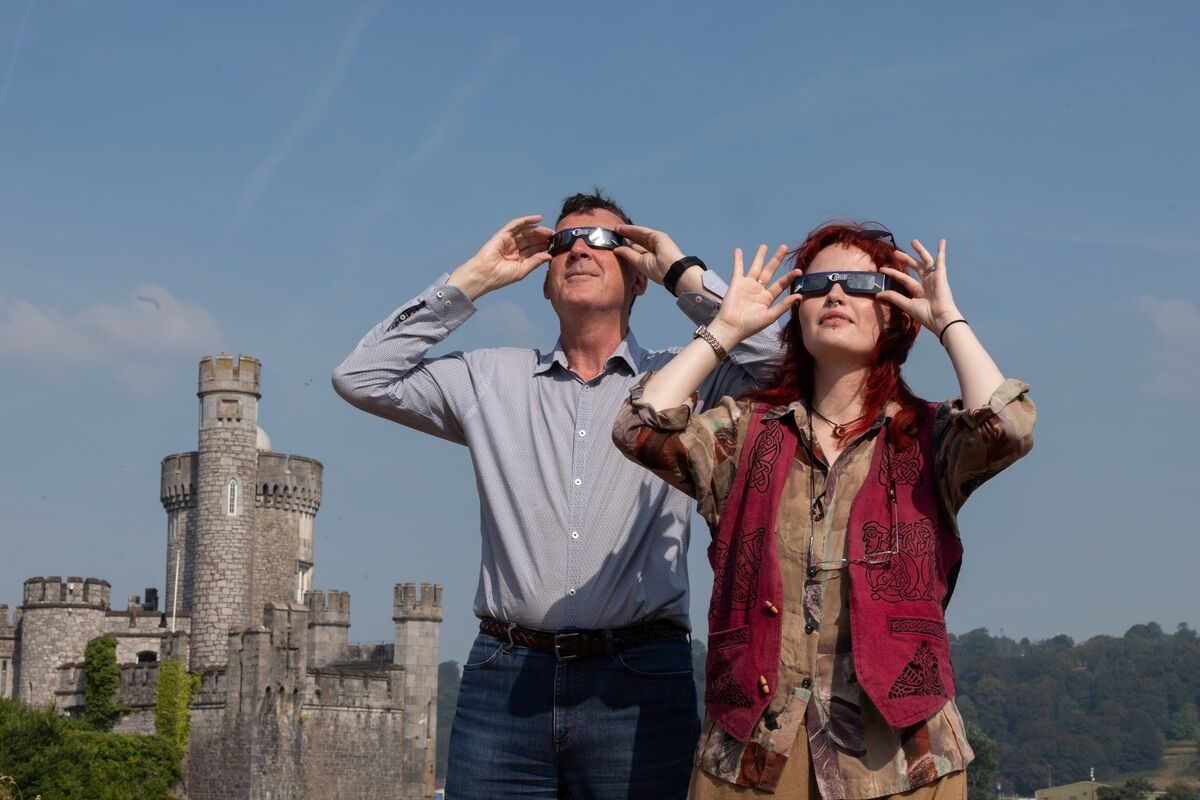
Science museums, planetariums and observatories are often among the safest places to buy genuine glasses. Branches of national retailers such as Specsavers and Boots Opticians may also have certified solar glasses at selected stores.
In Cork, Blackrock Castle Observatory has free solar eclipse glasses, donated by Rochester Museum and Science Center, available for collection on-site ahead of Wednesday’s eclipse. The glasses are available to collect from the observatory during opening hours from 10am to 7pm. Stock is limited and glasses are being distributed on a per-person collection basis.
Sea Church in Ballycotton is hosting a solar eclipse viewing event where customers will be given free solar eclipse glasses.
Those having a gathering or wanting to engage in activities to safely view the eclipse can try the pinhole camera approach. You will need a piece of cardboard and one piece of paper, a thumbtack or something small and pointy. Place a neat small hole in the center of the piece of cardboard. Hold the cardboard up to the sun. Hold the paper at as large a distance as your hands will allow from the cardboard.
To make a box projector, use a cardboard box, a pin or something similar like a needle, tinfoil, paper, scissors, and tape. Tape the paper to the back of the inside of the box. On the other side of the box, poke two holes with your needle at least ten centimeters apart or as wide apart as you can beside each other. Cover one of these holes with tinfoil. Poke a hole in the tinfoil. Using the tape, seal the box closed, ensuring no light can get in anywhere except for your two holes.
To use, hold the box up to the sun so that the light can come in the side with the tinfoil-covered hole. Look through the other hole to observe the sun.
Wednesday will be warm and dry, though there'll be some scattered outbreaks of rain or showers, especially further to the west. It will be a cloudy start to the day but will likely brighten up in many areas. Cloud is forecast to remain near some western and southwestern coasts, with some mist and fog possible in those areas.
- For more information on the total solar eclipse, visit www.eclipse26.ie.




 App?
App?


