Cork Deaf Association Advocacy Officer: ‘We can change things...but it takes time’
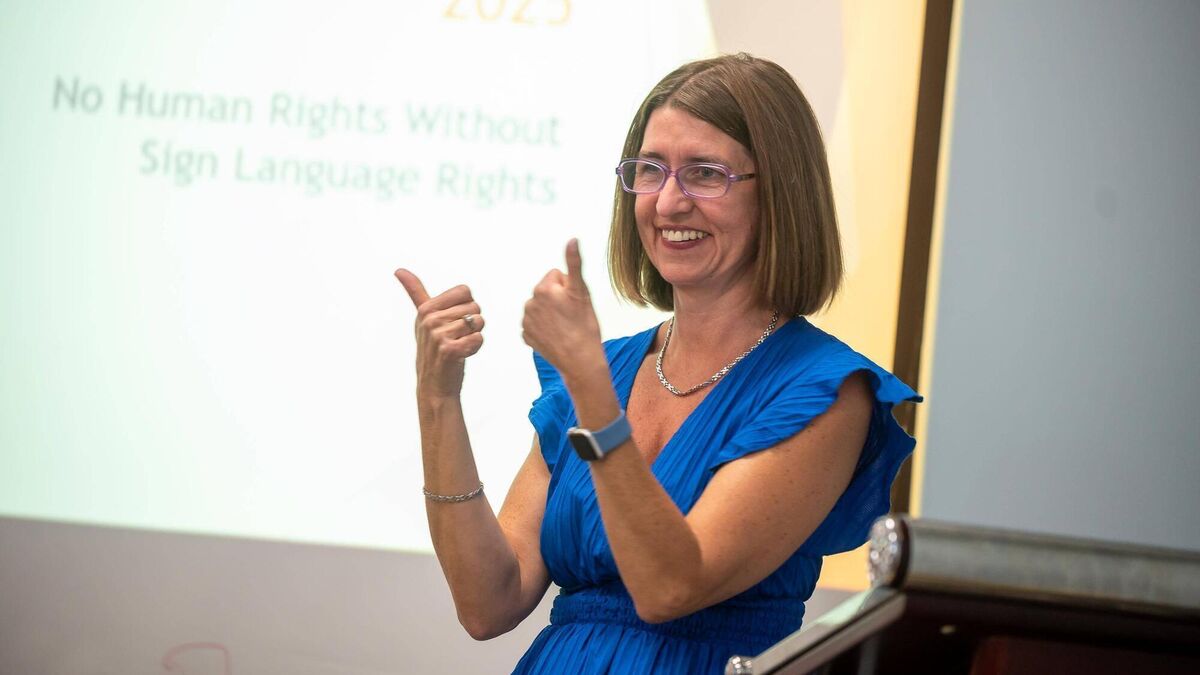
When you're a deaf person, sometimes you can face very negative attitudes and it's because of the lack of awareness, says Susan. Picture. John Allen
When Susan O’Callaghan graduated from her business studies and accounting degree over 25 years ago, she began applying for jobs.

She was invited to an interview by one company, and replied to request an Irish Sign Language (ISL) interpreter as she is deaf.
“There was no response,” she recalls. Despite following up again, she did not receive a reply.
“I felt that employers don’t know what it means [to be deaf]... What about my abilities and what about my rights? What about my right to access?”
Rather than feeling defeated, O’Callaghan dedicated herself to removing barriers faced by deaf people in society. She got a job with Cork Deaf Association (CDA), where she now works as Advocacy Officer. On National ISL Day last month, she was recognised by CDA for her 25 years of service.
When we meet, with the assistance of an ISL interpreter, O’Callaghan tells me why she was initially drawn to a role with CDA.
“I wanted to make sure that deaf people had their own sense of safety, the sense of a safe space, that they had access to information through sign language.”
She has worked in various positions over the years, but advocating for the rights of deaf people has always been important to her.
“Communication really is a big issue,” she says. “I’m trying to change negatives into positives and campaign to ensure people’s rights are met and their ability is recognised.”
O’Callaghan regularly experiences issues communicating with her bank and car, home, and health insurance providers. “These organisations are often very restrictive due to GDPR requirements and frequently refuse to communicate with me via Irish Remote Interpreting Service (IRIS) relay services because they consider it a third party.”
“Resolving simple issues takes much longer compared to hearing people, who can quickly deal with them over the phone. I often have to send emails, wait for responses, follow up multiple times, and explain my situation repeatedly before any progress is made. This creates inequality in access to essential services and adds unnecessary stress and time burden,” she says.
Public services also present challenges, and healthcare is an area where many deaf people encounter barriers. O’Callaghan explains that some hospitals are not aware of the system for booking a qualified interpreter, and deaf people may be left waiting for care.
Sometimes, family members are asked to translate, which can also cause issues.
“There could be misdiagnosis, miscommunication...if you’re not getting access to the information, it can have serious consequences.”
She recalls her own experience in hospital when pregnant. While on a video call to a friend, she didn’t see a nurse approach her bed.
“I couldn’t hear someone coming in the door, and then all of a sudden a nurse was walking in… she just came in with an injection straight away, not telling me,” she says. “That was quite emotional.”
In an effort to improve things for deaf people, O’Callaghan has helped CDA to roll out Deaf Awareness Training to public services. More than 600 people from the HSE, Tusla, Revenue, Cork city and county councils, UCC, hospitals, and An Garda Síochána have received training.
As part of the initiative, CDA also launched Ireland’s first Deaf Awareness module on HSELandD, the HSE’s national learning platform.
O’Callaghan says it’s important that organisations know their responsibilities to provide access for deaf people.
“It’s not for the deaf person to bring in an interpreter or family member,” she says. “It is your responsibility to provide for the interpreter, and you have to have appropriate systems in place.
“Don’t put the burden on the deaf person and assume they will do it.”
She has seen the impact of Deaf Awareness Training on people’s attitudes and actions.
“When you’re a deaf person, sometimes you can face very negative attitudes and it’s because of the lack of awareness…they don’t know what to do,” she says. “But once they receive that awareness training and they learn from their mistakes, they see how they can improve.”
To ensure consistency around the country, O’Callaghan would like to see the creation of a national role with oversight for deaf awareness.
“We need to have a permanent person who’s responsible for it so that they can get in contact with all the public bodies, and they can be going through different checklists with all these companies.”
She has personally felt the benefit of having proper support and funding available.
Using a government-funded voucher scheme, she booked an interpreter for a family wedding so she could fully enjoy the occasion.
“I felt so included fully into the party, and that was phenomenal. Family members were able to just chat away naturally. They didn’t have to give me just bullet points of what they were talking about,” she says.
However, she points out that the voucher scheme is limited to five per person for the whole year.
As she receives recognition for her service, she reflects on a quarter of a century of advocacy and campaigning.
“I’m here 25 years, but it just flew by, and I would hope that this highlights what needs to be done… to secure equality and access, and for deaf people to be respected more.”
Looking to the future, she wants to build on what she has achieved. “I feel very proud,” she says. “There’s been so many improvements, there’s been so many changes…We’ve been very successful. And now I’m thinking, what more?”
O’Callaghan wants to encourage members of the Deaf Community to push for their rights to be recognised. “Some people might think…’I’m fed up of campaigning, or I’m fed up of lobbying’, and they’ve gotten so used to the way they’ve been treated,” she says.
Her message to other deaf people is: “We can change it, but it takes time.”

App?