‘If one woman is inspired to run for election, we’ll have done a good job’
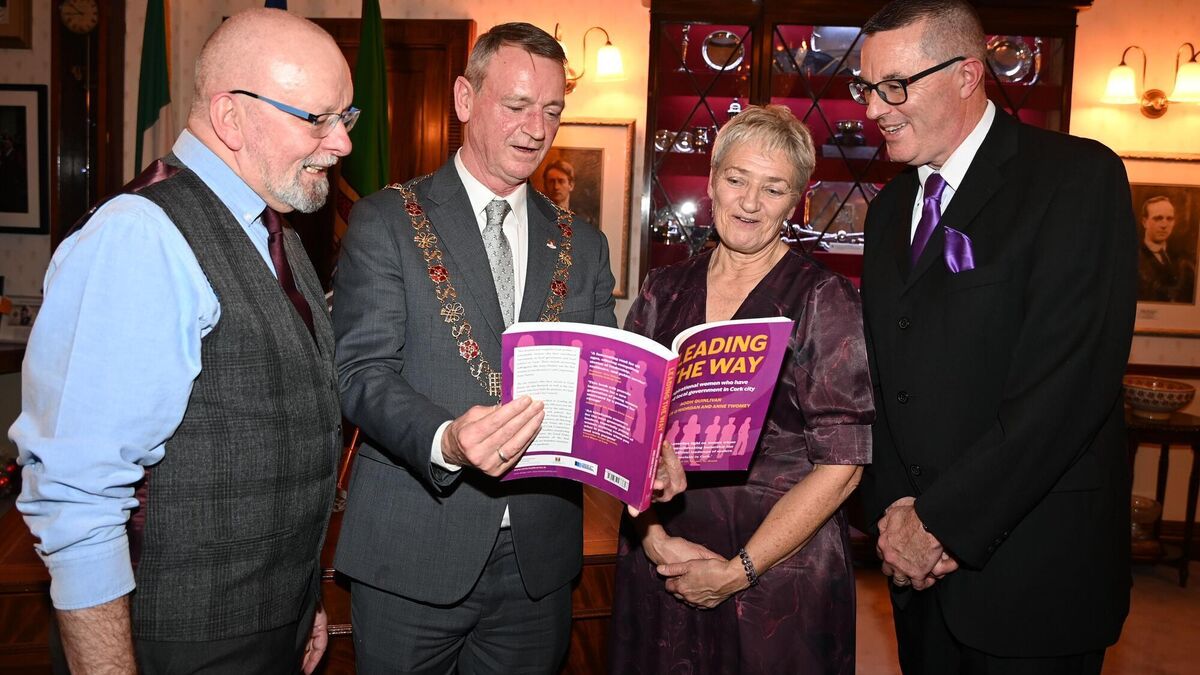
The Lord Mayor of Cork Cllr Fergal Dennehy John Ger O'Riodan, Anne Twomey and Aodh Quinlivan authors of the new book, 'Leading The Way' about inspirational women who have shaped local government in Cork city at the launch held at the City Hall, Cork. Picture: Eddie O'Hare
“To be President of Ireland, must you be a woman and must you be called Mary?”
That was the “wonderfully innocent question” a national class pupil put to author and UCC senior lecturer in the Department of Government and Politics, Dr Aodh Quinlivan.
“It was in 2003 when I did a talk for a group of sixth class pupils about why they should take an interest in politics, issues, current affairs and matters of concern in their own community. One of the pupils asked me that and of course, it was based on the fact that in the 12 years of this pupil’s existence, they had only seen Mary Robinson or Mary McAleese in Áras an Uachtaráin. In essence, this is the philosophy espoused by the former tennis star, Billie Jean King – see it to be it. We need role models, and we need heroes,” said Aodh.
With that in mind, he has co-authored a new book titled which profiles 12 inspirational women who have made significant contributions to local government in Cork city.
Along with fellow writers, John Ger O’Riordan (retired local government official) and Anne Twomey (Adult Educator with the Cork Education and Training Board), their motivation was to demonstrate positive role models in local government for young women.
The book, published by Cork City Libraries, with the support of the Cork City Council Women’s Caucus and Commemoration Programme, begins with profiles of three women who did not serve on Cork Corporation/City Council but who paved the way for others.
Anna Haslam was a campaigner for women’s rights and a leading figure in the suffragette movement. Largely due to her persistent lobbying, women were included in key local government legislation in 1896, 1898 and 1911.
This set the scene for Susanne Rouviere Day - an Irish feminist, novelist, and playwright – to emerge as the first woman to contest an election for Cork Corporation in 1914; alas, she missed out on a seat by a mere five votes. Meanwhile, Mary MacSwiney was a famous figure in local and national politics, whose achievements have tended to be overshadowed by what happened to her famous younger brother, Terence. Elected to the Dáil in May 1921, she was a major influence on local politics in the city.
Other profiles include the first woman to win election to Cork Corporation, which was Anne Sutton in January, 1920. Noted for her diligence and hard work, she served until June, 1924, when she resigned her seat. Two months later, a public inquiry into the workings of the Corporation led to its dissolution until 1929.
Jenny Dowdall has the distinction of being Cork’s first woman Lord Mayor. Elected as First Citizen in 1959, she was particularly active in the promotion of cultural life of Cork.
Chrissie Aherne bridged a gap of 30 years in becoming the first woman since Dowdall to be elected Lord Mayor of Cork, in July, 1989. The first grandmother to hold the office, her primary concerns during her term were unemployment and the lack of opportunities for Cork’s youth.
Deirdre Clune was elected Lord Mayor in 2005. That year, Cork celebrated its prestigious status as a designated European Capital of Culture and Deirdre was to the fore in promoting Cork as a vibrant and exciting city.
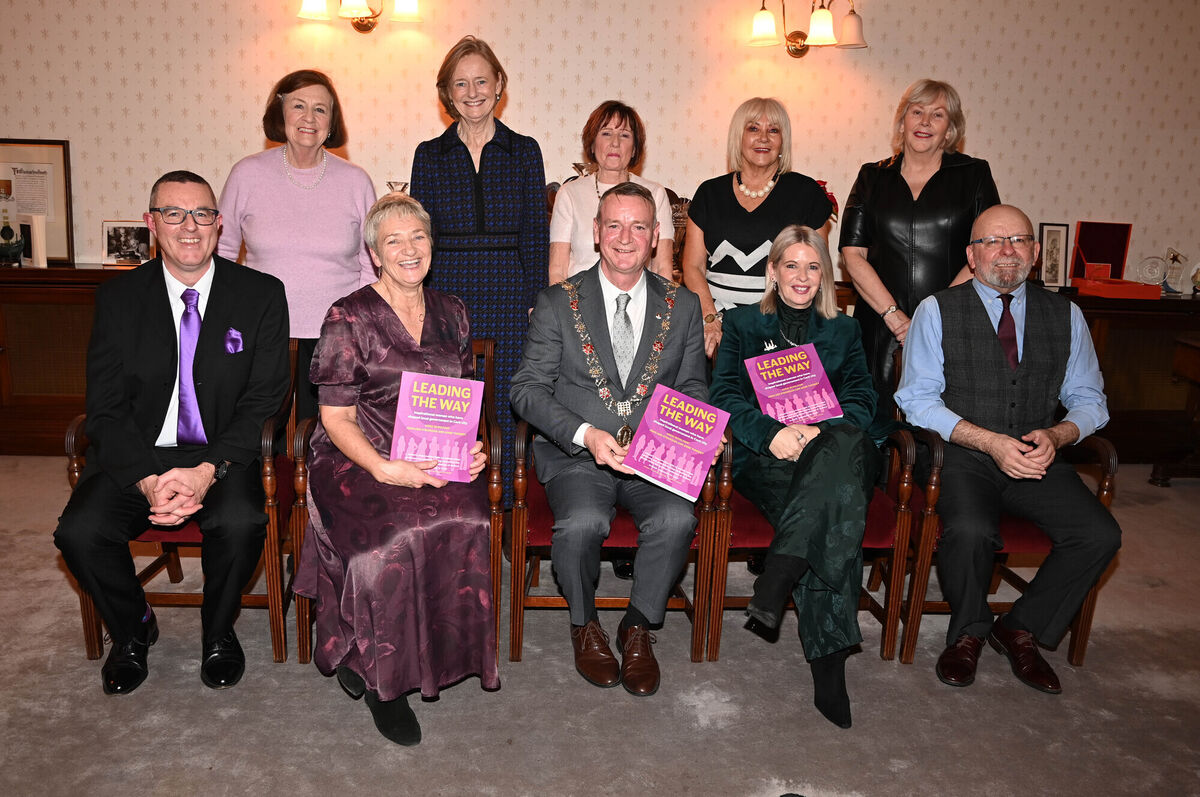
The first Labour Party woman to serve as Cork’s Lord Mayor was Catherine Clancy in 2013/2014. During her term in office, she enjoyed great support from party colleague, Cllr Lorraine Kingston, who was elected as Deputy Lord Mayor. This was the first occasion in Cork city that the positions of Lord Mayor and Deputy Lord Mayor were both held by women. The following June, Catherine presented the Mayoral chain to Mary Shields.
Mary’s ambition for her year in office was to give total service to the people of Cork. She was committed to working to ensure less partisan party politics in the Council Chamber to create a strong, united approach on important Cork issues.
The latest woman to serve as Lord Mayor was Deirdre Forde, elected in 2022.
The book also puts the spotlight on Ann Doherty, who in 2014 became the first woman appointed as Chief Executive to Cork City Council, and Valerie O’Sullivan, who was appointed as Chief Executive of Cork City Council in October, 2024.
In terms of female representation in local government, Aodh says there’s a long way to go yet.
“Taking the last seven cycles of local elections for city and county councils, the representation of women in our councils has risen from 12% in 1991 to 26% in 2024. “The 2024 local elections saw a record-breaking number of women, 681, on the ballot papers.
"In 2024, however, we had lots of women in the field, 681, but only 248 were elected. When you compare this with 2019, 225 women were elected but, over the following five years, the number of women in local authorities increased to 246, mainly through co-options. So, the net position in 2024 was a gain of just two seats, 246 to 248.
“Cork City Council is below the national average as five women out of 31 councillors were elected in 2024 (16%). That number has since increased to six due to co-option, but there is some distance to travel before a critical mass of women councillors in City Hall is achieved.”
What he calls the ‘shameful decision’ to abolish town councils in 2014 hasn’t helped. “At the stroke of a legislative pen – because unlike the Seanad, local government structures are not protected in Bunreacht na hÉireann – we removed an entire tier of local democracy and 83 democratically elected councils."
"Why does the abolition of Town Councils impact particularly on women? The obvious point is a reduced capacity to participate in that we went from 1,627 local councillors to 949. More women were elected to our Town Councils than any other level of government in Ireland. Election to your Town Council was in reach for many people because, if you were organised and availed of family and friends, you could win a seat with a few hundred votes. Town Councils were a useful entry point into politics for young people, women, people from different ethnic backgrounds, people with disabilities etc. In removing that entry point, we narrowed the pool of people who were willing or able to contest elections for City and County Councils,” he said.
The writers hope that the book will have a broad educational appeal for people of all ages who are interested in local democracy, but it’s aimed at teenagers, especially girls.
“We hope that it will be impactful. If one secondary school girl is inspired to stand for local election and aspires to become Lord Mayor of Cork, we will have done a good job,” said Aodh.









 App?
App?


