People suffering from rare disease ‘beg’ for life-changing medicine
By Cate McCurry, Press Association
A young woman living with a rare disease said it is “profoundly dehumanising” that a life-changing medicine may not be approved in Ireland as she pleaded with health officials to authorise the drug.
It comes after the HSE Drugs Group decided to recommend that the drug Skyclarys, used for Friedreich’s ataxia (FA), should not be covered by the HSE.
It raised concerns about “limitations and uncertainties” associated with the efficacy of the drug and its current price.
The recommendation will be considered by an HSE senior management team, which will make a final decision on August 25th.
For the first time, there was a treatment out there that could give me control over this cruel disease, which is relentlessly destroying my body
Friedreich’s ataxia is a rare progressive neuromuscular condition affecting around 200 people in Ireland.
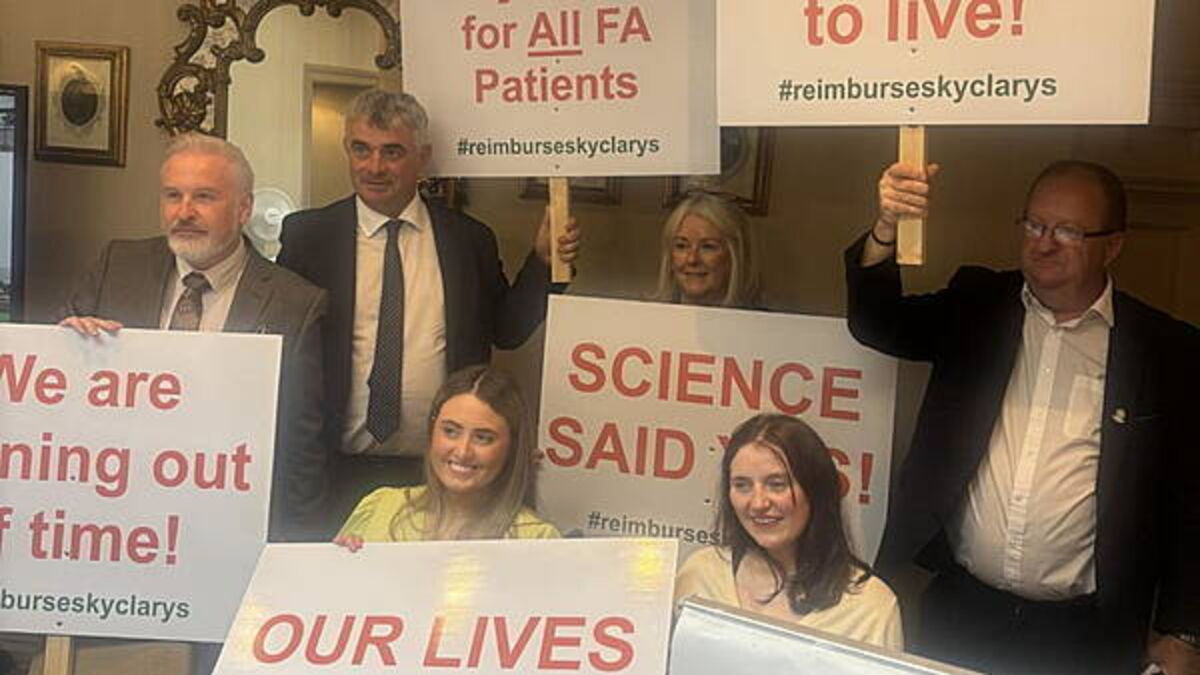
People with Friedreich’s ataxia, their families, friends and political representatives held a meeting on Thursday afternoon to discuss access to Skyclarys.
Emily Felix, 28, was diagnosed with the disease when she was aged 12.
“This disease keeps on taking. Month after month, year after year, ability after ability, Friedreich’s ataxia won’t stop until every aspect of your life is ruined by the disease, and the person you once were becomes harder and harder to recognise,” she told the meeting in Dublin.
“Today I need assistance with almost every aspect of daily life. I can’t go to the bathroom independently. I need support with almost every aspect of daily life. Imagine for a moment not being able to go to the toilet on your own. Imagine needing assistance for the most basic part of your life.
“For the first time, there was something that could help us fight back. For the first time, there was a treatment out there that could give me control over this cruel disease, which is relentlessly destroying my body.
“Skyclarys can’t give us back all our control, but it gives us a tool to fight and preserve the abilities we still have.
“I have spent years doing everything I can to preserve those abilities. I go to the gym twice a week. I pay privately for physiotherapy. I push myself constantly because I know that every bit of strength matters.
“When we found out about Skyclarys, we believed access was simply a matter of time. But, instead, we have spent the last two years waiting for Ireland to reimburse the drug, which has been reimbursed in 11 European countries.
“It feels as though cost has become the deciding factor and there is something profoundly dehumanising about that. To be reduced to a number on a spreadsheet, to have your future reduced to cost. To feel that your life is being measured against a budget line.”
If one child, just one, is suffering in this country, and we can find a cure, or we can find something that's going to give them a better quality of life, then price is superfluous to that fact.
Emma O’Shea was also diagnosed with the disease. Her brother passed away after he was also diagnosed with Friedreich’s ataxia.
“I’m here because I don’t want my parents having to bury another child,” she said.
Father-of-two Craig Coady said he is “begging” the HSE to make the drug available.
Mr Coady’s son, Rory, 13, died from the disease last year. His older son, Paudie, was diagnosed with the condition.
He told the meeting that he is “begging” for access to the drugs.
“Everything’s been taken away from him (Paudie). He’s no longer going out to play with his friends. When he was told he could no longer play soccer, pieces of his heart left. It went. It died. It died, and he’s never been the same since,” he said.
Mr Coady, whose wife was diagnosed with Huntington’s disease five years ago, added: “The only person I have left at home is Paudie. I certainly don’t want to be left at home on my own in years to come. He’s all I’ve left.
“I just beg again, begging, begging. That’s all we need to be doing for the government and the HSE to give us that drug, so they can get on with their lives. It’s just not right. It’s just not right.”
Dr David Lynch, a neurologist at the Children’s Hospital of Philadelphia and director of the Friedreich’s Ataxia Programme, said that the drug is safe and shows no major side effects.
Speaking to the meeting from the US, he said: “Some 90 per cent of individuals will note some improvement that they can tell me about. They’ll say their speech got better; they’ll tell me their hands got better.
“They’ll tell me they have less fatigue. They might tell me all of these. They might also just tell me, I can’t tell you what got better, but this is the first year that I didn’t get worse.”
Michael Collins, leader of Independent Ireland, urged the HSE to approve the drug at their meeting next week.
Independent Ireland TD for Cork Ken O’Flynn said: “People are out of time.
“If one child, just one, is suffering in this country, and we can find a cure, or we can find something that’s going to give them a better quality of life, then price is superfluous to that fact.
“This debate should not be happening. Governments need to get their fingers out, and we need to remember this is about looking after our citizens.
“This is about looking after our children. This is about making sure that the last thing you have to worry about is medication.”