Girl had ‘no pulse’ and was ‘not breathing’ after Dublin stabbing, trial told
By Cillian Sherlock, Press Association
A little girl who was stabbed during an alleged attempted murder in Dublin was “not breathing” and had “no pulse”, according to an ambulance worker at the scene.
The Central Criminal Court in Dublin has heard multiple children and an adult were injured in the incident, including a girl who is now in a wheelchair and non-verbal.
Riad Bouchaker, aged 52 and of no fixed address, is charged with attempted murder of two girls and one boy, and assault causing serious harm to an adult, at Parnell Square East in Dublin City on November 23rd, 2023.
Bouchaker is also charged with assaulting three other people, and with producing a 36cm kitchen knife.
He has pleaded not guilty to all eight charges.
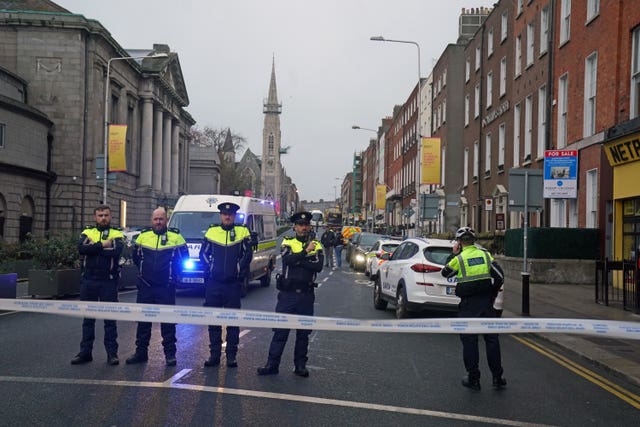
Conor Garvey, a critical care technician with the National Ambulance Service, told the court on Wednesday he had been flagged down by a man frantically waving his arms.
He said he saw a member of the Dublin Fire Brigade performing chest compressions on a child who looked like she was in a life-threatening condition.
He did an assessment and decided she “wasn’t breathing and had no pulse” and had a “laceration approximately 1-1.5 inches going across the front of the chest” with “blood oozing out of the wound”.
The jury heard that Dr Lisa Corley also arrived at the scene after being alerted to the “paediatric stabbing”.
She had been working as a specialist registrar at the Rotunda at the time and said it was “clear” the girl was “critically injured”.
She explained how paramedics had inserted an airway and had done a procedure involving drilling into bone marrow.
She asked someone to run to get blood from the Rotunda lab and said it was clear the child needed to get to Temple Street Hospital “as a matter of urgency” due to the “open chest wound”.
Consultant anaesthetist Dr Peter Harper had been cycling to Temple Street when he came across the scene.
He told the court: “I observed there was a lot of ambulances, fire engines, and gardaí. I never seen anything like it.”
He offered his assistance after seeing a child with a “stab wound” to the centre of their chest.
He said the child “had no pulse”, “looked very pale”, and had a “stab wound”.
He said the likely diagnosis was that her heart had been perforated and that was the cause of cardiac arrest.
Dr Harper rang ahead to Temple Street Hospital so they could start getting a theatre and surgeon ready, adding it was “lucky” the largest operating theatre happened to be free as they needed a lot of space.
Prior to this evidence, the jury heard from two people involved in removing the knife from the scene.
A then 17-year-old French boy told the jury he had been on his way to work in a restaurant in the centre of the city, having come to Dublin one month previously.
The witness, now 20, said he heard a woman screaming on Parnell Square East and looked across the street and saw a “man that was assaulting a woman”.
He explained how he intervened to “grab the knife off the attacker”.
He said: “I came close enough to the attacker to disarm the man, to grab the knife from his hand.”
The witness said that at the moment he intervened, someone else came and hit the man in the head with a motorcycle helmet.
He said he had to use force to take the knife, and that he threw it on the floor when he had it.
The court heard he suffered a scratch to his finger and cheek but they healed within a number of days.
Under cross-examination, he said he told gardaí in his original statement that the man looked “mentally unstable”.
Through his interpreter, he said this may because of the “numerous hits with the helmet”.
Mr Justice Tony Hunt told him he was “brave” and “modest”.
The court then heard from Eder Nascimento Dos Santos who said he had been cycling past the incident and jumped off his bike.
Dos Santos said he crossed the road and saw the knife on the floor, adding that he took it “away to try to prevent more people from getting hurt”.
The witness told the court he had seen a man stabbing a girl several times.
Under cross-examination, it was put to Dos Santos that he had originally told gardaí that he believed the child was a boy.
A barrister for Mr Bouchaker questioned Dos Santos about whether he may also be wrong about seeing a child be stabbed several times.
He said: “I don’t think I’d be wrong about that.”

Earlier, the court heard from one of the first gardaí who responded to the incident.
Adam Kealy appeared via videolink to the Central Criminal Court and said he got to the scene as fast as he could when a call came in through Command and Control.
The former member of An Garda Síochána who now lives in Australia said he saw a member of Dublin Fire Brigade kneeling over another man and appearing to restrain him by gripping his forearm and wrist.
Kealy said he had split up from his garda colleague who had been directed by a member of the public to the possible location of a knife.
He said he was unaware if the person on the ground had any other weapons so he informed him he was going to do a search, handcuffed him and patted him down.

He said he retrieved a wallet which contained a Public Services Card with the name Riad Bouchaker.
Kealy said: “He was conscious. He was looking around. I didn’t speak too much with the man on the ground at that time.”
The court heard Kealy accompanied Bouchaker to the hospital where he was told he was was sedated.
He said he was being told this because if gardaí wanted to obtain a urine sample, benzos and morphine would show up in the forensic tests.
He said he was later told that two urine samples were obtained and a doctor informed him that it was negative for toxins.
Kealy said it was his understanding that the initial drug test on the urine sample had come back negative.
He then removed handcuffs from Bouchaker.
Under cross examination from Bouchaker’s defence counsel, Mr Kealy said: “He didn’t verbally speak to me at any stage.”
The court had earlier heard from three other witnesses to the events, including two sisters who had been visiting Dublin from Australia.
The trial continues.