Charlie O'Shea showed he can be the real deal even if Leinster outmuscled a young Munster side
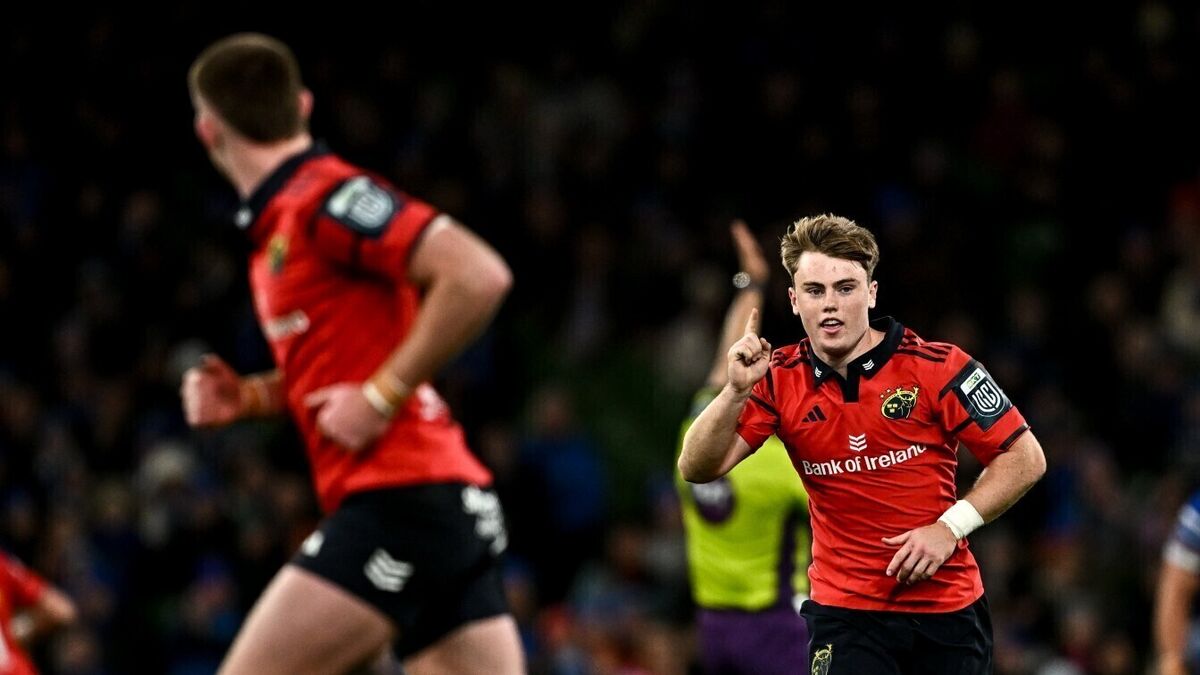
Charlie O'Shea of Munster celebrates converting his side's opening try during the United Rugby Championship match against Leinster at the Aviva Stadium. Picture: David Fitzgerald/Sportsfile
I found myself in a wet and windy Aviva Stadium last Saturday night for the latest chapter in the rivalry between Leinster and Munster.
I was there for one reason. Well, almost one reason. The food and drink may have played a small part.
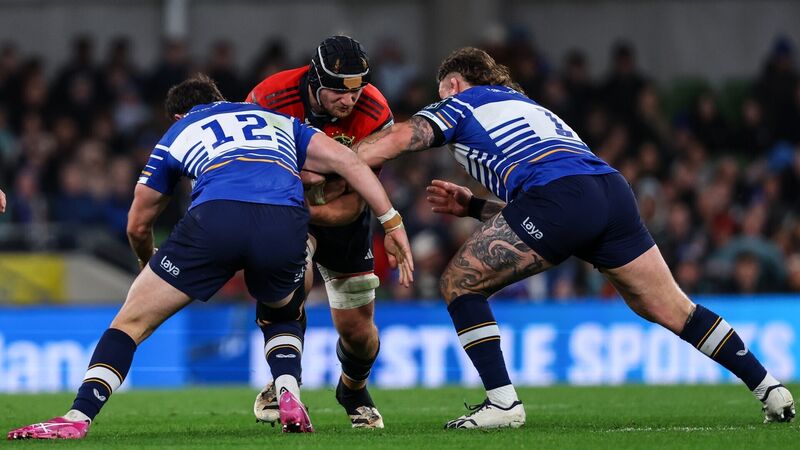
But primarily, I was there to see the new kid on the block, the latest name generating excitement among Munster supporters, the player many are already tipping as the future of Munster rugby: Charlie O'Shea.
Ordinarily, the build-up would have centred on Jack Crowley and Sam Prendergast and which player might edge ahead in Andy Farrell's thinking ahead of the Autumn Series. With both sidelined through injury, however, the spotlight belonged to O'Shea.
Over the previous few weeks, I had heard plenty about him. The praise was coming from people far more knowledgeable than me, so I wanted to see for myself.
Who exactly was Charlie O'Shea? Where had he come from? And was he really as good as people were suggesting?
The more you examine his story, the more remarkable it becomes.
Just two years ago, in 2024, O'Shea was lining out for Dolphin in their South Munster U18 Open Cup triumph while also playing Gaelic football with Erin's Own.
In 2025, he completed his Leaving Cert at Christian Brothers College and, at the third attempt, captained the school to Munster Schools Senior Cup glory after heartbreaking final defeats in 2023 and 2024.
From there, he moved on to UCC, where he has played just 15 All-Ireland League games.
As recently as June, he was announced as one of eight players joining the Munster Academy for the 2026-27 season. At that stage, he would probably have been viewed as Munster's fifth-choice out-half.
Then opportunity knocked.
Making his first competitive start against the Bulls at Thomond Park earlier this month, he announced himself in spectacular fashion, scoring two tries, creating another with a superb cross-field kick and adding three conversions in a 26-22 victory. Last week, he made his Champions Cup debut in Munster's win over Racing 92 at Páirc Uí Chaoimh.
All of which made Saturday night's assignment against Leinster fascinating. Standing opposite him was former Munster out-half Joey Carbery.
First impressions can often be deceiving, but O'Shea, just 20 years old and barely 12 stone, looked even younger than he is. Standing among some of the most physically imposing athletes in European rugby, he appeared almost boyish.
My initial reaction was concern. Not because he didn't belong, but because of the enormity of the challenge facing him.
Leinster's team sheet was packed with internationals, Lions and proven professionals. This was rugby at its most unforgiving level.
Yet O'Shea never looked intimidated.
Munster started brightly and their young out-half looked calm and composed from the outset. His seventh-minute penalty opened the scoring and settled any early nerves. By the 28th minute, Munster led 10-0 after Shane Daly crossed for a well-worked try, converted by O'Shea.
Moments later came the highlight of his evening.
Awarded a penalty inside his own half, O'Shea stepped forward and nailed a magnificent long-range effort to extend Munster's lead to 13-0. Even with the wind at his back, it was a kick that required courage as much as ability.
Leinster eventually responded when a sensational long pass from Jamison Gibson-Park created a try for Tommy O'Brien, but Joey Carbery's missed conversion left Munster leading 13-5.
As half-time approached, Leinster began to tighten their grip on possession and territory, but Munster held firm and carried an eight-point advantage into the break.
At 13-5, with the wind due to favour Leinster in the second half, the real examination of Charlie O'Shea was only beginning.
O'Shea was largely confined to defensive duties during the opening quarter of the second half as Leinster cranked up the pressure and Munster's discipline began to falter.
The home side thought they had scored in the 50th minute but were held up short. A five-metre scrum followed, and the pressure eventually told when Ryan Baird crossed in the 55th minute.
Carbery converted and Munster's lead was cut to a single point.
When Alex Nankivell was shown a yellow card, the momentum had swung decisively in Leinster's favour.
The extra man quickly paid dividends. Charlie Tector crossed in the 63rd minute to hand Leinster their first lead of the night at 17-13.
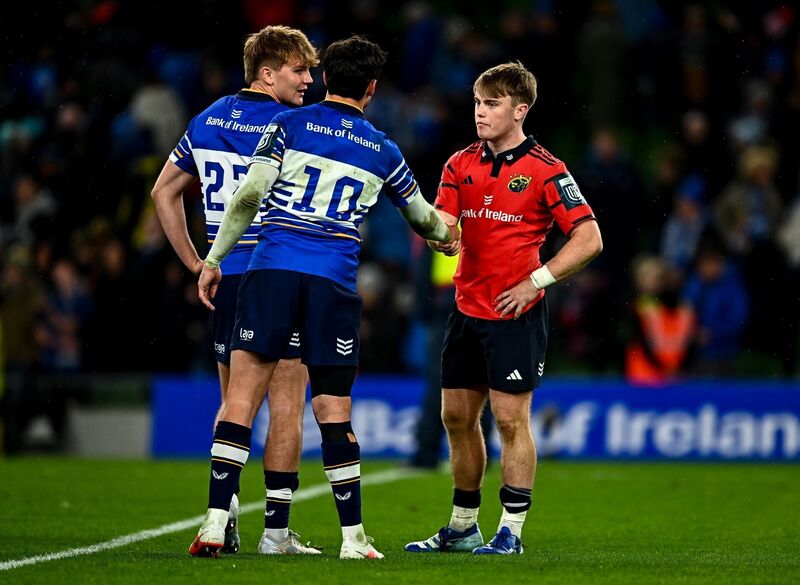
Shortly afterwards, O'Shea's evening appeared to be over when he was replaced by JJ Hanrahan. As he left the field, he could do so knowing he had more than held his own on one of rugby's biggest provincial stages.
More importantly, he had shown he possesses the temperament as well as the talent to match the growing hype surrounding him.
Ironically, he was called back into action when Shane Daly departed through injury in the 70th minute. By then, however, Leinster were firmly in control.
Jamie Osborne's try, converted by Carbery, stretched the lead to 24-13 with seven minutes remaining. Ben O'Connor's late try secured a losing bonus point for Munster, but O'Shea was unable to add the difficult conversion from the touchline.
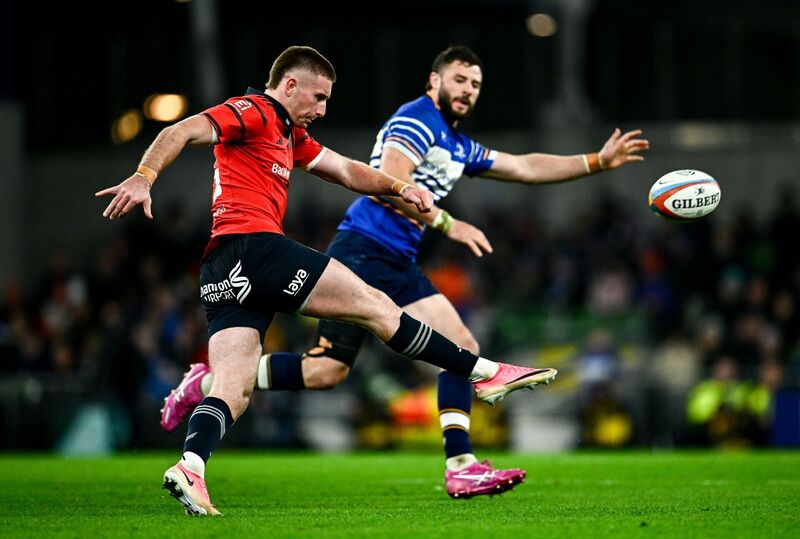
And that was that.
One final reflection from the night.
Ten years on from the passing of Anthony Foley, Leinster and their supporters showed tremendous class with their eighth-minute tribute to the Munster legend. The sustained applause around the Aviva Stadium was sincere, moving and warmly appreciated by the travelling support.
Rivalries are an essential part of sport, but moments like that remind us there is always something bigger than the result.
Foley's memory and O'Shea's emergence represented two sides of Munster rugby: the legacy that inspires it and the future that sustains it.
If Saturday night proved anything, it is that Munster's future appears to be in very safe hands.






 App?


