Christy O'Connor on the impact black cards are having on hurling this summer
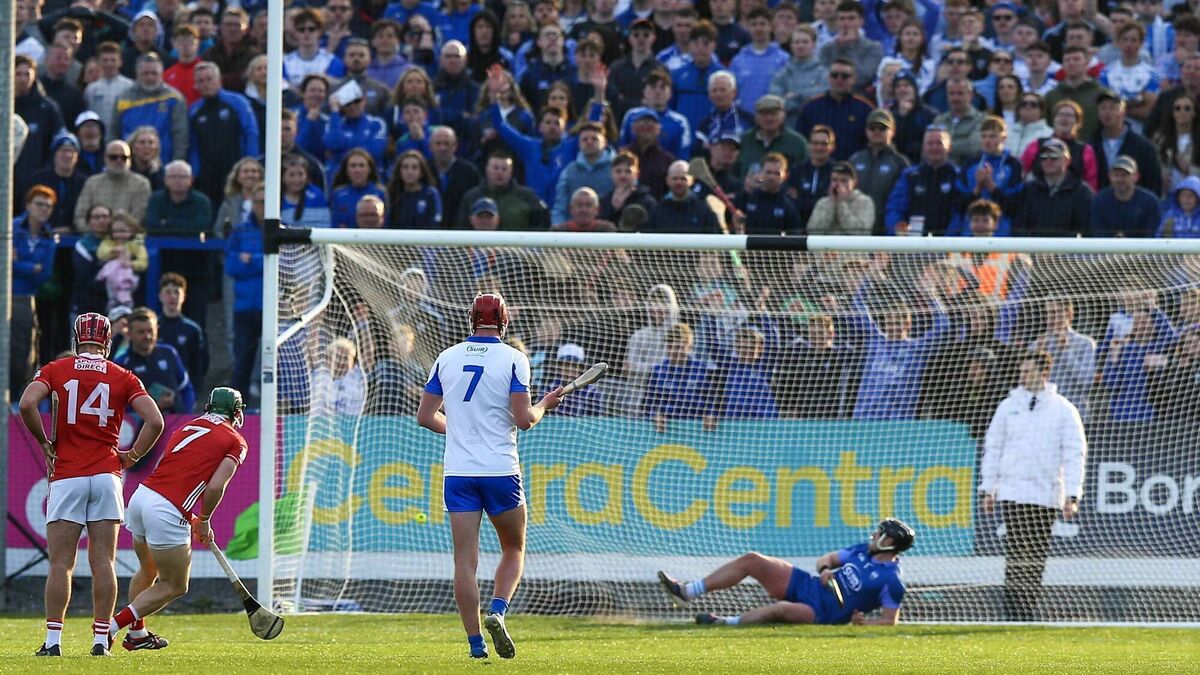
Cork's Mark Coleman beats Waterford keeper Billy Nolan with this penalty during the Munster Senior Hurling Championship clash at Azzurri Walsh Park. Photos: INPHO
As Eoin Cadogan, Richie Hogan and David Burke were chatting to Aisling O’Reilly in their half-time analysis on the Cork-Waterford game on GAA+ last Saturday, the TV camera flashed to Mark Fitzgerald, who was sitting on a sideline seat with his arms folded, waiting for his ten minutes in the sin-bin to run out before returning to the action.
Fitzgerald had been black-carded for a foul on Brian Hayes in the 32nd minute. Fitzgerald did pull Hayes to the ground while the sliotar was dropping but the St Finbarr’s man didn’t have possession of the ball – which is required in hurling for the black card to be issued.
The question could also be asked if it was a pull-down from Fitzgerald or were both players grappling, which is what often happens in that situation? A pull-down is a penalty and a black card but only if it is a clear goalscoring opportunity. And it wasn’t.
How cynical was the pull-down either? Hayes leant into Fitzgerald so the defender was off-balance and was falling backwards before pulling Hayes down.
“I felt for Mark Fitzgerald there,” said Cadogan. “I find it hugely frustrating to be conceding a penalty and losing a man for 10 minutes for a one-v-one contest. This is what we want in the game of hurling.
“I didn’t think there was a whole pile in it. You had two big men contesting an aerial ball. Is that (a black card) going to be the difference at the end? Who knows.”
A black card eventually was the difference because the game was effectively over when Waterford picked up a second black card in the 60th minute after Jack Fagan pulled down Alan Connolly. And this time, unlike the first penalty which Billy Nolan saved from Connolly, Mark Coleman buried it past the Waterford goalkeeper.
Fagan’s offence was a black card because he cynically pulled down Connolly. Waterford could argue that Connolly just about had possession of the ball and that they still had two defenders between Connolly and the goal. But the rule is the rule. And Fagan broke it.
The purpose of the rule is to discourage cynicism in goal-scoring situations. An hour earlier down the road in Wexford Park, David Purcell scored a goal for Dublin against Wexford but Darragh Carley was clearly mindful of the punishment once Purcell stepped inside the Wexford defender.
If there only was a penalty, and not a 10-minute stint in the sin-bin, would Carley have taken a chance and hauled Purcell down? Possibly.
What players do know now though, is that – unlike previous years – referees are doling out black cards in the championship.
It was one of those extremely rare occasions that two penalties were awarded for that infringement in the same game, but nobody expected that to happen in the championship. Except it did.
Fitzgerald was also black-carded that afternoon in January for dragging down Brian Roche. When Robert Downey was black-carded in the same game for fouling Reuben Halloran, Cork could have argued that there was plenty of defensive cover between the Waterford player and the goal - and also because the covering defender had his arm wrapped in the tackle by the attacker and was dragged to the ground. But Murphy was prepared to err on the side of implementation.
That has clearly been the instruction to referees because black cards have been issued more regularly in this championship than in any other.
There were times when the black card appeared to have been forgotten by referees. Much of that was down to the rule being so vague that it was deemed to be almost unenforceable.
Firstly, the referee has to decide if a goal chance was prevented by the foul. Secondly, the regulation specifies that a player should not be considered to have a goal chance unless he is not only inside the 20 metre line but also further than 25 metres from the sideline.
The technical detail of what exactly constitutes “clear goalscoring opportunities” was always bound to cause confusion because there are so many grey areas around the topic of cynical play.
Yet how is that application classified? There are numerous different ways in which modern players are coached to commit fouls in goalscoring scenarios so as to ensure they don’t fall into the black card category.
With so much confusion around the topic, referees were erring on the side of caution. But now they’re clearly prepared to err on the side of implementation.
That is positive but the question still needs to be asked if the punishment – conceding a penalty and losing a man for ten minutes - is too severe?
Now that referees are issuing black cards and that the rule is (mostly) delivering the correct outcome of what the black card was intended to deliver, should a black card be downgraded to a yellow?
That seems even more realistic when some of those calls are in that grey area between black and white – as Fitzgerald’s offence was on Saturday. And particularly when having to play with 14 men for ten minutes is so costly.
“I was of the thinking,” said Cadogan on GAA+ last Saturday “that a one-v-one scenario where a man is bearing down on goal and you drag him to ground, trip his leg, and you stop the goalscoring opportunity, that’s cynical, that’s a penalty.”
Fitzgerald’s foul on Hayes last Saturday was a penalty. But was it cynical and a black card? No.










 App?
App?


