Christy O'Connor: Modern GAA players are allowed to broaden their horizons, fans don't own them
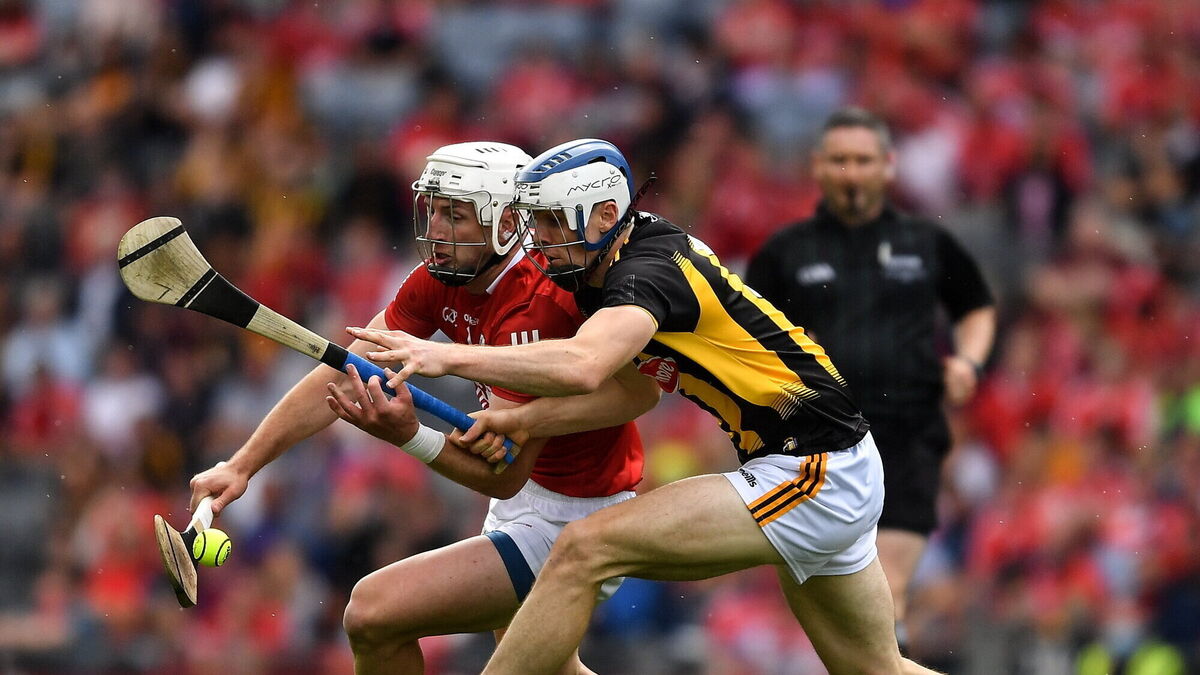
Patrick Horgan of Cork is tackled by Huw Lawlor of Kilkenny at Croke Park. Picture: Ray McManus/Sportsfile
It’s rare for someone from Kilkenny to stir the pot and criticise their own but former All-Ireland-winning captain Andy Comerford has made a habit recently of rattling cages with a big stick.
Comerford first started banging the cage to try and ignite the beast after one of Kilkenny’s tamest performance in living memory when Galway rolled over them in the league in early March.
“Lads with All-Stars, take them from out from under the pillow, stop shining them and throw them to one side,” said Comerford on Community Radio Kilkenny City’s TC Tyres World of Gaelic Games programme presented by Ciaran Neary.
“It’s All-Irelands we need. Any of those lads that have All-Stars before, they need to get rid of them, forget about them. Forget about the commercialism, forget about all that. We need to get down to work.”
As a regular analyst on Neary’s show, Comerford was only getting warmed up. A week later, he issued a public plea for Huw Lawlor and Billy Ryan to return from their travels and rejoin the Kilkenny squad.
"I don't know what the scenario is with these Australian guys,” said Comerford. “I was in Australia, you see the Sydney Harbour Bridge and you see the beach. There's a beach in Tramore.
"You're only going to get one crack at an All-Ireland here. Wouldn't it be a great uplift for the panel to see these lads coming back? Sydney Harbour Bridge, you see it and good luck.”
Comerford’s passion for Kilkenny, and his desire to see the county back to where he feels they belong, is to be commended. So is his honesty, but it also underlines how supporters often feel like stakeholders in the choices players make around their careers, especially around their decisions to travel, or even to retire.
So, despite a player’s desire to return to some form of normality, that connection to the community doesn’t always make it easy for GAA players to just walk away and do what they want.
For a lot of inter-county players, their identity is centrally bound up with their status and standing within the community. So, when the time is eventually right to walk away, and the player can do so on their terms, the decision is still never easy because of how those players are representing more than just themselves.
Many players are rightly lauded and feted when they announce their retirement, but the applause isn’t always as loud when the supporters feel that the player, irrespective of their personal situation and choice, has more to give.
It's entirely different again when a player decides to travel. The same selfish questions are often routinely asked around that decision. Why would a player walk away from his county when they have so much to give? Why are they turning their back on their team-mates? Have they not enough time to travel during the off-season, or when they retire?
Yet that’s exactly what those questions are – selfish. What right has anybody to question somebody’s decision in their personal life when they are playing an amateur game? The hopes of a county and its supporters are irrelevant to what is best for that individual.
Some players know that if they don’t go travelling for a prolonged period at a certain time in their life that they may never get that opportunity again. Why should somebody else’s opinion intrude on those plans?
There was a time when the prospect of an All-Ireland medal, or even being involved in an inter-county team, was enough to keep players at home, but inter-county hurlers and footballers are no longer bound by that prospect.
Rory O’Carroll is an ideal example because he walked away when he, and Dublin, were at their peak. In five seasons between 2011-’15, O’Carroll won three All-Irelands and two All-Stars before deciding to leave it all behind at 26 as the best full-back in the game on a side destined for greatness. O’Carroll relocated to New Zealand.

“I’m open to the idea I could play again,” O’Carroll said in February 2016. “And I’m open to the idea I may never play again. I’ll see how it goes. I’m not too worried about what is down the line.”
He wasn’t interested in just travelling. O’Carroll took on a role in addiction services with the Salvation Army that involved taking group therapy sessions at a women’s prison in Auckland.
When O’Carroll returned from New Zealand, he was called back in with the Dublin footballers in May 2019. During their five-in-a-row season, O’Carroll only played 106 minutes across five championship appearances.
The only game he started was a dead rubber Super 8s match against Tyrone. O’Carroll was hauled off with 15 minutes remaining. He never played championship again.
O’Carroll turned his back on three, possibly four, more All-Ireland medals, and a starting place on the six-in-a-row team of immortals. It didn’t bother him.
Society has changed and the mindset of players, at club and inter-county, is vastly different to what it was. The world is a smaller place and many players want to see it rather than make the huge lifestyle choice that demands so much from them as inter-county, and even club, players.
There will surely be times this summer when Lawlor and Ryan will miss the buzz and wish they were there in the middle of the action. Yet, that is the chance they are prepared to take.
And they are more than entitled to take it by the decision they have made.








 App?
App?


