Cork City run the risk of being cut adrift as popularity soars in the League of Ireland
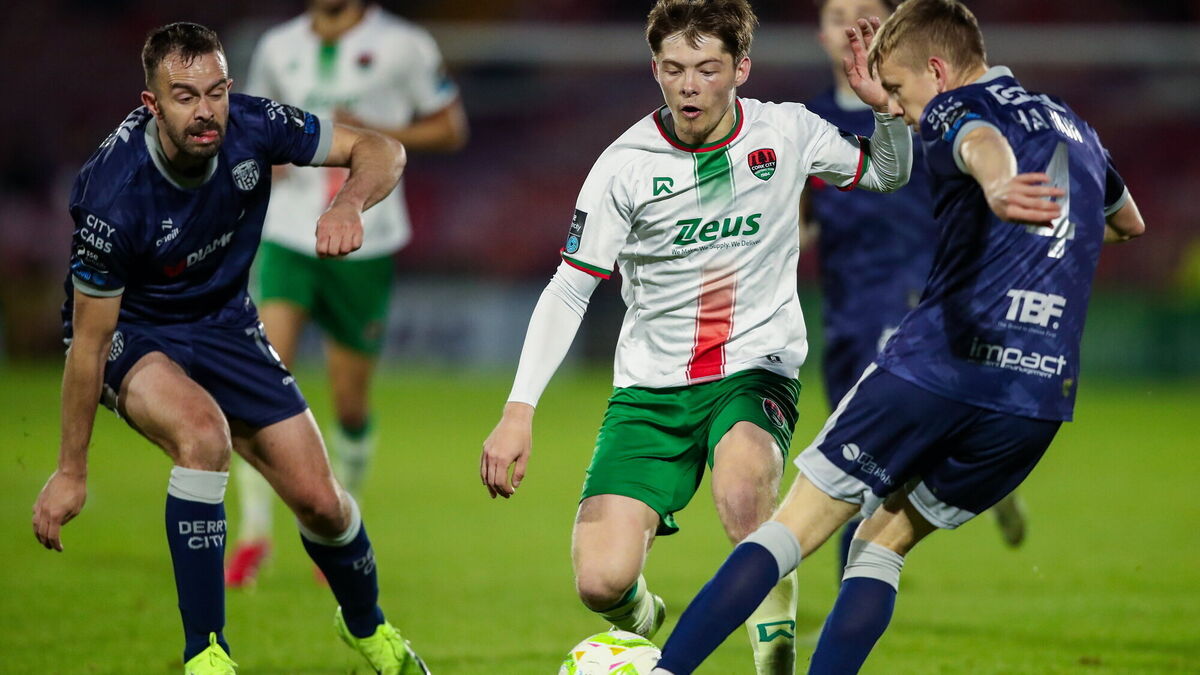
Kitt Nelson of Cork City in action against Robbie Benson, left, and Ciaran Harkin of Derry City during the SSE Airtricity Men's Premier Division match between Cork City and Derry City at Turner's Cross in Cork. Photo by Michael P Ryan/Sportsfile
They say the world will end with a whimper instead of a bang.
This means very little in association football, where a bad decision can be apocalyptic and a new appointment can be billed as the second coming.
It does offer some sense in meaning as to how clubs fall away and go from being giants to just making up the numbers while peddling through a cycle of relegation and promotion.
Every country has one, from former European champions Hamburg in Germany to three time First Division winners Leeds United in England.
As they struggled to get back, the game has been taken to a new level through ballooning TV right contracts, the spending power of the nouveau riche, and burgeoning international markets through mass exposure on social media.
Somewhere in this netherworld is Cork City, one of the best supported clubs in Ireland, in the nation’s second city.
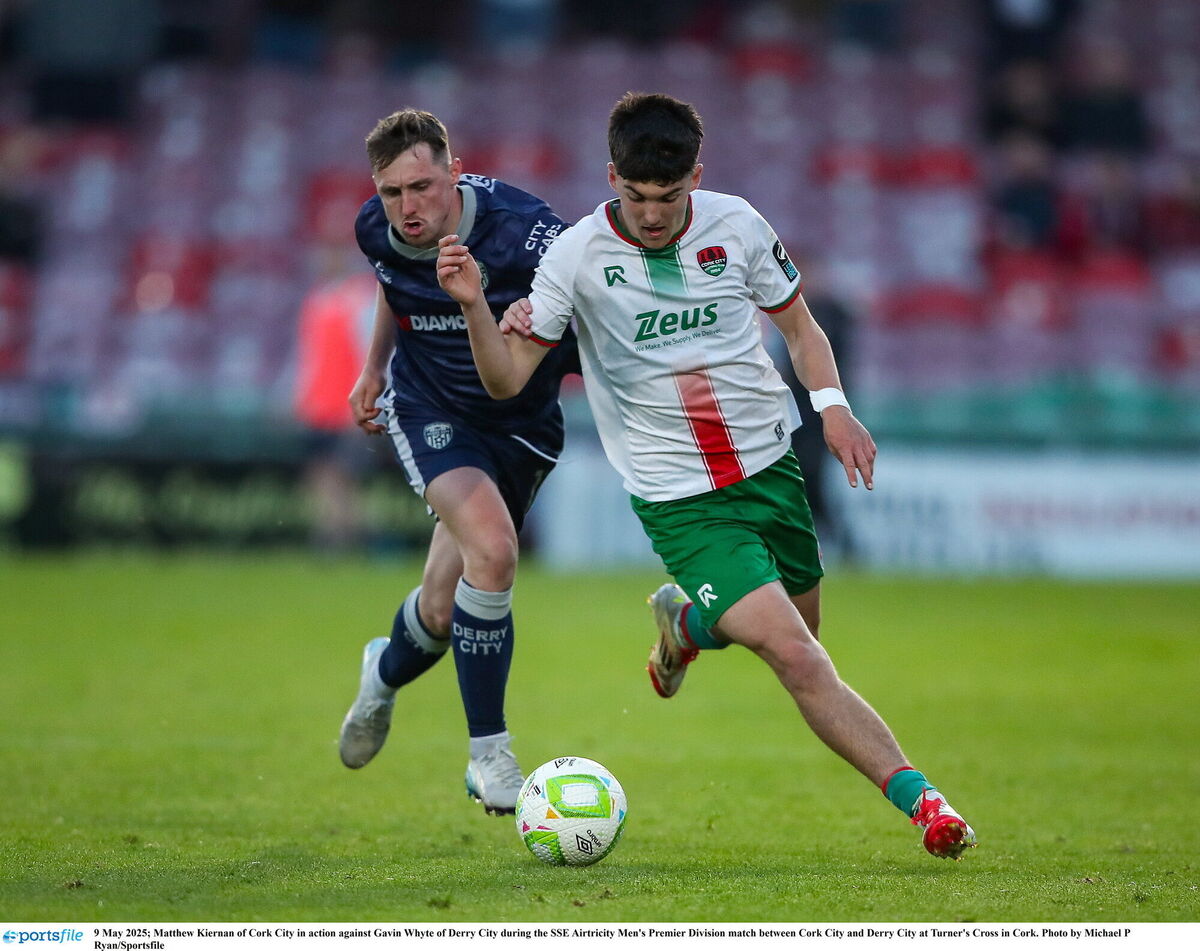
They are currently fighting to avoid relegation for the third time in six seasons, while figuring out what to do after their manager, Tim Clancy, stepped aside in recent weeks.
That means City are now aiming for fifth fresh start in six years; a sequence that stretches back to John Caulfield’s tenure at the start of the 2019 season.
In 2025, the club is once again trying to get something going, while the rest of the Premier Division bar Sligo Rovers is in a convoluted battle for the title.
That means big gate receipts, television exposure, and more advertising for the chosen few, and with that comes revenue which can be invested back into a squad.
The Rebel Army are looking on, desperate to get in on the action while some of the city’s best players ply their trade elsewhere.
That's a symptom in its own right of where the club is, as it exposes the lack of expectation and financial power at Turner's Cross compared to the rest of the Premier Division.
It wasn't supposed to be like this. City started building for the future last summer by re-signing Ruairi Keating and Sean Maguire, in addition to handing a permanent contract to Sean Murray.
These deals felt like a hand to glove fit and a natural step, and then reality bit on opening night as promotion was formally toasted.
That came in the form of an injury to teenage sensation Cathal O’Sullivan and it set the tone for a few weeks that slowly left the club crippled as players dropped out.
Greg Bolger, the most experienced holding midfielder in the group, followed.
Maguire was next to drop out, with a hamstring issue that took two months to resolve.
Malik Dijksteel kept the attack alive in his absence, and is now out following a collision during a game with Sligo Rovers at Turner’s Cross.
The worst was to come, with Keating rupturing his Achillies during a match with Derry City at the Brandywell.
Benny Couto added his name to the list at the end of April, and his ankle issue will take months to heal.
All the while, City were searching for new assistant manager after Jamie Hamill returned to Scotland.
This was one issue, of many, that Tim Clancy highlighted in a tell-all interview with The Echo after confirming his departure.
"A club the size of Cork City needs a lot of work," he said.
"The size of the club, the expectations of the club, a lot of work goes into it, and you need the structures around you as well to be able to fulfill that role.
"If you don’t have those structures and you are short-staffed and are sort of up against it, it’s difficult to fulfil the role to the best of your capabilities."
What those structures entail is hard to decipher, that can only be answered by the board and shareholders.
The expectation is the only real tangible thing that can be put into words, and that comes from a storied history that has seen three league titles, four FAI Cup victories, and many famous nights in Europe.
In addition to all of this, there is a pathway from Turner’s Cross to the national stadium after former players like Kevin Doyle and Chiedozie Ogbene swapped one green jersey for another.
Now there is a club just aiming for some period of positivity and normality, which includes safety.
This is a far cry from what came before, with the club competing to win something every season and to represent the city in Europe.
This could be how a great club ends, and how one of mediocrity takes its place.








 App?
App?


