Christy O'Connor on why the Cork club championships are now the most competitive in GAA
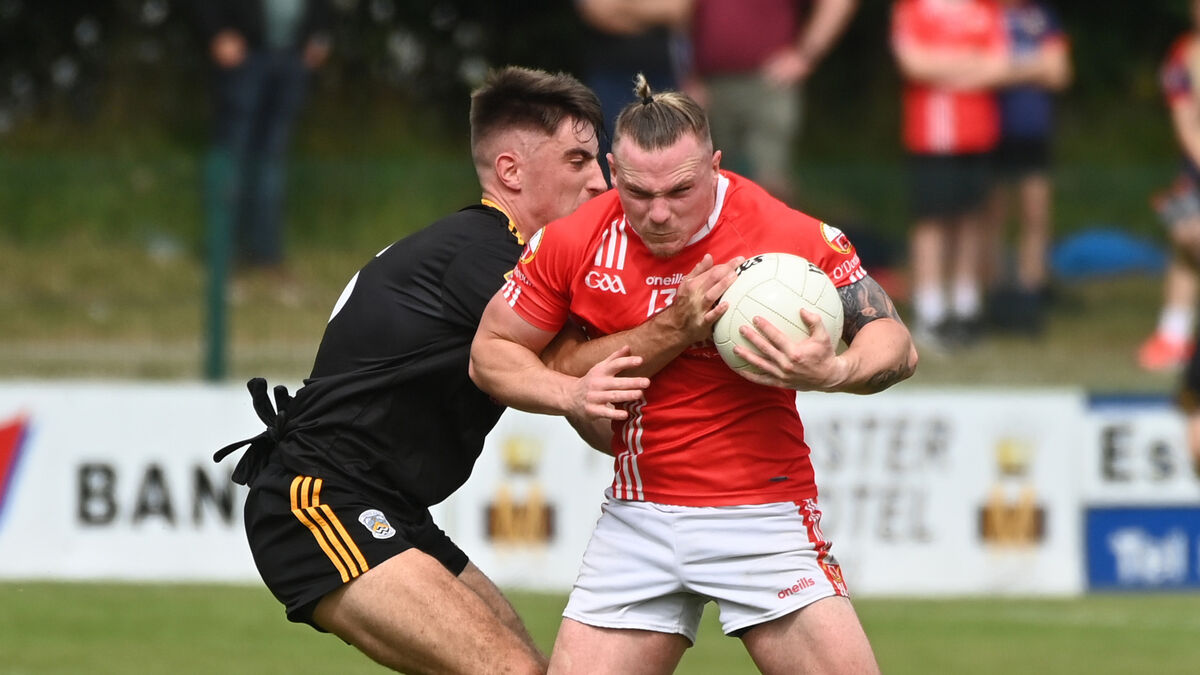
CLOSE CALL: O'Donovan Rossa's Thomas Hegarty is tackled by Fermoy's Greg Lardner during the Bon Secours Senior AFC at Bandon. Picture: Eddie O'Hare
AFTER O’Donovan Rossa defeated Fermoy in their final Group A game in the SAFC recently, manager Gene O’Donovan spoke to Denis Hurley about the disappointment of exiting the championship on scoring difference.
After ending up on 4 points and in a three-way tie with Knocknagree and Kanturk, O’Donovan Rossa had the same scoring difference as Kanturk, but the Skibereen side were eliminated on total points scored.
It was a very disappointing way to exit the championship but O’Donovan was realistic in the wake of the defeat.
"We won and we lost,” he said, “but I wouldn’t knock the format for a second. What [Cork County Board secretary] Kevin O’Donovan has done will bring Cork football on an awful lot. It might take a few years but we’re really going to see the benefit of these competitions, where, every time you go out, it matters."
It certainly does in Cork – in both codes. At the end of August, after two rounds had been played across the five football grades from Premier Senior to Premier Junior, the excellent Cork Tables (championship) Twitter handle tweeted the raw data and the compelling details of what it meant for all teams with one round still to play.
Of the 60 teams involved, only four had qualified – Nemo Rangers, Dohenys, Bantry and Dromtarriffe. Only eight teams could not qualify, which meant that 48 clubs were still playing for the remaining 26 knock-out places.
Even at that, those teams qualified were still fighting to reach a semi-final while those eliminated were trying to avoid the relegation game.
When all the games were played and the groups were decided, the Cork Tables Twitter handle provided more fascinating detail to underline the competitiveness across the five grades in football.
The average winning margin in each and every grade came down this year compared to last year. Some of that data was startling when the numbers were outlined in black and white; in the IAFC, the average winning margin in 2021 and 2022 was 7.2 and 7.3 points respectively. This year, it was down to 3.9 points.
That’s no surprise considering that seven of the 18 games in the IAFC were decided by one point or less.
Nemo Rangers were the only team to win all three group games in the PSFC, while Clonakilty qualified for the quarter-finals on 3 points and either Douglas or St Michael’s (who meet in a playoff on Friday evening) will have qualified for the last eight on just 2 points.
In Premier Intermediate hurling, none of the 12 teams managed to win their three games. With almost every team taking points off each other, just one point separated the top nine teams in the three groups.
The Cork championships have become so competitive that they are uniquely cutthroat in a group format. Although Tyrone still run a knockout football championship, while counties like Down and Laois are similarly paved with qualifying rounds before the quarter-finals, most counties now operate the group system of four like in Cork.
A lot of counties though, have opted to replicate the system now in place for the new inter-county football championship, where three teams qualify from a group of four, with a preliminary quarter-final introduced.
Even in Galway, where every team in Senior A hurling was given ample opportunity to qualify last year, with four teams emerging from a group of 6, Galway now have four groups of 4, with the top three in each group qualifying.
The restructuring in Galway this year now sees 12 of the 16 teams qualify for the knockout rounds in Senior A. It’s similar in Armagh where 12 of the 16 teams (with four groups of four) qualify for the knockout stages.
That does guarantee more teams more knockout games but one of the biggest criticisms of that format is lack of real consequences with so many of those matches – especially for the stronger teams, where many of those group games are already foregone conclusions.
The harshest critics will say that that system is not really championship. The cynics will say that it’s just another means of county boards trying to maximise revenue.
The corollary of that argument though, is that it’s counter-productive – because supporters (especially the neutrals) don’t attend many of those group games where they feel so little is at stake.
There is always something on the line in Cork, but the system isn’t without its critics either. For example, in the PSFC this season, every team had three weeks between each group game, whereas that luxury didn’t exist in the PSHC.
In the county board’s defence, every team is aware of the dates of their championship fixtures months in advance. And something always has to give somewhere in a county that has to fix more matches than anywhere else in the country. And a certain number of teams are always going to suffer somewhere in that system.
On the whole though, the Cork championship system is working a lot better than most championships around the country.
And, right across the board in hurling and football, the Cork championships are becoming one of the most competitive and cutthroat in the country.










 App?
App?


