Why the mindset around women’s sports must change to keep teenagers involved
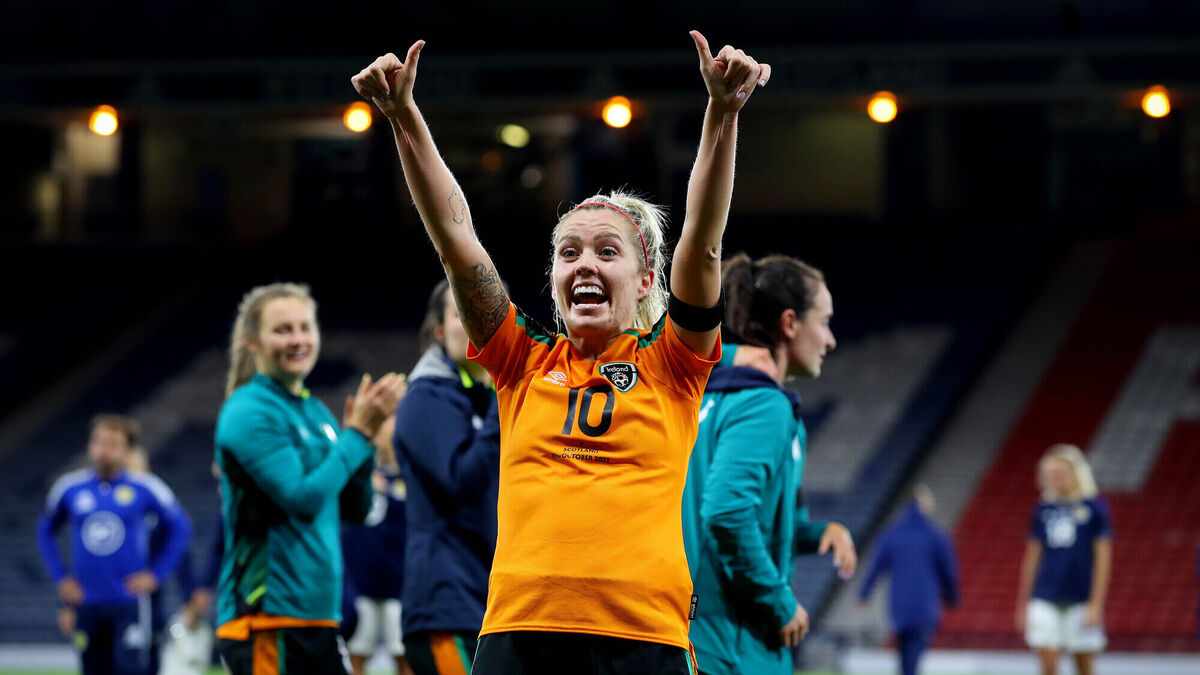
Ireland’s Denise O'Sullivan celebrates after reaching the World Cup. Picture: INPHO/Ryan Byrne
BY the age of 13-15 the majority of girls have labelled themselves 'non-sporty' with few attempts to counter it.
It might be difficult to pinpoint an exact reason for teenage girls leaving their chosen sport, but more often than not teens find that there are limited opportunities, an underappreciation and an overall lack of respect for them.
Sports should be a space in which girls feel welcomed and included.
One of the most powerful barriers they face is the feeling of not being “good enough” which promotes girls leaving the sport or not participating at all.
Research undertaken by Sports Ireland released in the ‘Adolescent Girls Get Active Research Report’ shows that teenage girls in this country have a narrow, and often negative experience of a small number of traditional sports and now think this is all sport can be.
But what can be done to promote women’s sport in Ireland?
More often than not, as we all know, men’s games are deemed more important, of superior quality and are worth watching over a women’s game. This statement just isn’t true anymore.
The Irish women’s soccer team for example made history by qualifying for a major tournament for the first time. This itself is without a doubt one of the most important milestones in the history of Irish women’s sports.
This qualification should kickstart the interest in women’s soccer by not only watching it but also playing it, but beginning a sport is not the major problem it’s trying to keep girls playing throughout secondary school.
Many aspects of a teenage girl’s life change once they start attending second-level education. Unsurprisingly, friends and their social environment are central to a girl’s support network, and they strongly prioritise time with friends over everything else.
A reason for girls leaving sports is that their friend group stop playing or that it is not deemed ‘cool’ enough to play, but what can be done to change this opinion?
First of all, a change of approach needs to be taken by coaches and managers within the sport itself to make it more inclusive and accessible to girls that may not be comfortable attending sports on their own.
Girls need constant encouragement and a positive environment in which they feel comfortable attending weekly. A win-by-all-cost attitude also has to alter to encompass every player on the squad and not just the girls with natural abilities.
Girls often associate this term with team and contact sports, so others that are interested in exercise do not feel targeted with sporting initiatives. This phrase has to be changed to include every aspect of sport from physical activity to socialising with others.
On a global level though a huge shift has to be made in terms of how we think about women’s sports in general. If there is not going to be a change at the top level, then how can we expect young girls to stick with a sport?
The issue is that women’s sports will always come second in line with their male counterparts. Many people are of the opinion that ladies’ games are of no interest to them and of lesser quality than men's.
This assumption seems to be a universal problem that obviously affects how young girls think about their sports. More has to be done to promote women’s matches be it on TV or social media.
People often have the excuse that they don’t know a girl’s match is even taking place until it’s all over.
This just isn’t good enough anymore; women’s sports deserve our respect and teams like the Irish women’s soccer squad are one of the greatest examples.
By changing this opinion people seem to have about women’s sports, teenagers will be able to witness the appreciation the nation has for female sports. This will filter down to their individual playing, which would ultimately encourage them to continue it.
We need to understand that girls not only leave sports because of their experience with it but also how they observe the sport through what everyone else says. Girls can base opinions on how they see their sport is publicised through the press and what others think of it.
There has to be an extensive shift in how we promote, speak and interact with women’s sports if there is any hope of young girls continuing.









 App?


