Train driver ignored warning signal and damaged Cork to Dublin track, report finds
The driver later said they had been aware of the overspeed, but instead of reporting it as required, they became focused on complying with the speed restrictions for the remainder of the journey.
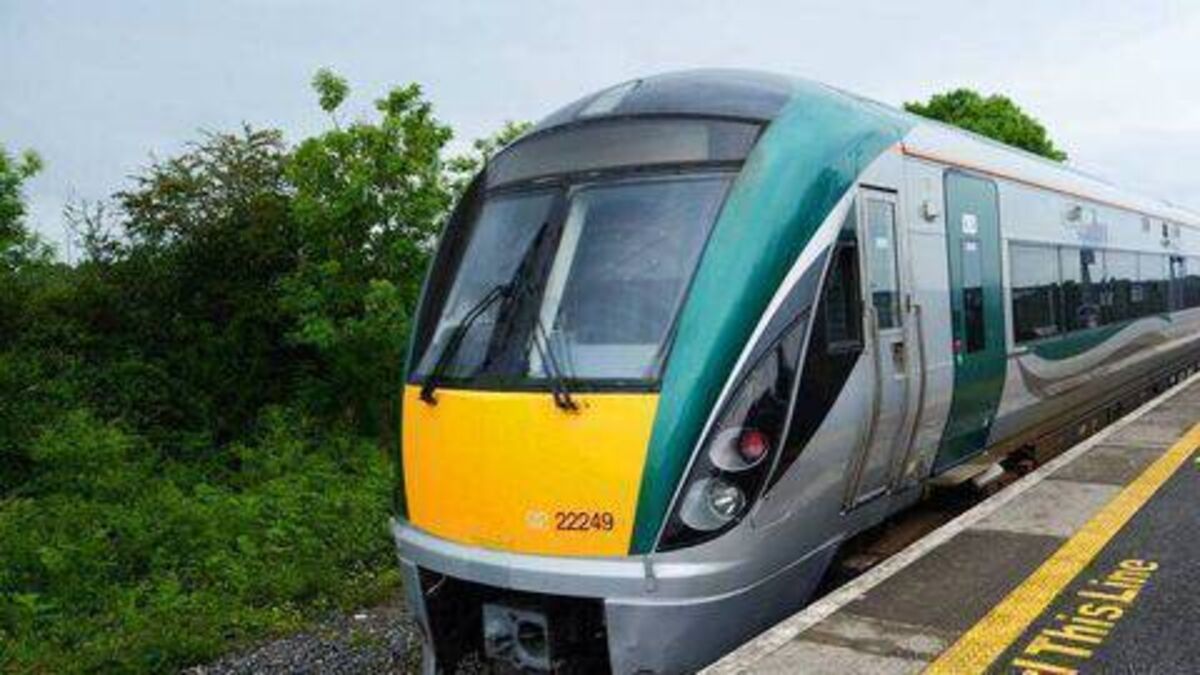
Iarnród Éireann incurred a cost of more than €7,000 after a train driver dangerously ignored warning signals on the Cork to Dublin mainline last year.
Following an incident on the Cork to Dublin mainline in February 2025, an investigation was launched by the Department of Transport's railway accident investigation unit (RAIU).
The incident was recorded as one of 15 SPADs – signal passed at danger – recorded on the Irish railway network in 2025, representing an increase of approximately 37% on the previous year.
According to the RAIU, on February 8, 2025, a train driver reported for duty at Mallow Train Station despite feeling unwell.
The driver worked the 11.25am Mallow to Tralee passenger service without incident. However, immediately before departing Tralee, they mobilised the cab incorrectly by inputting the train ID as Train A307 and not Train A309.
During the journey, between Rathmore and Banteer, an overspeed event occurred, with Train A309 reaching 127km/h where the permissible speed is 113km/h.
According to a report, the driver later said they had been aware of the overspeed, but instead of reporting it as required, they became focused on complying with the speed restrictions for the remainder of the journey.
At approximately 2.33pm, the train passed a railway signal at Killarney Junction near Mallow at 'danger', meaning a red in-cab indication had been displayed, and the driver continued, without authority, whilst travelling at a reduced speed of 69km/h.
According to the RAIU, there is a 64 km/h permanent speed restriction at this signal junction.
The train then continued onto the Cork to Dublin mainline through a track switch, which was not set for the movement, resulting in damage to components, before continuing as far as a signal point before Mallow Station, where the driver brought the train to a stop.
The RAIU said the signal passed at danger (SPAD) at the Killarney Junction scored 23 on a scale between 0 and 28, making it high risk.
As a result of the incident, damage was caused to the track switch point, amounting to a cost of €3,065.32.
The track switch was also out of commission for more than 27 hours, preventing movements on the Tralee line.
Due to the damage caused, 19 train services were cancelled, with their substitution by bus coming at a cost of €4,100.
Following the incident, a relief driver was deployed to bring the train into Mallow station, and arrangements were made for the original driver to be tested for drugs and alcohol.
The result of the tests were negative, and further health assessments were conducted on February 18, with no underlying illnesses found.
The driver remained off duty until a post-incident review took place, and later returned to work upon its completion.
Concluding their investigation, the RAIU made three safety recommendations to Iarnród Éireann, including a review of the professional driving handbook, to ensure the inclusion of clear guidance for drivers when feeling unwell.
Other recommendations included the provision of simulation facilities to better understand railway emergency calls, the identification and assessment of the operational risks associated with SPADs at individual junctions, and to implement enhanced risk control measures.





 App?


