Tom MacSweeney: Ballycotton remembers famous 1936 rescue off Cork Harbour

Mary Standford on display in Ballycotton.
This is a week when the Ballycotton community in East Cork can remember that their village has a proud place in the annals of the Royal National Lifeboat Institution.
On the cliffside above the village stands the original Mary Stanford lifeboat which, this week in 1936, carried out a rescue off Cork Harbour that has become a key part of RNLI history.
Tonight in the Garryvoe Hotel the rescue will be recalled when a book is launched to help raise funds for its ongoing maintenance. Written by Galway historian Gerry Kearney, originally from Cloyne, it documents the lives of 267 men and five women of Cloyne parish — Ballycotton, Churchtown South, Cloyne, Shanagarry — and their maritime and military service in the Merchant Navy, Coastguard, Red Cross, during the First World War and links to their later lives.
These include the famous Ballycotton Coxswain Patrick ‘Patsy’ Sliney and Thomas Flavin Walsh of the Mary Stanford crew, which went to the rescue of the lightkeepers aboard the then Daunt Rock lightship, Comet, who were in great danger during a week of gales.
A strong south-easterly with rain and snow hit the Cork area on February 7. Ballycotton Bay was a seething turmoil. Huge waves swept into Ballycotton Harbour.
The next morning, with the gale still howling, Ballycotton Lifeboat Station was told that the lightship, with eight men aboard, had broken from its moorings and was drifting helplessly in huge seas and gale force winds.
With Coxswain Sliney in charge, the Mary Stanford was launched into the turmoil of Ballycotton Bay. Its seven-man crew battled enormous waves as they fought their away against the gale towards Cork Harbour.
‘People watching her leave the quay went to the church to pray,’ a contemporary report records.
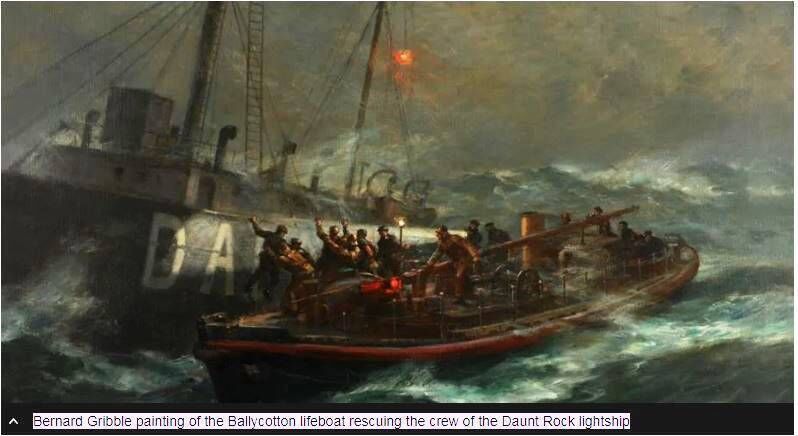
They located Comet quarter of a mile from Daunt Rock, in grave danger. Multiple attempts were made to tow her, but heavy waves snapped a steel cable.
The lifeboat stood by until nightfall as the lightship was tossed about. The MV Innisfallen and HMS Tenedos arrived on the scene so the Mary Stanford could go to Cobh to get stronger cables.
After being all day without food, the crew got a meal, a few hours’ sleep, changed to dry clothes and got back to the Daunt Rock area. The storm was still strong and there was thick fog.
Mary Stanford remained into another night. Commissioners of Irish Lights vessel, Isolda, arrived but the lifeboat was the only hope of saving the lightship crew. It needed refuelling at Cobh then returned to the dangerous scene. Comet had drifted perilously close to Daunt Rock, its bow going underwater.
At 9.30pm the only option was to get the lifeboat alongside the lightship as both vessels were thrown about in the sea conditions. It was extremely dangerous but Coxswain Sliney did it. His crew shouted instructions to the lightshipmen to jump onto the Mary Stanford.
The RNLI archive records: “On the first attempt, one did. By the third, five more had jumped successfully, leaving two exhausted, clinging to the lightship rails.
Fourth and fifth rescue attempts were futile. On the sixth the Ballycotton lifeboat men successfully dragged the two on to the Mary Stanford. The lightship crew were disembarked at Cobh by 11pm. Then the Mary Stanford returned to Ballycotton.
The crew had been at sea for 49 hours, with only three hours' sleep. All suffered cold and salt burns, having completed one of the most demanding rescues ever undertaken, an example of endurance and bravery.
An RNLI Gold Medal was awarded to Coxswain Sliney. Second Coxswain John Lane Walsh and Mechanic Thomas Sliney were awarded Silver. Crew members Michael Coffey Walsh, John Shea Sliney, William Sliney, and Thomas Walsh all received Bronze Medals.
In 1974 a painting of the rescue by Bernard Gribble was featured in the RNLI’s 150th celebrations and An Post issued an Irish commemorative stamp, designed by Michael Byrne.
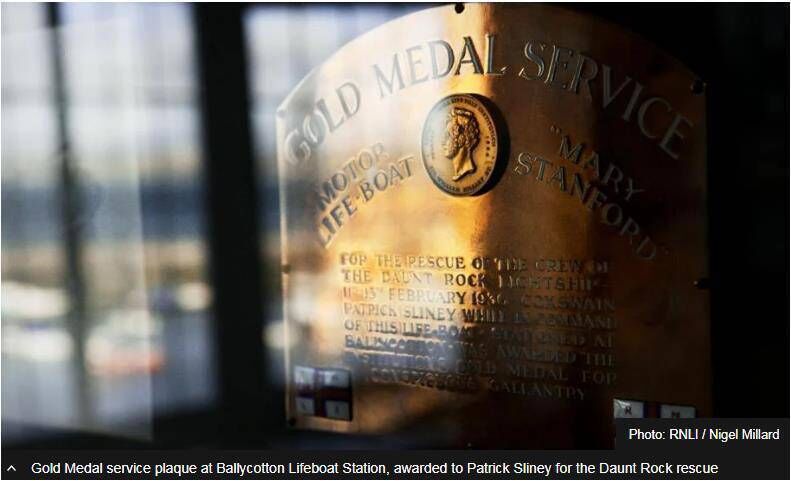
Gerry Kearney, who has written several historical books, says: “Being from Cloyne I knew about this rescue and found links through crew members into the First World War and how, after that, they had continued into later life. It was a great sea rescue.
"When the Mary Stanford was, in her later years, threatened with destruction, Ballycotton villagers decided it should be preserved and fought successfully for that. It stands now as a symbol of courage and service by lifeboatmen and a mark of the community’s pride in honouring and remembering them.
"It is East Cork’s most important maritime landmark. All proceeds from book sales will go towards its ongoing care and conservation.”
- The launch at 7pm in Garryvoe Hotel will be a night of history and maintaining local heritage. The Rovers group will perform .
- is on podcast platforms and available hereavailable here.
 App?
App?


