Do Cork students think social media should be banned?
With the use of social media and AI tool Grok becoming a major concern for society, reporter John O’Shea visited a city school which has recently introduced pouches for storing devices. 
Do Cork students think social media should be banned?

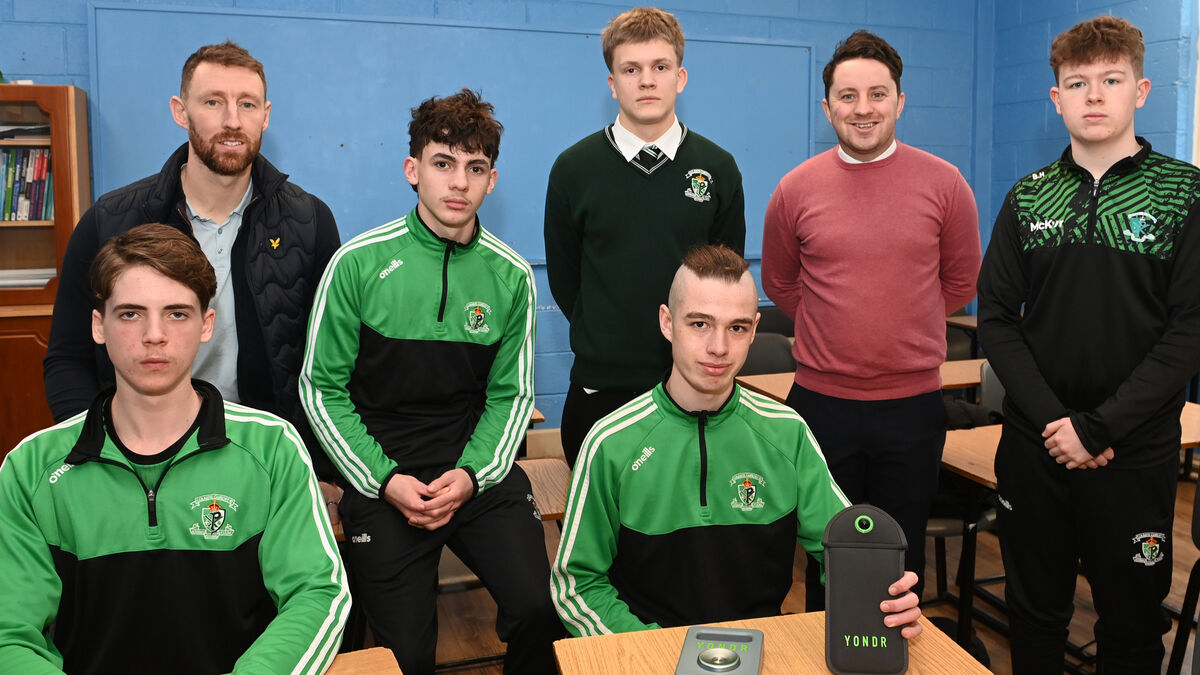
Transition year students Addison Crowley, Calvin O'Connor, Luke Sweetman, Noris Iurisniti and Ben Hourihane with teacher Jamie Burns and deputy principal Liam Shorten at Coláiste Chríost Rí. Picture: Larry Cummins.

THE dangers of the AI tool Grok have been very prominent in the news agenda recently with parents across the country, including Cork, being understandably concerned about its use.

It emerged in recent weeks how the tool, owned by Elon Musk’s X social media platform, was being used to digitally undress images of women and children.

It has placed a further spotlight on the dangers for young people across Cork of what they may encounter online.

One month into Australia’s world first social media ban for children under the age 16, Australian government data showed that social media companies have revoked access to 4.7m accounts suspected of belonging to Australian teenagers.

So, what do the young teenagers of Cork feel about the recent dangers highlighted by social media?

At Coláiste Chríost Rí in Turners Cross, students recently spoke about their views on the ever-growing online world.

TY student Addison Crowley told The Echo said the social media ban for under 16-year-olds is something he would like to see introduced in Ireland.

This, he feels, is because of the inappropriate and harmful material which can be frequently encountered online by young people.

“I definitely think it should be in place in Ireland because it will benefit every teenager.

“You have so much darkness and despair when it comes to social media. You have things from online bullying to cyberattacks.

“I don’t think any harmful material like that will ever come out again if social media is limiting it.

“I have been a victim of cyberbullying myself. So, as a personal decision, I totally cut that out of my life.”

Addison mentioned the changes he has noticed in his life since moving away from social media.

“I would definitely say that my mood and my overall humour as a person has definitely benefited from deleting social media.

“I think the trouble with teenagers is that they have a harder time actually getting themselves involved in social interactions, because they are too busy stuck behind a phone.”

Taoiseach Micheál Martin said recently that the Government will adopt an evidence-based approach to control the impact of social media on young people, while also not reacting in a knee-jerk fashion to bans being imposed by other countries.

Although student Calvin O’Connor feels that a social media ban for youngsters across Ireland could be seen as helpful, logistically this is something that would be difficult to implement and police.

“I think it would help, but I don’t think a social media ban would completely work.

“There are always going to be people who can find a way around it and tell their friends how to get around it. So, I think a lot of people will still be on social media.”

A study commissioned by the Australian government earlier in 2025 found that 96% of children aged 10-15 used social media, with 70% having been exposed to harmful content.

This included misogynistic and violent material, along with content promoting eating disorders and suicide. One in seven children also reported experiencing grooming type behaviour from adults or older children, while more than half said they had been the victim of cyberbullying.

Rather than an outright social media ban for Ireland such as in Australia, Calvin outlined how he feels young people should be educated more often about the dangers of social media.

“I think it would be great to educate people about that and also teach them about digital footprints — that would help as well.

“That is because you might see online a lot of people think they can comment stuff and get away with it, without realising that there might be repercussions when it comes to applying for college or trying to get a job interview.”

Student Luke Sweetman agrees that there should be greater policing online in terms of the content which can be seen by young children in particular.

“I wouldn’t say that a ban is necessary. But I definitely think that there should be limits and restrictions on what minors can do online.

“There definitely is stuff that under 16-year-olds shouldn’t be seeing.

“But I think if we are able to cut down on harmful material and make it safer, it would be a lot better.”

Luke continued with how he feels that the use of social media overall has a more positive impact than negative.

“I think it is really good to be able to connect with friends in that way and talk online when you are far away.

“I think there are a lot of people who spend too much time on social media. But I think that having a balance is pretty healthy.”

Noris Iurisniti also thinks that a total social media ban in Ireland would be excessive. But he feels that some form of limitation or restriction on what those under can see online would be beneficial.

On the recent controversy surrounding Grok AI being used to digitally undress images of women and children, Noris said: “That is dangerous. If anything, they should wipe out AI on social media, rather than just wiping out social media for people under 16.

“I think classes to teach people about the dangers of social media would be a good idea.”

Pouches take ‘seven or eight hours of social media time out of students’ lives’

Coláiste Chríost Rí introduced a phone pouch system recently to create a phone-free zone during school hours and to help improve student interaction in the classroom.

The phone pouches are lockable and students carry the pouches with them throughout the day.

Pupils attending the school place their device in the pouch upon arrival at school at 8.30am and do not have access to their phones — unless permitted by teachers for educational purposes — until school ends at 3.25pm. The pouches are sealed with a magnetic lock upon arrival and can only be opened at designated unlocking stations at the end of the school day.

Deputy principal at Coláiste Chríost Rí, Liam Shorten, told The Echo: “It has worked very well and none of our students are on their phones from the time they pass in through the gate every morning until they leave.

“So that takes seven or eight hours of social media time out of the students’ lives.”

He said that sometimes the teacher may need a phone in class for an educational project.

“We have mobile unlocking stations that teachers can bring into class to unlock the phones,” said the deputy principal.

Mr Shorten added: “This is my sixth year in the school and you can definitely see a huge increase from when I started here.”

He said a lot of the boys were visibly on their phones before the pouches were brought in.

 Calvin O'Connor with one of the lockable YONDR mobile phone pouches. Picture: Larry Cummins.
Calvin O'Connor with one of the lockable YONDR mobile phone pouches. Picture: Larry Cummins.

“We have stopped that now with the pouch system. We have seen a huge increase in the level of engagement in the class.

“Also, socially, the boys are talking to each other a lot more now, as opposed to having the phone out the side of their pocket, looking down and not concentrating on what their friends are saying.”

Mr Shorten feels Ireland could benefit from greater restrictions to protect young people online.

“I think, with the proper controls, it would be very beneficial. Particularly when you see everything going on with AI at the moment, with Grok and images of young boys and girls.

“There are youngsters in Ireland as young as eight and nine years old who have social media accounts, who are not even out of primary school yet.

“So I would be very much in favour of something to protect young people as much as possible from the dangers that are there online.”

TikTok begins rollout of new age verification technology across the EU

As calls for an Australian-style social media ban for under-16s increase, including here in Ireland, TikTok is beginning the roll-out of new age verification technology across the European Union in the coming weeks.

The system, which has been piloted in the EU over the past year, analyses profile information, posted videos and behavioral signals to predict whether an account may be belong to a user under the age of 13.

Accounts flagged by the TikTok system will be reviewed by specialist moderators rather than face an automatic ban, and may then be removed.

VERIFICATION

Meta, the parent company of Facebook and Instagram, uses the verification company Yoti to verify ages of users on its social media platforms.

Last week, in response to a parliamentary question about age verification for private online platforms, communications minister Patrick O’Donovan said: “I am committed to working with all stakeholders, nationally and internationally, to ensure robust online safety measures are in place, in particular, to protect children and young people from inappropriate, harmful and illegal online content.

“We are not yet at the stage where all of the issues raised can be answered.

"However, I can confirm that the introduction of age verification through the government's digital wallet will be in line with EU law and that all necessary steps will be taken to ensure that data protection and other rights of users will be protected.

“Online safety is a top priority for me and I plan to make online safety a key theme of Ireland's presidency of the European Union.

"In my view, age verification is an essential component of any online safety framework and that is why I am committed to developing this age verification tool as part of Ireland’s digital wallet."


Read More

Cork City Hall hosting four-day 'model UN' event 

more #Cork - News articles

Tributes flow in for Cork native and former MEP Brian Crowley Tributes flow in for Cork native and former MEP Brian Crowley
Teen hospitalised after e-scooter incident on Cork's northside Teen hospitalised after e-scooter incident on Cork's northside
Former MEP and West Cork native Brian Crowley dies, aged 61 Former MEP and West Cork native Brian Crowley dies, aged 61

More in this section

Cork court hears judge impose life sentence on killer of 'decent, loving and complete' Bruna  Cork court hears judge impose life sentence on killer of 'decent, loving and complete' Bruna 
Teen hospitalised after e-scooter incident on Cork's northside Teen hospitalised after e-scooter incident on Cork's northside
Former MEP and West Cork native Brian Crowley dies, aged 61 Former MEP and West Cork native Brian Crowley dies, aged 61

Sponsored Content

Turning risk into reward: Top business risks in 2026 Turning risk into reward: Top business risks in 2026
Top tips to protect Ireland's plant health Top tips to protect Ireland's plant health
River Boyne in County Meath, Ireland. Water matters: protecting Ireland’s most precious resource
Contact Us Cookie Policy Privacy Policy Terms and Conditions

© Examiner Echo Group Limited

Add Echolive.ie to your home screen - easy access to Cork news, views, sport and more