‘Homelessness wasn’t always this bad in Cork', a morning in the life of Cork Simon's outreach workers
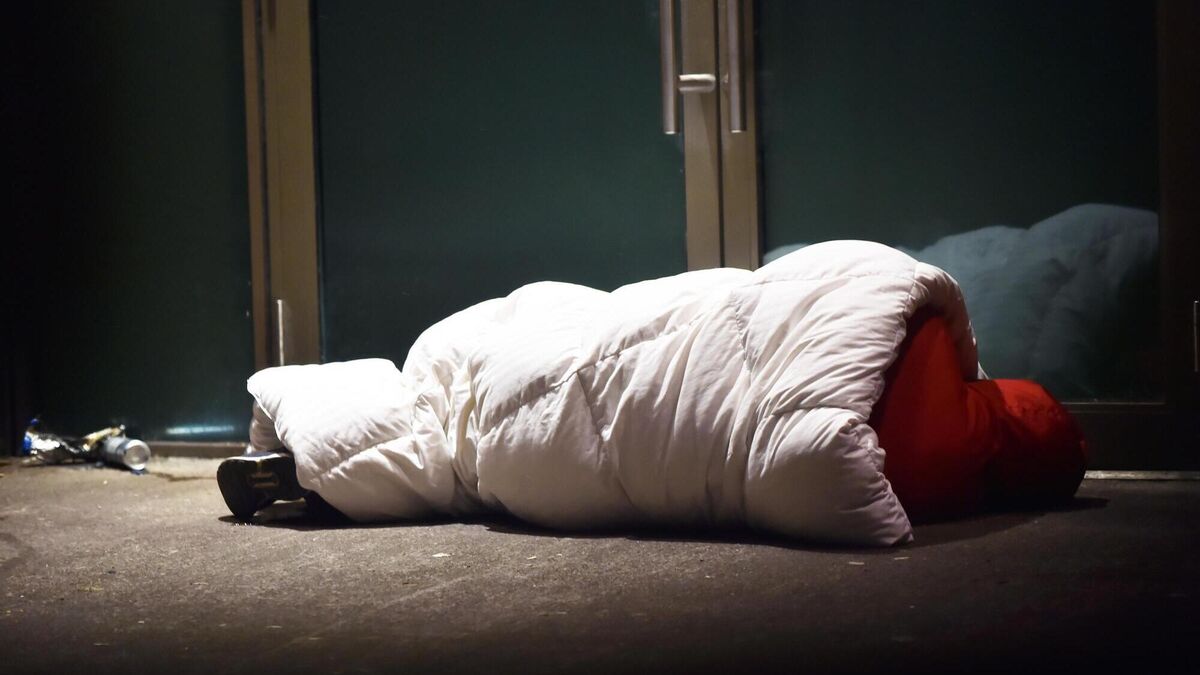
Sheltering in a doorway just yards from Cork Simon in Cork city. Image: Eddie O'Hare
It’s coming up on 7am and it’s still dark on Patrick St, bitterly cold on a horrible December morning as the rain lashes down on hard, wet streets.
Outside Penney’s, two outreach workers from Cork Simon approach a person-shaped blue sleeping bag on the ground, wedged against the shop door, the doorway affording little shelter.
The sleeping bag is sodden, and in this light it is darkened to black where it meets the concrete. Kevin, one of the outreach workers, crouches down and gently asks the sleeping man if he’s all right.
The man mumbles that he is, he’s soaked, he says, but he’ll try and sleep a bit more.
Kevin tells him to be sure and call into the Cork Simon shelter on Anderson’s Quay in a little while, to get a hot shower and a change of clothes, and a bit of breakfast.
Kevin’s colleague, Rory, has already moved down the street to Brown Thomas, where he’s chatting to a man lying on the pavement in a doorway even less sheltered than Penney’s.
It’s a scene that is repeated over and over through the two hours Kevin and Rory are out this miserable early morning. “You wouldn’t put a dog out in this,” Rory says later.
It’s hard not to think of a line spoken by one of Kevin and Rory’s predecessors when accompanied them on a similar early morning encounter with rough sleepers a couple of years ago – “You wouldn’t be able to do this sober”.
The atrocious weather means there are fewer rough sleepers in the city centre today, but we still encounter 25 people sleeping out on the streets of the Republic’s second city, most, but not all, of them are men.
After an hour or so, we stop for refreshments in Cork Coffee Roasters on Anglesea St, and, chatting over coffee, the controversial topic of the recent €7m revamp of Bishop Lucey Park – which has left it open 24 hours and almost completely devoid of grass – comes up almost immediately, and Kevin says he read someone in liken it to “a Russian bus stop”.
Kevin continued: “We found one person sleeping in there a couple of days after it opened up and they were going: ‘I’m never going in there again, cos there’s no cover, there’s no shelter, there’s nowhere to hide’.
“But when the weather gets nice, I would imagine we’ll get people in there in clusters and that’ll be the next hotspot then.”
News that the HSE has tendered for a premises for Cork’s first purpose-built day centre for homeless people is welcomed by both men, and there is praise for Fine Gael TD Colm Burke – “The guy in Blackpool” – who has long championed the development.
“In fairness to him, there has been some movement on it, but with all these things, the wheels are very slow to turn,” Kevin says.
Some of the services envisioned for that centre are currently provided by the Cork Simon Day Centre on Anderson’s Quay, which is open to service users from 9am to 1pm five days a week. There they can get some brief respite and access medical assistance, counselling, food and showers, and the outreach workers help them to fill in forms for vital services.
Both men agree that a purpose-built day centre would give people a place in which they would have shelter and dignity during the day. It might also free outreach workers up to concentrate more on the core of their work, Kevin suggests.
“In Dublin, outreach workers don’t have to run a day centre or an office, their primary job is to link in with rough sleepers.
“The other side of the coin is that homelessness is getting worse, year on year, it wasn’t always this bad in Cork, so for us to be traditional outreach workers like you would see in the likes of London or Liverpool, we need the extra help that the [HSE-run] day centre would give.”
Rory adds that Cork city is small, and they tend to know where rough sleepers are, and they can attend to them, but they are aware of people in satellite towns such as Midlelton, Youghal and Cobh, and they simply don’t have the time to get to them.
“There are a lot more people becoming homeless in the county that we can’t get to. We’re getting phone calls about people in Mallow, in West Cork.
“There are a lot more people, too, becoming homeless who don’t have what might be seen as ‘traditional’ homeless issues, addiction and issues like that. We see people who just can’t find a place to rent, because there’s nowhere to rent, or what is there is extortionately expensive,” he says.
“We have one or two lads who are working in supermarkets around the city and they’re sleeping on mattresses on the floor in our Night Light facility, or else they’re sleeping rough.”
Living on the street exposes people to secondary trauma, they add, and this can lead to substance dependency in people who did not have such addictions before they became homeless, reversing one traditional route where addiction would lead to homelessness.
Another issue they come across regularly is the increasing number of people with severe mental health issues who routinely end up on the streets, and this is something they both say is a very troubling and a relatively recent development.
“These are very vulnerable people,” Rory says. “This is something that seems to be happening more and more.
The number of people sleeping rough every night on the streets of the city has remained a stubborn constant, Kevin says, despite the allocation of greater resources by Cork City Council’s accommodation placement service (APS).
“That would have been the same figure a year or more ago, and APS has opened up more beds since within the city boundaries, so those people would now be in B&Bs or temporary B&Bs, but the rough sleeping figure has remained the same,” he says.
“There are more emergency beds but there are more people becoming homeless, so the rough sleeper estimated number remains the same, that has not gone down.”
They both say APS does “a lot of good work” but if not for the additional – and very welcome – extra resources allocated by the city council, Cork Simon’s outreach workers would likely be meeting even more rough sleepers every morning.
Rory says that the housing crisis is responsible for much of this, because in times past people had a choice of accommodation.
“You would be able to find some place to rent because you would be able to pick and choose. Now landlords are able to pick and choose their tenants,” he says.
Both men grew up in social housing in Cork city and say the collapse in the building of social housing has contributed greatly to the housing crisis, as has the influence of vulture funds on the housing market.
Asked how they feel on the subject of a supervised injection facility (SIF) for drug users in Cork city, both men say: “It has to happen” and Rory says it is essential that it happens soon.
“For Ireland as a society to address the problem of addiction, and if people who might use the ‘j’ word don’t want to see discarded needles on the street, if we have a dedicated facility, that will reduce the problem.”
Asked about the concerns of those who might say such a facility will concentrate intravenous drug users into its orbit, they both say there are always objections, but the evidence from the country’s first SIF, in Dublin, has been positive.
Before he ever worked in homelessness services, Kevin worked around Christchurch Cathedral in Dublin, so he is very familiar with the area around the Merchants Quay SIF in the capital.
“Merchants Quay is very similar to what Cork Simon does, everything is very similar in terms of the clientele and what goes on in the area. The feedback that I have got from people in the area is that the supervised injection centre has really made things better in the area,” he says.
“This is only anecdotal, but from what I’ve heard, overdoses are way down, and the crime in the area is way down as well, because people aren’t committing those crimes to feed their addictions.”
Asked if there is anything the pubic could be doing to help Cork Simon in its work helping Cork’s homeless community, Rory quips: “donate to Cork Simon”.
Kevin adds that if members of the public come across people sleeping rough, it would be very helpful if they contact the shelter.
“We don’t know, unfortunately, where everybody is, and people pop up in places and we mightn’t hear about it or see it, so if you do see someone sleeping rough, please give us a call,” he says.
It’s coming up on 9am, and it’s a little brighter now, but the rain has not lifted. There are miniature rivers flowing on Anglesea St as we run for our cars.
Kevin and Rory head back to Anderson’s Quay, where the doors will be opening soon and people will be heading in for a bit of breakfast, a shower and a change of clothes.
There Kevin and Rory will begin the second part of their day, connecting Cork’s most vulnerable citizens with the services they need.
See corksimon.ie









 App?
App?


