Who are the EU’s 27 new commissioners?
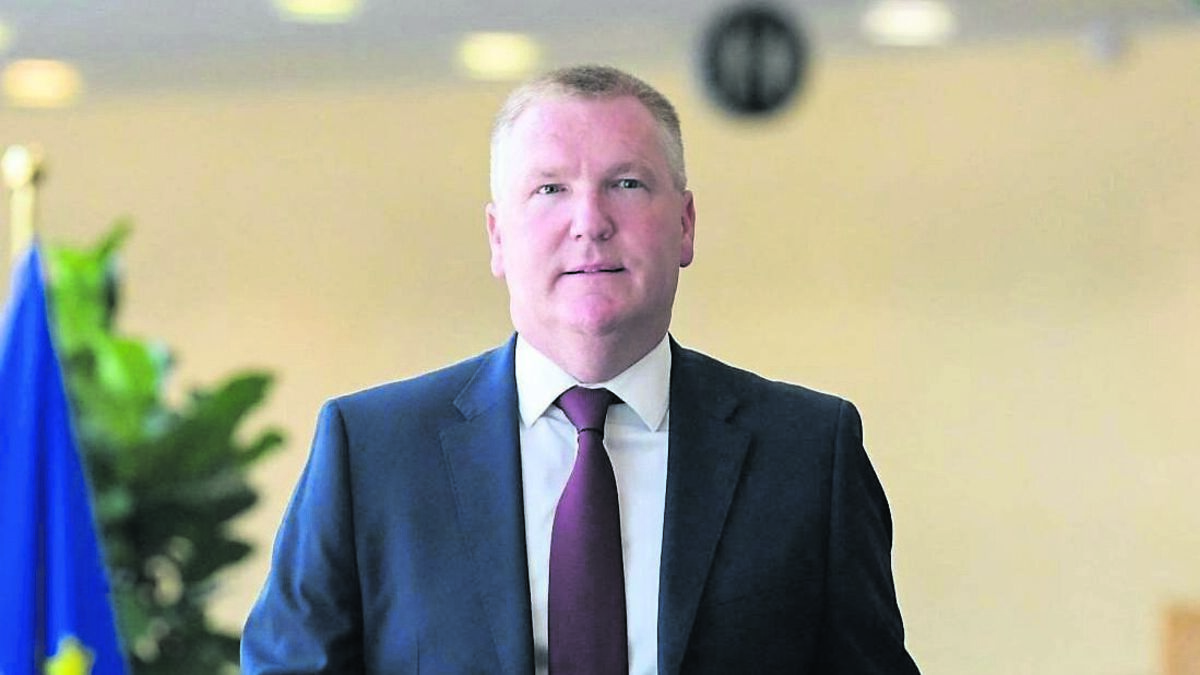
Commissioner-designate for Democracy, Justice and the Rule of Law, Michael McGrath, arriving for a meeting of the Board of Commissioners in Brussels.
EUROPEAN Union commissioners have a five-year mandate and are replaced following the European Parliament elections the same year.
They are the most senior executives at the European Commission and their portfolios span from agriculture to environment, and from trade to justice.
Usually, the EU country’s governing party or coalition nominates their commissioner candidate, but commissioners do not represent their countries’ interests.
Each commissioner must act in the common interest of the EU.
The re-elected commission president, Ursula von der Leyen, had requested gender parity, urging each member state to propose two candidates, a male and a female. However, only Bulgaria proposed one of each.
Some other member states, for example Belgium and Romania, later switched their candidate to female to achieve a better gender balance.
This gender recommendation was not legally binding.
On September 17, Ms Von der Leyen confirmed the structure of the next commission and presented her college of commissioners, and their associated portfolios, at a press conference in the parliament in Strasbourg. The college will have 11 female commissioners, representing a gender division of 41% women and 59% men.
The next steps will include the commissioner-designates appearing before a series of committee hearings at the European Parliament, where their competence and knowledge of their portfolios will be scrutinised. These hearings are scheduled to be held this month. Following this, the parliament will vote on whether to approve the college as a whole or not.
Future Commission 2024 - 2029
n Germany, Ursula von der Leyen: Portfolio - President of the European Commission
The German native is now set to enter her second five-year term as president. Ms Von der Leyen is a medical doctor, who specialised in gynaecology.
Commissioners - Designate
Austria, Magnus Brunner: Portfolio - internal affairs and migration
Austria’s chancellor, Karl Nehammer, of the conservative party (ÖVP, which is a member of the European People’s Party), said on X that the finance minister, Magnus Brunne (also ÖVP), is an “experienced government politician, with high competence in financial, economic, and competition policy at national and European level”. Mr Brunner has been Austria’s finance minister since December 2021 and, before that, was the state secretary in Austria’s ministry for transport, innovation, and technology.
Belgium, Hadja Lahbib: Portfolio - preparedness and crisis management; equality.
Hadja Lahbib has been Belgium’s foreign affairs minister since 2022 and played a significant role during Belgium’s presidency of the council, which ended in June 2024. Previously, she worked as a news anchor for RTBF, the Belgian French-speaking news channel, for 20 years, where she was a special correspondent for Afghanistan and the Middle East.
Bulgaria, Ekaterina Zaharieva: Portfolio - startups, research, and innovation.
Ekaterina Zaharieva, ultimately selected by Ursula von der Leyen, has previously held ministerial roles in the government.
Croatia, Dubravka Šuica: Portfolio - Mediterranean.
Ms Šuica was mayor of Dubrovnik for eight years (2001-2009).
Cyprus, Costas Kadis: Portfolio fisheries and oceans.
Costas Kadis, a professor in environmental sciences, previously served as minister for health (2007-2008), minister for education and culture (2014-2018), and minister for agriculture, rural development, and environment (2018-2023).
Czech Republic, Jozef Síkela: Portfolio - international partnerships.
Jozef Síkela (from the centre to centre-right STAN party, which sits in the EPP) is the Czech minister of industry and trade and is well-known in Brussels for the role that he played during the Czech presidency in 2022, when national leaders agreed on a gas-price cap to reduce the EU’s dependency on Russian fossil fuels.
Denmark, Dan Jørgensen: Portfolio - energy and housing.
Dan Jørgensen (Social Democrat, S&D) is Denmark’s minister for development, co-operation, and global climate policy, a role in which he has been serving since 2022.
Estonia, Kaja Kallas: Portfolio - high representative for foreign affairs and security policy and vice-president of the European Commission
Prior to Ms Kallas serving as the first female prime minister of Estonia (2021-2024), she was the leader of the Estonian Reform Party (2018-2024), a member of the Estonian parliament (2011-2014, 2019-2021), and an MEP (2014-2018).
Finland, Henna Virkkunen: Portfolio - executive vice-president tech sovereignty, security, and democracy
Henna Virkkunen has served two terms in the Finnish government, as the minister of education, the minister of public administration and local government, and as minister of transport and local government. She has been an MEP since 2014 and sits in the EPP political group.
France, Stéphane Séjourné: Portfolio - executive vice-president, prosperity, and industrial strategy
Mr Séjourné has been French minister for Europe and foreign affairs since January and a member of the president, Emmanuel Macron’s political party, Renaissance, since 2016, although he originally entered politics as a member of the French Socialist Party.
Greece, Apostolos Tzitzikostas: Portfolio sustainable transport and tourism.
Apostolos Tzitzikostas has experience in navigating the Brussels political landscape: He previously served as president of the EU’s committee of the regions.
Hungary, Olivér Várhelyi: Portfolio - health and animal welfare
Incumbent Hungarian commissioner for neighbourhood and enlargement, Olivér Várhelyi (Fidesz, a member of the Patriots for Europe group) was nominated for a second term. Prior to becoming commissioner, Mr Várhelyi was Hungary’s permanent representative to the EU.
Mr Várhelyi’s mandate was contentious, with multiple controversies in the last five years.
Ireland, Michael McGrath: Portfolio - democracy, justice, and the rule of law
Mr McGrath had been minister for finance since December 2022 and he represented Ireland at the Eurogroup and Economic and Financial Affairs Council, meeting regularly with EU commissioners and the ECB president.
Previously, he was Ireland’s minister of public expenditure and reform (2020-2022). Mr McGrath was also a governor on a range of international bodies, including the International Monetary Fund, the World Bank, and the European Investment Bank.
Italy, Raffaele Fitto: Portfolio - executive vice-president, cohesion, and reforms
Raffaele Fitto (Brothers of Italy, ECR) is the current Italian minister for European affairs, the south, and cohesion policies. He has served in the national parliament in Italy, and in the European Parliament as an MEP.
Latvia, Valdis Dombrovskis: Portfolio - economy and productivity implementation and simplification
Valdis Dombrovskisis is the incumbent commission vice-president for ‘An Economy that Works for People’ and was nominated for a third term as Latvian commissioner.
Lithuania, Andrius Kubilius: Portfolio - defence and space
Lithuanian MEP Andrius Kubilius (Homeland Union party (TS-LKD), EPP) was put forward for the role of European commissioner. The news came just days after the prime minister’s first choice, foreign minister Gabrielius Landsbergis, withdrew his candidacy, having failed to get the approval of the president.
Mr Kubilius has served as an MEP since 2019, having previously held the role of prime minister (1999-2000 and 2008-2012).
Luxembourg, Christophe Hansen - Portfolio: Agriculture and food
Christoph Hansen (CVS-EPP) first became an MEP in 2018. He was re-elected to the European Parliament in 2019 and 2024.
Malta, Glen Micallef: Portfolio - intergenerational fairness, youth, culture, and sport
Glenn Micallef has occupied the role of head of secretariat for the prime minister for the last four years.
The Netherlands, Wopke Hoekstra: Portfolio, climate, net zero, and clean growth
Hoekstra is a member of the Christian Democrat Party (member of the EPP political group), which is no longer in government in the Netherlands.
Poland, Piotr Serafin: Portfolio, budget, anti-fraud, and public administration
Piotr Serafin is a senior Polish diplomat and is well known in Brussels circles, currently serving as Poland’s permanent representative to the EU since 2023.
Portugal, Maria Luís Albuquerque: Portfolio, financial services and savings and investments
Union Maria Luis Albuquerque (PSD – S&D) was minister for finance during the Portuguese financial crisis and engaged with the troika measures in the years after the eurozone crisis. Ms Albuquerque served as a board member of Morgan Stanley Europe and on the boards of different Portuguese universities.
Romania, Roxana Mînzatu: Portfolio, executive vice-president for people, skills, and preparedness
MEP Roxana Mînzatu (Partidul Social Democrat, S&D) was elected as an MEP in the recent European elections in June.
Slovakia, Maroš Šefčovič: Portfolio, trade and economic security; inter-institutional relations and transparency
Commission executive vice-president for Slovakia, Mr Šefčovič has been nominated for a fourth term.
Slovenia, Marta Kos (TBC): Portfolio, enlargement
Ms Kos is a former ambassador to Germany and Switzerland, and a former vice-president of prime minister Robert Golob’s liberal Freedom Party.
Spain, Teresa Ribera Rodríguez: Portfolio executive vice-president, clean, just and competitive transition
Spain’s ecological transition minister, Teresea Ribera, is a former UN climate negotiator and played an influential role during the EU’s energy crisis, advocating for the implementation of a price cap on gas known as the ‘Iberian exception’.
Sweden, Jessika Roswall: Portfolio. environment, water resilience, and a competitive circular economy
The minister for EU affairs, Jessika Roswall has previously occupied the role of minister for Nordic co-operation.
Ms Roswall will be the fifth woman and the first politician from the Moderate Party (which is a member of the EPP political grouping) to take on the role.




 App?
App?


