Nostalgia: Real capital punishment in Leeside’s Georgian era
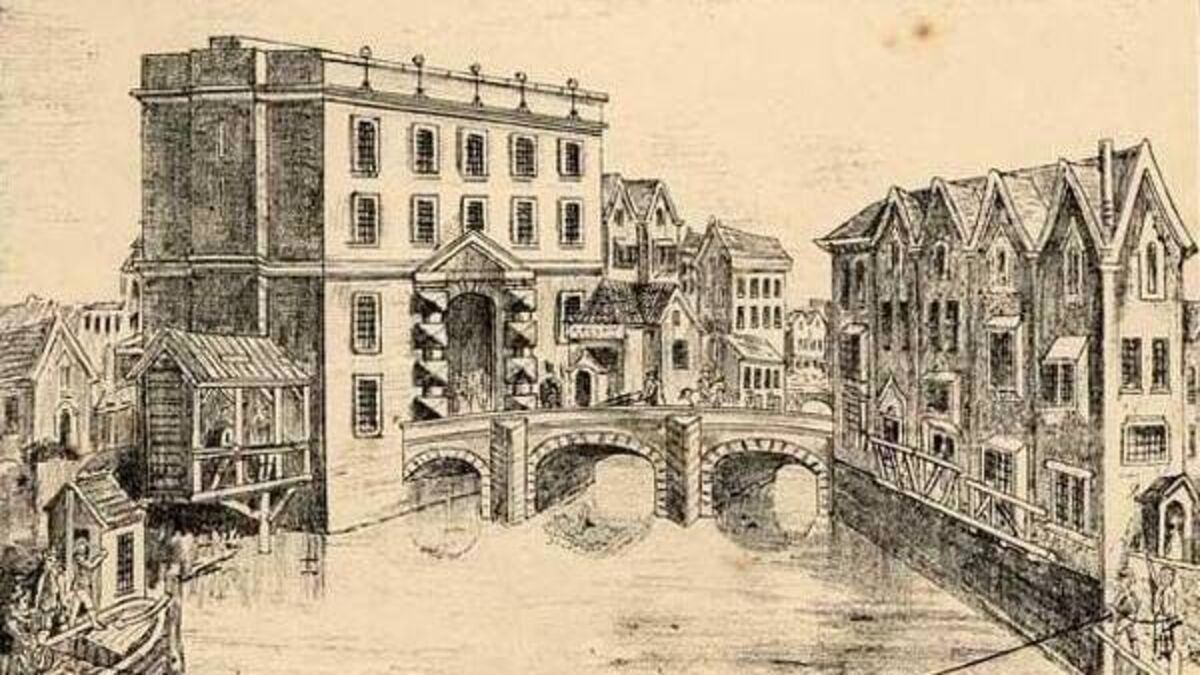
Bosanquet’s painting of the 18th century County Goal, South Gate Bridge and Globe Lane tenements on the right.Painting: Courtesy, Cork City Library.
CORK historian CJF MacCarthy tells us that death, transportation, whipping and imprisonment were among the sentences imposed on wrongdoers in Georgian Cork.
These crimes were a frequent occurrence in Georgian Cork. A regular police force didn’t exist prior to 1834 and previous to that time, the peace of the city was guarded by the sheriffs, constables and nightwatchmen. The latter two bodies protected the citizens’ lives and property as far back as 1386 when at that time, and for many years after, they were rewarded for their labours by “Smoke Silver”, a tax of one farthing on every house from which smoke issued. Pedestrianism at night in the city was often a dangerous activity. A record of 1770 states: “There were at this time lurking in various parts of the city active villains who were every night employed in breaking open stables.” And for 1772 we read of many instances of persons being robbed on the roads adjacent to the city. Mail coaches were repeatedly the target of attacks and with loss of lives.
Trade riots too were a regular occurrence; the tradesmen of Cork and Dublin were engaged in a ferocious war with one another in 1776 and in subsequent years. We read that in 1776, the sum of £600 was granted to five Dublin tradesmen in compensation for goods made by them and destroyed on their way to Cork by a riotous mob.
And on January 11, 1772, a number of men, with their faces blackened, and armed with hangers and bludgeons, entered the shop of a draper near the North Gate Bridge, where they put out the candles, broke his windows in pieces, and cut, spoiled and carried off large quantities of his goods.
The reason for this outrage was that the Cork shopkeeper sold Dublin and English goods.
In 1698, the wooden trade in Cork received a mortal blow from England, and about half a century later we read... four hundred weavers and combers walked in procession through the streets to Gallows Green, near the Lough, carrying an effigy dressed in chintz and foreign cotton, which they burned. And several linen and cotton gowns were burned on the backs of the wearers, being sprinkled with brandy.
Food riots were often a natural consequence of the trade riots, and two very serious ones erupted in 1763 and 1776 respectively when many people lost their lives.
These were very much in vogue during those times. The pillory was a common mode of correction; it turned on a swivel so that the full face of the culprit would be a sure target for the mud and rotten eggs of the street locals. Tarring and feathering was employed as late as 1784 while branding with a red-hot iron was reserved for the more hardened criminals.
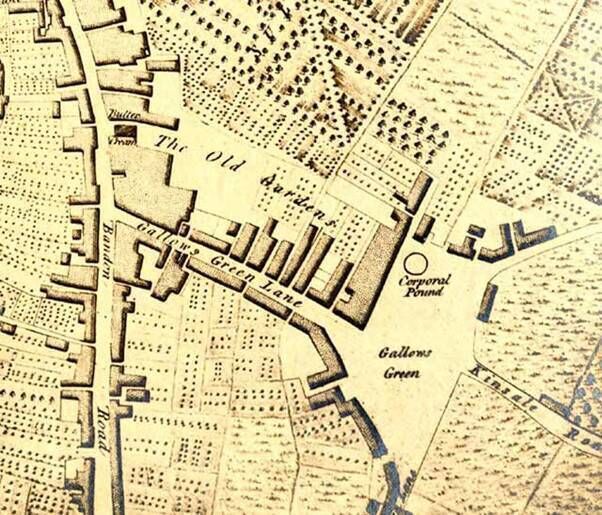
Flogging from the North Gate to the South Gate Bridge or through the streets to Gallows Green was almost a daily occurrence.
Executions were carried out in public, and the heads of the criminals were afterwards spiked on the North and South Gaols and were to be seen on the latter gaol up to the early part of the 19th century.
Public executions were also often carried out at Gallows Green, Broad Lane, (off North Main St where the entrance to St Francis’ Church/Car Park is situated today) Shandon St and Grand Parade.
The Hibernian Chronicle for 1773 gives us an interesting account regarding thieving from a shop on the south eastern end of North Main St, known as the Flags: Mr Nixon who keeps a hardware shop on the Flags, having frequently missed articles that were stolen out of his shop, made use of the following extraordinary method to discover the robber.
A glass case in which he keeps buckles, etc, being broken open on Wednesday night, and some articles taken thereout, he the night following procured a big rat-trap, in which he placed a pair of buckles as a bait, when the thief paid him a visit as usual, and endeavoured to steal the buckles, was caught fast by a finger in the trap, on which he was secured and conveyed before a magistrate, who committed him to jail, he was tried and convicted of the above crime, and ordered by the court to be whipped on three market days.
- CJF MacCarthy Files
- Cork City Library Files
- Cork City and County Archives Files
- Cork Historical and Archaeological Society Files





 App?
App?


