Nostalgia: The fascinating history of Sunday’s Well runs deep
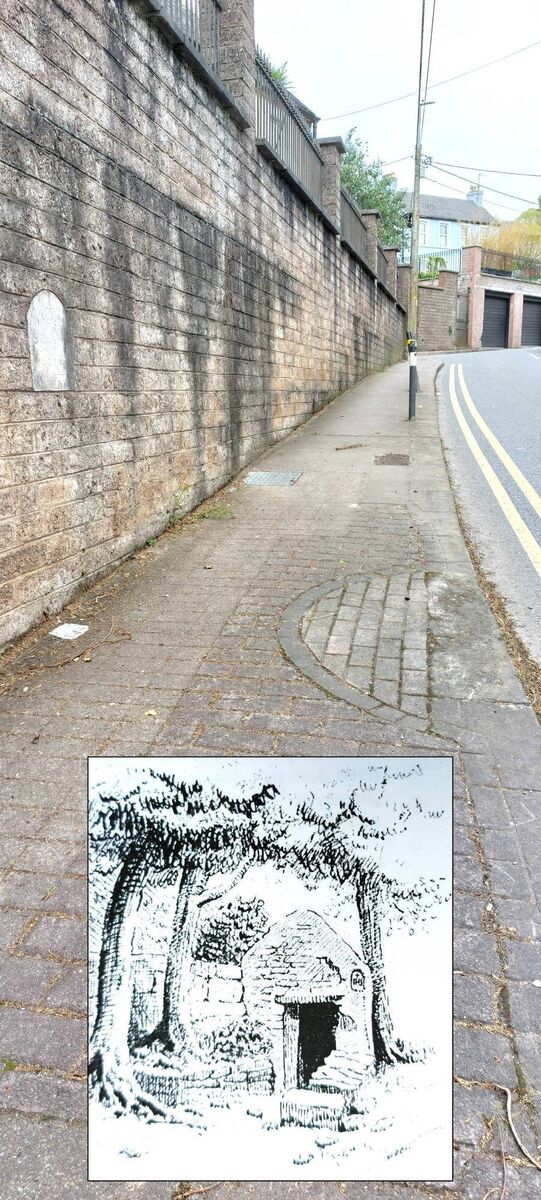
The well is still there today but arched over from public view.
Nostalgia: The fascinating history of Sunday’s Well runs deep

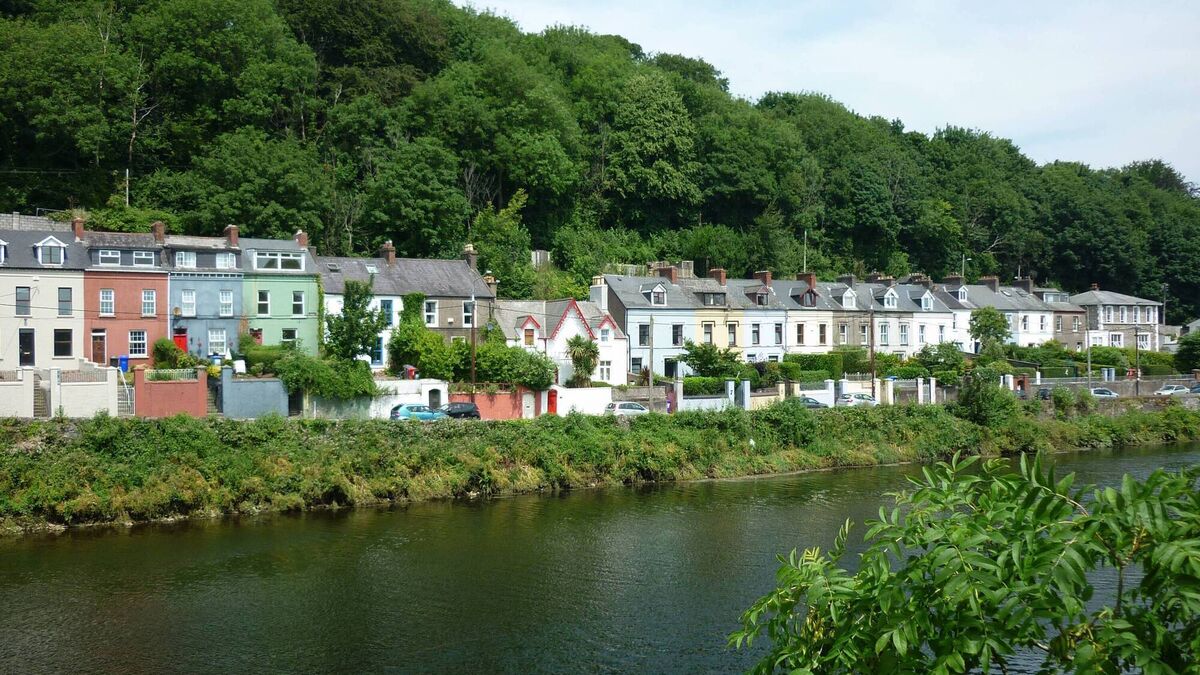
A beautiful terrace of houses on Sunday’s Well Road basking in summer sunshine with the rich thick foliage of the ancient Shanakiel woods in the background, taken from Thomas Davis Bridge. I remember as a young boy my friends and I would leave the North Mall, some of us with small hatchets in tow, to chop down branches from trees in Shanakiel woods for Bonfire Night. Then we’d drag them along Sunday’s Well, down Wise’s Hill and onto the North Mall. Many a car passing tooted their horns and gave us a big smile and wave – traffic was slow in those days. Photograph: Richard T. Cooke

IN medieval times reference is made to ‘The Ever-flowing Well’ and to ‘Sionnach-Coil’ (the Foxes’ Wood) both situated on a hill near Cork, and now identified with Sunday’s Well and Shanakiel respectively.

The adjacent eastern area was in early times called “Carrigeenaveigh” (the Little Rock of the Deer), anglicised as Buckstone, a name still surviving in the area. The Well is still there today but arched over from public view.
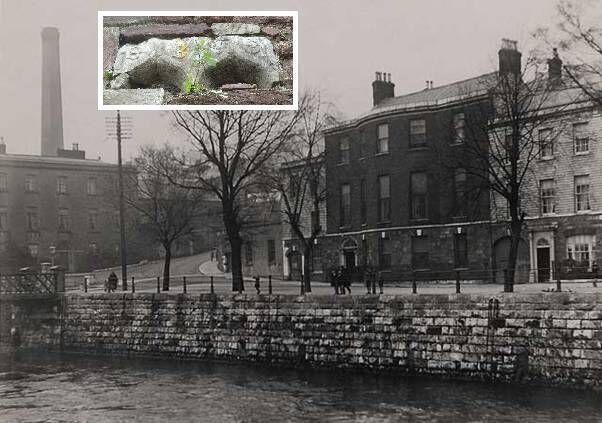
The junction of the North Mall and Wise's Hill, shows the former residence of the Distiller, Francis Wise who with his brother Thomas established a distillery on Reilly’s Marsh in 1779. In the background is the 19th century 160 ft high distillery stack. Adjacent to the house is the old distillery wall running up Wise’s Hill which is a remanet of the old red-sandstone wall and loading granary docks of the distillery. Photograph: Courtesy: Cork Camera Club Collection, Cork City Library Insert Photograph of ancient stone mullion: Richard T. Cooke.

It is one of those ancient wells that was held sacred by the Druids and people in pre-Christian days. The ancient spring has given Sunday’s Well its name, the Irish equivalent being ‘Tobar Rí an Domhnaigh’, meaning the Well of the King of Sunday.

It was a holy shrine in the form of a small circular structure, caped with stone, and shaded by an elm and two ash trees.

Early in the morning on summer Sundays one could see hooded devotees, with rosary beads, performing their ‘turrish’ or penance beside the Well, and various votive offerings were attached to the branches of the over-hanging trees, a custom prevalent in India and Africa.

Popular rendezvous

Today, as you walk along Sunday’s Well Road, you’ll notice on the pathway a half-moon shaped brick structure which marks the spot where the Holy Well is situated. On the left, on the wall is the original white limestone plaque that was located on the Well which reads 'Sundays Well 1644'. Photograph: Richard T. Cooke Insert: Sketch by Thomas Crofton Croker, taken from Seán Ó Coindealbháin, Holy Wells. JCHAS. 1946, p. 160.

The Well became a haunt for historians, writers, poets, and artists of the day visiting the lush peaceful wooded hill of Shanakiel and Sunday’s Well. In 1644 a French traveller, M. de La Boullaye La Gouz tells us, ‘the Irish believe this Well is blessed, and cures many ills.’

Dr Charles Smith in his writings for 1774 says its ‘a pretty hamlet, called Sunday’s well, lying on a rising ground, and commands a view of the city and river. Here is a cool refreshing water, which gives the name to the place, but it is hard, and does not lather with soap...’.

John Windele, who penned valuable history on Cork during his stay in Blair Castle (situated off Sunday’s Well Road) wrote in 1839: ‘It takes its name from one of those ancient fountains, which, long ere the Christian faith was preached in Ireland, was held sacred by its Druids and people.

The exertions of the first missionaries were ineffectual to prevent their worship, and they had to content themselves with diverting the popular devotion, and substituting objects of Christian reverence.

Sunday’s Well, in Irish, ‘Tobar Rí an Domhnaigh,’ ie the fountain of the Lord, is one of those converted shrines.’

Thomas Crofton-Croker who made a sketch of the well, tells us in 1845: ‘Sunday’s Well is at the side of the high road, and is surrounded by a rude, stone building, on a tablet on the wall of which the letters IHS mark its ancient reputation for sanctity. It is shadowed over by some fine old ash trees, which render it a picturesque object.’

Arched over

Seán Ó Coindealbháin in his writings tells us: ‘At the beginning of 1946 when the adjoining roadway was being widened and improved, it was necessary to remove the stone building covering the well and to run the road over the well.

However, to mark the site, the stone tablet bearing the inscription, ‘I.H.S., Sunday’s Well, 1644’, which had been on the building, was placed on the wall adjoining the road. ‘Rounds’ are no longer paid there.”

Shanakiel

After the Siege of Cork in 1690 many minds in the corporation as well as many wealthy merchants saw an opportunity to spread their wings, to get out of their cramped dark lanes and old tumbling down walled city. Soon the physical appearance of Cork began to change rapidly. With the reclamation of the ancient marshes the city began to spread and its population increased.

Quays were built and this saw trade and industry flourish and with that, merchants and business people began moving out of the old city to the fresh air of the countryside.

One of those was Timothy Conway who had a clockmakers business at No 3 North Main St. He acquired a holiday home in the wooded Shanakiel, where the grounds of old Shanakiel Hospital was (now the home of Quality Healthcare Ireland) and named it ‘Jemappes Cottage’. It became a meeting place for the United Irishmen of the city prior to the insurrection of 1798 and tradition tells us that the military leader of the time, Lord Edward Fitzgerald, narrowly escaped capture on one occasion when he visited the place.

Adjacent to the cottage was the Muggery Club — this clubhouse was a simple structure built over a ‘well’ of good water leaking from the original low-level city basin (reservoir). Here for the sum of a half-penny one could get a mug of water with a joke or compliment which made the ‘tilly’ more valuable than the water purchased. Shanakiel Hill had its famous ‘strawberry beds’, the price being 3d and for as many strawberries as one could eat while on the grounds.

Development

Sunday’s Well prided itself on exclusiveness and on its high society classification. To add to its grandeur, a new development was taking place in the early years of the 18th century – the construction of a new bridge, Wellington Bridge, now called Thomas Davis Bridge in 1830 and around this time the Wise brothers constructed Wise’s Hill. Later in 1927 Daly’s Bridge opened.

This new road system and traffic saw Sunday’s Well Lane become Sunday’s Well Road and this pleasant riverside resort hamlet soon developed into a suburb of some distinction as we know it today.

Sources: CJF MacCarthy Files, Cork City Library Files, Seán Ó Coindealbháin, Holy Wells, JCHAS. 1946 Cork City Council: Places of Cork-Sunday’s Well captions.

Read More

Tributes on Bishop Buckley’s 40th anniversary

More in this section

Diary of an autistic man in Cork Prison: 'I cried when you visited me' Diary of an autistic man in Cork Prison: 'I cried when you visited me'
No job losses or closures at our Cork hotels, says Blue Haven Group owner No job losses or closures at our Cork hotels, says Blue Haven Group owner
We need better roads, housing and transport options for our staff, says Cork Apple boss We need better roads, housing and transport options for our staff, says Cork Apple boss

Sponsored Content

Heads are turning for pharmacy investment property in the heart of buzzing Charleville Heads are turning for pharmacy investment property in the heart of buzzing Charleville
Charity places available for Cork City Marathon Charity places available for Cork City Marathon
Turning risk into reward: Top business risks in 2026 Turning risk into reward: Top business risks in 2026
Contact Us Cookie Policy Privacy Policy Terms and Conditions

© Examiner Echo Group Limited

Add Echolive.ie to your home screen - easy access to Cork news, views, sport and more