City centre 'not meeting full potential':Upstairs space is untapped resource
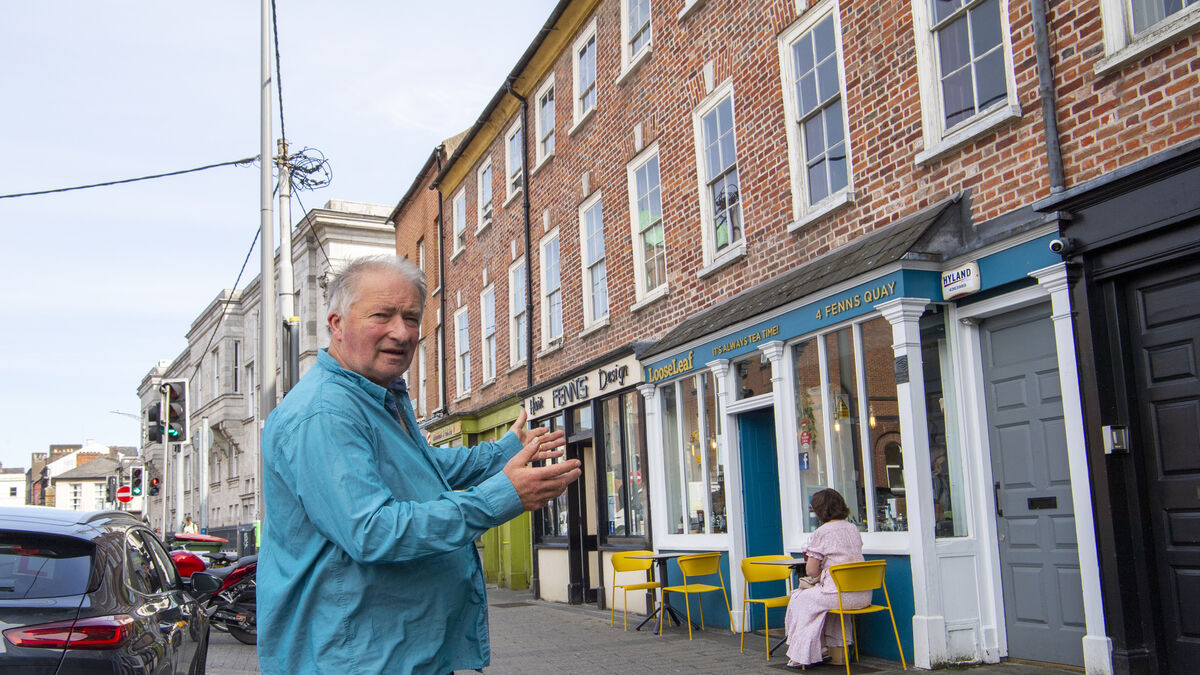
Chris Southgate, conservation consultant at Fenns Quay, Cork. Picture Dan Linehan
A number of schemes are available to property owners through both Cork councils, to incentivise renovation of upper-floor ‘above the shop’ spaces into accommodation, most notably the Repair and Lease Scheme.
Both Cork City and County Councils offer up to €60,000 upfront to property owners to refurbish vacant ‘above the shop’ units. The value of repairs is then offset against agreed rent in a long-term lease with the council, who will use the property for social housing.
However, as reported by this paper in June, there has been a disappointing uptake of the scheme by Cork property owners.
Independent Cork County councillor Ben Dalton O’Sullivan proposed a motion in June for the council to further promote the Repair and Lease Scheme.
“When you go into county towns like Midleton, Youghal, or Carrigaline and you look up above the shops, there’s buckets of empty spaces,” Mr Dalton O’Sullivan said.
“I would say 70% of the problem is awareness,” he added, as he continues to call for greater promotion of the scheme to property owners.
Green Party city councillor Dan Boyle said that successive schemes haven’t taken off because they haven’t lasted long enough or haven’t offered enough of an incentive.
“There’s been a number of schemes since the 1990s, and while there’s an initial good take-up, these sorts of schemes have a limited timeframe, and they’ve never really been refined enough to see how they work better, on a more long-term basis,” Mr Boyle said.
“I think they’re too unambitious in what they’re doing. They’re there to give a policy response to something that needs to be done, but not being backed up with sufficient resources to allow them to gain critical mass,” he said.
John Murray, director of Sherry Fitzgerald Lettings in Cork, said that the problem is the inertia of the shop owners that have upstairs space.
“A shopkeeper might be operating fine using rooms upstairs for storage or maybe as an office, and too busy working seven days a week to take the opportunity to sit back and think, ‘Okay, I could do it’…. Maybe they need someone to present it to them that a one-bed apartment in Cork City centre is going to make anything from €1,000 to €1,500 a month, and that store room that’s never used could be converted and bring you a rental income,” Mr Murray said.
While every property refurbishment project is different, Mr Murray estimates that converting upper floors into rented accommodation could make a return in as little as three to five years, and with funding of up to €60,000 available through the Repair and Lease Scheme, there’s “no reason” not to redevelop above the shop.
“I would love to see every shop and pub that’s wasting space upstairs storing boxes and rubbish that they’ve kept for 20 years moving it out, redeveloping, and renting out,” he said, adding that agents such as Sherry Fitzgerald are equipped to handle every step of the process on property owners’ behalf, from renovations to managing tenancies.
Conforming to building refurbishment regulations when dealing with old buildings, many without a separate entrance to ‘above the shop’ accommodation, can prove difficult and expensive.
Robin Knox, a fire-and-building regulations consultant who has worked on many heritage projects in Cork, said that trying to meet strict regulations when renovating an older building can be a “major stumbling block” for ‘above the shop’ living.
Mr Knox said that for protected or listed structures, of which there are many in Cork City, there is an acceptance that the structure cannot be altered to meet every modern regulation, and that compensatory measures can be used to bring that building back into use.
However, for older buildings that don’t quite meet the threshold of protected or listed, ‘above the shop’ renovations can be prevented by overly prescriptive regulations.
Mr Knox said that focusing regulation on making a building reasonably safe by using modern technology could be a solution to the regulatory stumbling block.
“A lot of modern advances can be put to good use to improve the standard of accommodation in these over-the-shop situations. No building is 100% safe, but one can make those building safe, or as safe as practically possible,” he said.






 App?
App?


