Cork research leads to cancer treatment trial with lithium

The first patients have been recruited for a trial in Cork. 
Cork research leads to cancer treatment trial with lithium

Prof Seamus O’Reilly and Dr Tracey O'Donovan working in the Western Gateway Building, UCC.

A clinical trial is underway in Cork into a potential treatment option for oesophageal, colorectal, and other gastrointestinal cancers that are resistant to traditional chemotherapy treatment, following ground-breaking research completed here.

Researchers at Breakthrough Cancer Research, University College Cork (UCC) and Cork University Hospital (CUH) have announced that they have undertaken exciting new cancer research that has unlocked why some cancers are drug-resistant, which has led to the development of a new lithium-enhanced chemotherapy treatment.

The research, which was funded by Breakthrough Cancer Research and led by Dr Sharon McKenna at UCC, has found that adding lithium to the chemotherapy regime blocks the cancer cell’s ability to repair the internal damage normally inflicted by chemotherapy.

The researchers say this makes the chemotherapy more effective and reduces the risk of cancer returning.

Lithium has been used before as a mood stabiliser in the treatment of neurological disorders but not in chemotherapy, so this is a novel concept.

Trial to look at safety of treatment 

During the clinical trial, which has just enrolled its first few patients in Cork, the research team will be monitoring the safety of combining lithium with standard chemotherapy, over a range of doses.

It will also establish how well lithium works in combination with oxaliplatin and capecitabine to treat patients with advanced oesophagogastric or colorectal cancer.

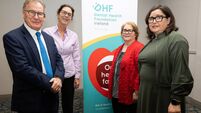
Orla Dolan, Chief Executive Breakthrough Cancer Research, Prof Seamus O’Reilly, Dr Tracey O'Donovan and Dr Sharon McKenna working in the Western Gateway Building, UCC.

Breakthrough had invested over €1m in funding to researchers at UCC so they could explore how cancer cells that responded to chemotherapy were different from those that did not.

They identified that a cell recycling process called autophagy (self-eating), which enabled the cells to repair themselves and recover, and found that lithium blocks this ability to repair, which greatly enhances the effectiveness of the chemotherapy treatment.

The discovery was made when Dr Tracey O’Donovan, one of the lead scientists working with Dr McKenna, principal investigator at Cancer Research at UCC, set up a series of tests with cells from patients with oesophageal cancer.

The results were far more impressive than any combination they had seen before as the combined chemo-lithium therapy killed off the chemoresistant cancer cells and prevented them from returning.

“We tested this new chemo-lithium combination in several pre-clinical models and found that tumours were being cleared much more effectively than single-agent treatments,” said Dr O’Donovan.

Trial to be led by Cork oncologist 

Consultant oncologist Professor Seamus O’Reilly, based at CUH and Mercy University Hospital, has agreed to lead the clinical trials following the research.

Prof O’Reilly said that more and more patients are being diagnosed with cancer in Ireland on a daily basis and that their lives needed to be extended.

“The most difficult part of my job is seeing patients you think are going to respond well to treatment do badly,” he said. “People whose lives should have been longer, whose cancer should have been cured, or whose suffering should have been less.

“Patients don’t fail treatments but treatments sadly do fail patients. We urgently need treatment advances to cure more people and to help those that can’t be cured to live longer and better.

“That can only be found by investing in groundbreaking cancer research, so I hope people continue to support charities like Breakthrough Cancer Research who help make research like this happen.

“Many new cancer drug treatments are expensive, limiting their impact as societies and patients struggle to afford them. Lithium is cheap, widely available, and as a result of this study, if positive, could be globally accessible,” he said.

more Cork health articles

Cork University Hospital restricts visits amid ‘unprecedented surge’ in norovirus cases Cork University Hospital restricts visits amid ‘unprecedented surge’ in norovirus cases
Last residents from flooded East Cork mental health centre move into new homes Last residents from flooded East Cork mental health centre move into new homes
Visitor restrictions in place at Cork University Hospital due to norovirus risk Visitor restrictions in place at Cork University Hospital due to norovirus risk

More in this section

Mary Crilly to retire from Sexual Violence Centre Cork but says she will continue campaigning  Mary Crilly to retire from Sexual Violence Centre Cork but says she will continue campaigning 
Cork's Father O’Leary Memorial Hall to be acquired by State body Cork's Father O’Leary Memorial Hall to be acquired by State body
Sloppy Winter Snow Ice and Road Salt on Car Exterior Met Éireann issues snow and ice alert for Cork as entire country under at least one warning

Sponsored Content

The power of the G licence The power of the G licence
Happy couple receiving new house keys from real estate agent Time to get to grips with changes in rental laws
Boatbuilder turned engineer proves alternative paths can lead to success Boatbuilder turned engineer proves alternative paths can lead to success
Contact Us Cookie Policy Privacy Policy Terms and Conditions

© Examiner Echo Group Limited

Add Echolive.ie to your home screen - easy access to Cork news, views, sport and more