UCC team delivers sustainable education amid civil unrest in Honduras
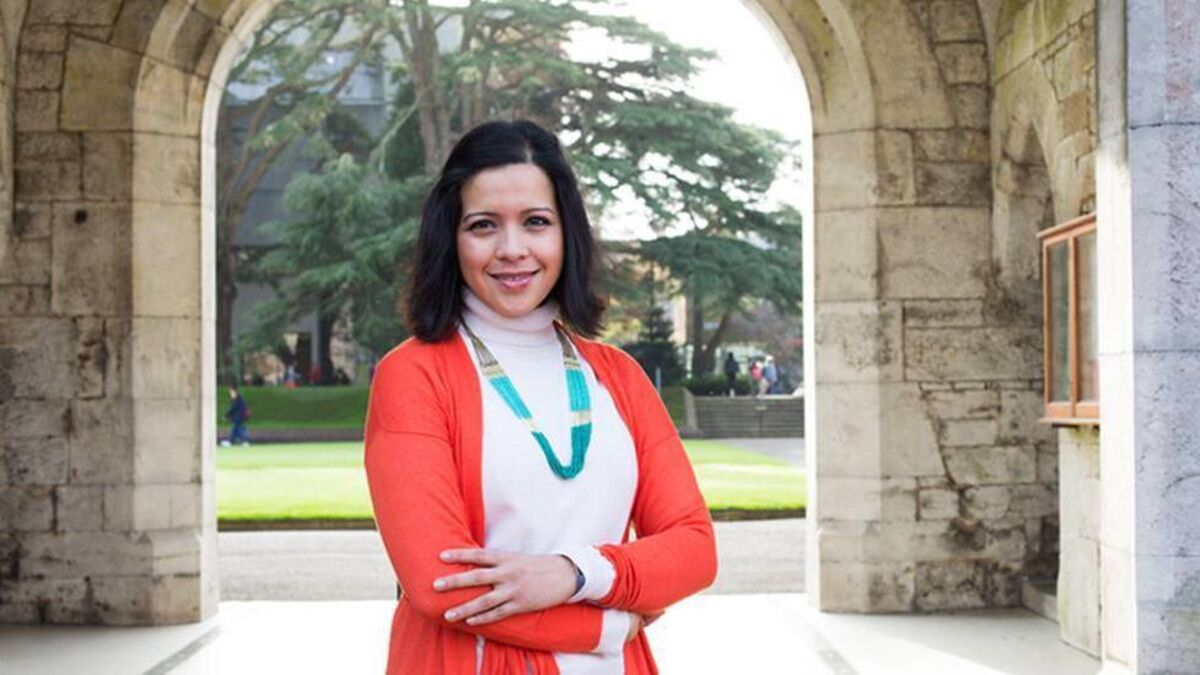
Yensi Flores Bueso - free to use, picture credit Clare Keogh.
A TEAM of UCC academics who worked on a sustainable education project for Honduran children is hoping it could form a template for similar projects in other poor countries.
The project began after UCC PhD student Yensi Flores Bueso began to focus on how to help her alma mater, the National University of Honduras.
She came to UCC from her impoverished home country on a scholarship though the Academic Mobility and Inclusive Development of Latin America (AMIDILA) Erasmus Mundus project. During her studies in cancer research at UCC, she became aware of the potential of the engineering of biological systems to create useful products.
Convinced such products could be useful in developing countries like Honduras, she turned to CancerResearch@UCC and APC Microbiome Ireland to source surplus molecular biology lab equipment and consumables. She also enlisted Fyffes plc who delivered the equipment to her alma mater, and covered the cost.
She was disillusioned to discover on a subsequent trip home that the equipment had not been used because there was a lack of awareness on the importance of performing scientific studies.
Yensi’s PhD supervisor in UCC, Dr Mark Tangney, said: “Yensi’s extensive engagement and feasibility assessment with locals made us realise that what we needed to do was design a strategy that would seed relevant teaching and learning in Honduras, in a manner that would become sustainable locally, via development of a self-perpetuating course.”
A grant was applied for through the EU Erasmus + International Credit Mobility (ICM) fund for training at the UNAH.
A UCC spokesman said: “The resulting scheme included the delivery of a short and intensive hands-on course at UNAH. Yensi and three other researchers from Mark’s lab – Sidney Walker (APC Microbiome Ireland-funded), Ciarán Devoy and Stephen Buckley – travelled to Honduras and delivered the course to 20 participants spanning UNAH students, lecturers, researchers and officials from the Honduran health and biodiversity government offices.”
During the training, students and instructors were caught up in protests in the area, becoming covered in tear gas when riot police were firing at protestors.
The UCC spokesman added: “Graduates of the course were supplied with reproducible teaching and laboratory materials so that they in turn can go and teach the course to others, which is now happening both in Honduras and other Latin American countries. These participants are now leading innovative SynBio projects aimed at fostering research, innovation and/or protecting biodiversity. While the receipt of laboratory equipment proved of no value in isolation, the subsequent training of the course participants in how to use the equipment and for what it is useful, unlocked its value.”


 App?
App?


