Looking back on the birth of the Irish Navy ahead of 80th anniversary
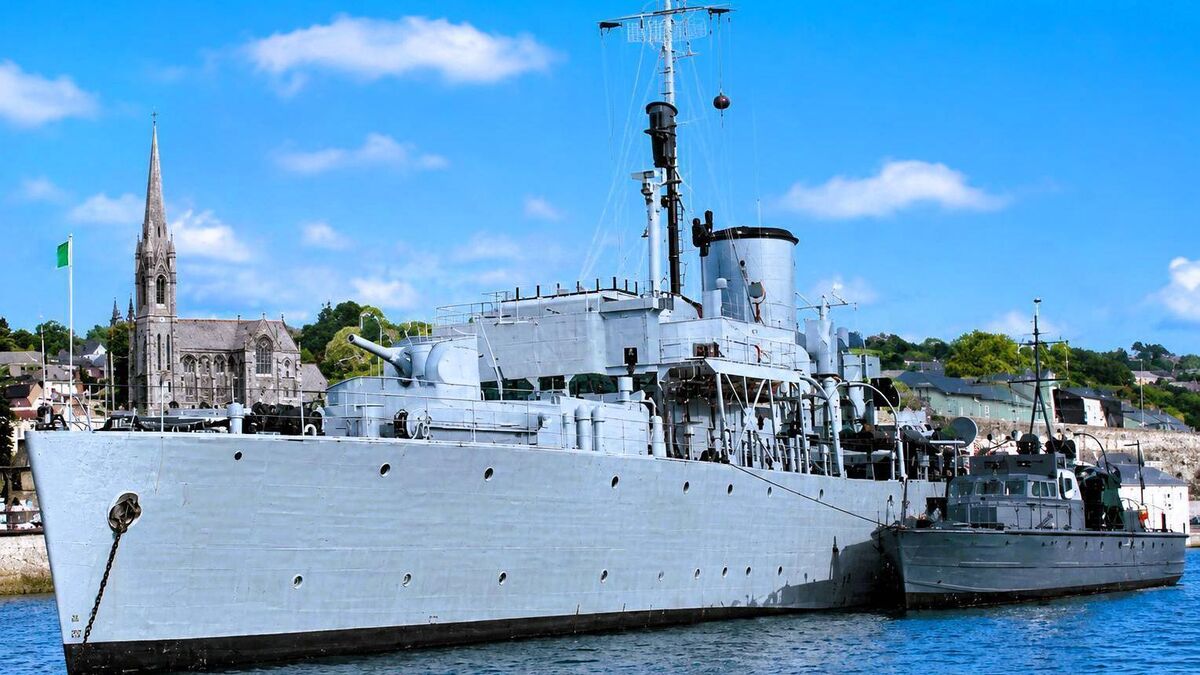
The LÉ Macha arrives at Cobh, accompanied on the last leg of its voyage by an Irish Motor Torpedo Boat., on November 18, 1946
The acclaimed British novelist, Nicholas Montserrat, in his semi-autobiographical book The Cruel Sea (later made into a film starring Jack Hawkins and Virginia McKenna) was among the first to bring the story of the doughty little war-time ships known as ‘corvettes’ to a wider audience.
The author, son of a famous Harley Street surgeon and himself a former Lieutenant Commander in the Royal Navy, had commanded no less than three of the unglamorous, but feisty, vessels on North Atlantic convoys during World War II, so knew at first-hand what he was writing about.
The book captures the brutal reality of naval warfare, where ‘ordinary’ men faced freezing weather , the constant threat of Nazi U-boats, and agonizing moral decisions.
The sea - the ‘cruel’ sea - posed as much of a threat to their continued existence as the enemy itself.
But Montserrat is also remembered in this country for something else: his rabid anti-Irish broadsides. Still bristling from Ireland’s neutrality during the war, he expressed bitter resentment at the Government’s stance, arguing that denying Britain the use of the ‘Treaty’ ports forced escort ships to travel hundreds of extra miles, thus leaving convoys highly vulnerable to U-boat, and air, attack.
Famously, he compared the blacked-out, blitzed British towns and cities with Ireland’s brightly-lit ones, suggesting the country was a shameless ‘free rider’, enjoying the tacit protection of the Allies while not making the slightest contribution to the war on Nazism.
With the passage of time we may now, perhaps, understand Montserrat’s first flush of anger in a more balanced way as, 70-odd years’ ago, he would not be have been in possession of all the facts,
Undoubtedly, we continue to admire his masterful, graphic, technically-correct writing that grabs our attention and deposits us, dressed in duffle-coat and steel helmet, lashed by raging seas and howling gales, on the open bridge of a heaving, wartime corvette.
His earlier anthology of true-experience stories (published during the war) was called Three Corvettes, depicting life aboard the vital little ships.
And, ironically, it was three such vessels , so fondly eulogized by Montserrat, that became the workhorses of Ireland’s Naval Service when it was launched on September 1, 1946.
******
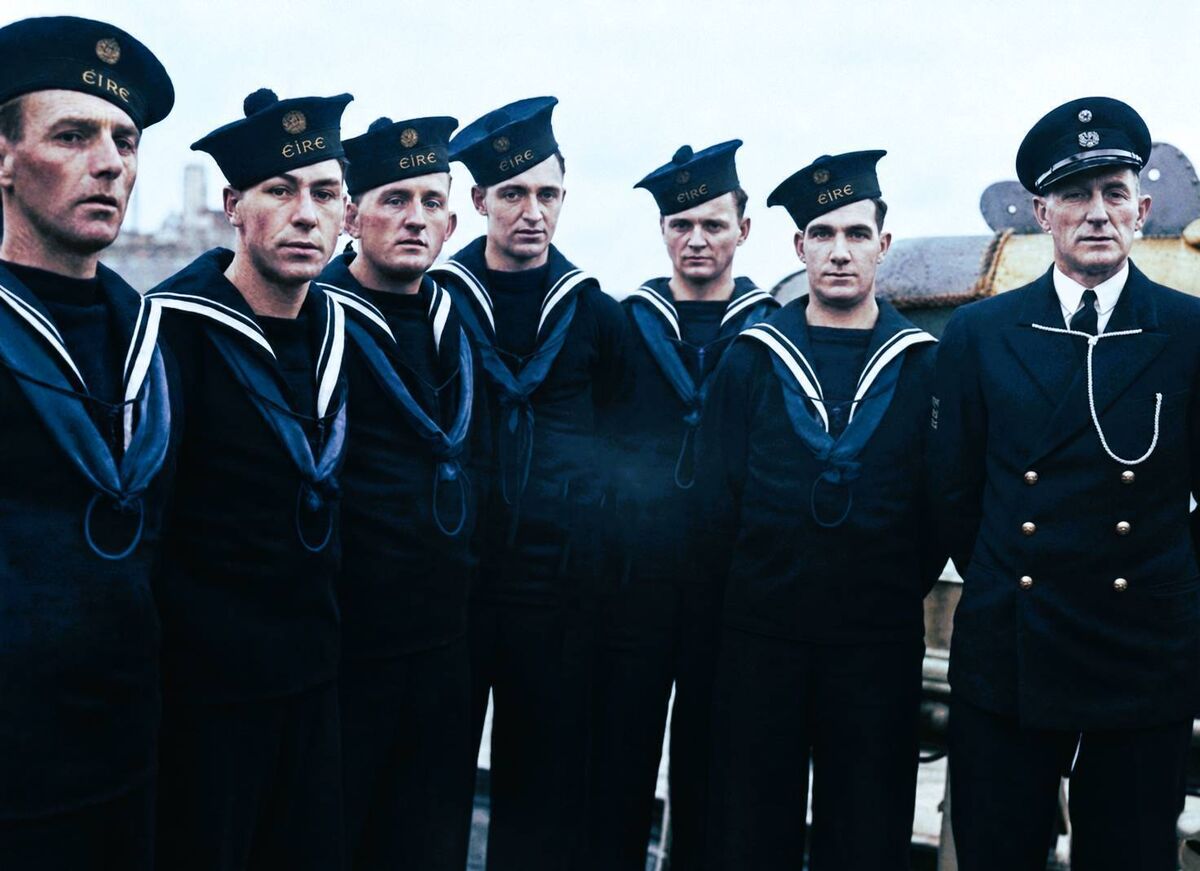
The foundation of the Irish Naval Service 80 years ago marked a decisive moment in the consolidation of Ireland’s maritime defence and sovereignty in the aftermath of World War II.
Although Ireland had maintained only a modest Marine Service in the Emergency years, the war had demonstrated beyond doubt the strategic vulnerability of the Irish coastline and the vital importance of safeguarding maritime approaches, fisheries, and communications. The creation of a fully constituted naval arm was therefore not merely a bureaucratic reorganisation, but a reflection of a maturing state prepared to assume greater responsibility for its maritime destiny.
At the heart of this new organisation stood its first commander, Captain Henry J. A. S. Jerome, who came to the Irish Naval Service with an impressive CV. Although born in the U.S, he gravitated towards the British Navy’s traditional training pathway. Graduating in 1917 from Dartmouth Naval College as a Midshipman, he saw service in World War I on board HMS Courageous.
His early career took him through the usual pattern of junior officer duties, gunnery training, and sea appointments on cruisers and destroyers of the inter-war fleet. For a time he was seconded to the Submarine Service, and by 1931 he was senior Lieutenant Commander on the cruiser HMS Enterprise on station in the East Indies. For three years, from 1936, he was loaned to the South African Naval Service.
During World War II, he held a series of increasingly demanding commands, including destroyers engaged in escort work in the North Atlantic and in November, 1942, was awarded the Distinguished Service Order (DSO) for ‘bravery and dauntless resolution’ in the face of constant enemy attack.
He earned a reputation for calm handling under pressure, a deep understanding of anti-submarine warfare, and a talent for organisation - qualities the Irish authorities valued highly when selecting a suitable figure to build a modern naval service almost from scratch.
Jerome’s experience brought professionalism, discipline, and a strong sense of technical rigour to the nascent force. The symbolism that came with his appointment was not lost on some. In 1776, an Irishman, John Barry, was commissioned Captain in the Continental Navy and would come to be known as the ‘Father of the United States Navy’.
Now, some 170 years later, an American was chosen to head up the Naval Service of an independent and sovereign Irish state.
******
The acquisition of the first seagoing ships of the new service underscored the seriousness of the Irish Government’s intentions.
In 1946, three Flower-class corvettes - veterans of the bitter Battle of the Atlantic - were purchased from the British Admiralty. Although no longer frontline units for a post-war Royal Navy, they were robust, proven, and well suited to patrol and fishery protection duties.
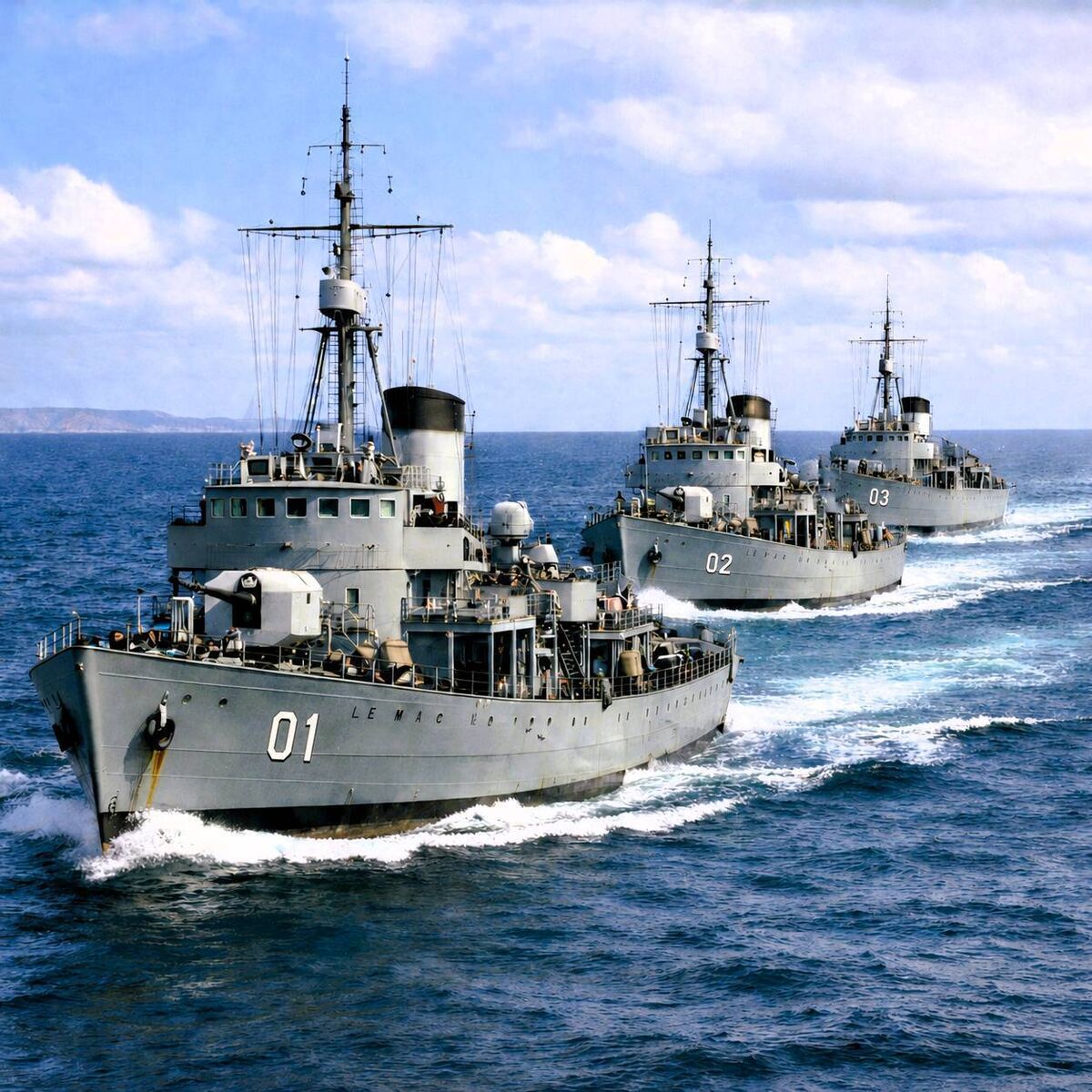
Their arrival would place the new Naval Service on a firm operational footing. The wartime histories of the three ships deserve attention, for they reveal the intensity of the tasks that shaped the ships Ireland had received.
The ‘Flower-class’ corvette (as the name suggests, each was named after a flower or plant) had been conceived in the crisis of 1939-40, when German U-boats threatened to sever Britain’s maritime lifelines.
Designed for rapid construction in small shipyards, these compact vessels - barely 205ft in length - became the backbone of Allied convoy escort forces. Their hull form, based loosely on that of a whaling ship, gave them distinctive lines and admirable seaworthiness, though at the cost of uncomfortable motion in heavy seas.
Their crews frequently endured brutal North Atlantic weather with decks awash, galleys drenched, and engines labouring against the swell. Each corvette was armed with a 4inch naval gun, an array of machine guns and depth charges., and was capable of 16 knots.
******
The first ship to be acquired was HMS Borage, renamed LÉ Macha by the Irish authorities. (LÉ stands for ‘Long Éireannach’, or ‘Irish Ship’. The three corvettes were named after legendary Irish queens).
It was built by George Brown and Co, of Greenock, Scotland, and completed on April 29, 1942. following which it performed duties on Arctic convoy escort routes. It was involved in numerous anti-submarine sweeps, protecting merchantmen carrying food, munitions, and vital raw materials. In 1943 and early 1944 it was assigned to Gibraltar, South and North Atlantic (outbound and homebound) convoy duties, operated with several escort groups, and took part in the defence of convoys under intense U-boat pressure.
Reports from its wartime service note several occasions on which it conducted depth-charge attacks against suspected submarine contacts and rescued survivors from torpedoed ships.
Through its efforts, and those of the escort groups it served with, countless merchant sailors reached port who might otherwise have perished. In three years, it helped guard more than 50 convoys, of which just two ships were damaged, and none was lost. In December, 1943, it was part of convoy JW 55B which was subjected to attack but resulted in the loss of the German battleship KMS Scharnhorst.
In 1946, Lt Commander Tom McKenna, OC Naval Base, travelled to the Royal Naval Dockyard at Devonport, near Plymouth, to inspect the newly-purchased ships and to make final arrangements for their commissioning. He was not impressed by what he found. Due to some civil-service speak being ‘lost in translation’ between the bean-counters in Parkgate Street and Whitehall, the Irish thought they were getting fairly pristine vessels for their £210,000 (for three ships); the British, on the other hand, regarded this bargain-basement price as meaning the vessels would be sold ‘as is’.
The hand-over was scheduled for November 15, 1946, and Lt Walter Reidy (ship’s master), accompanied by Lt T.P. Barry, Sub Lt C. Byrne, Ensign J.B. Flannery, Warrant Officers P. Devitt and T. Aslop and a ship’s company of 24 arrived at Devonport unsure of what to expect.
They needn’t have worried. All went exceedingly well, the ‘Brotherhood of the Sea’ smoothing things over, and the Royal Navy putting on an impressive ceremony with the C-in-C, Plymouth Command, leading proceedings in person.
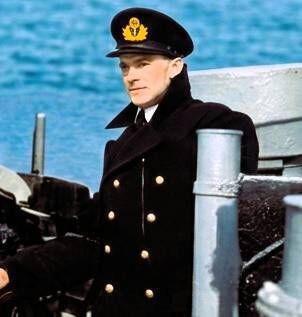
Representing the Irish Government was Mr John Dulanty, High Commissioner. The blessing and renaming of the ship took place conducted by Dom Steat Ellis, OSB (formerly of Glenstal Abbey) and Rev Donal Donovan, a native of Mallow, both of whom were serving in Plymouth.
The voyage to Haulbowline, which took 21 hours, was not easy; rough seas and gale force winds challenged Reidy’s excellent seamanship in the unfamiliar vessel. Both he and Macha came through their first outing together with flying colours. (Reidy was also delegated to command the remaining two corvettes on their trips from Plymouth to Haulbowline).
A small number of specialist Royal Navy personnel accompanied the ship to Ireland where they remained for several months, imparting their knowledge to their Irish counterparts.
In September, 1948, Lieut Commander Thompson, in its first important overseas undertaking, was tasked with repatriating the remains of the acclaimed Irish poet William Butler Yeats from Nice, France, to Galway.
Macha was sold for scrap in November, 1970.
HMS Oxlip (LÉ Maev) had a parallel wartime trajectory. Laid down by the firm of A & J Inglis of Glasgow, Scotland, it was completed on December 28, 1941. It, too, was assigned to the gruelling mid-Atlantic run. Its convoy logs record winter crossings with mountainous seas, frozen rigging, and constant vigilance against surfaced U-boats attempting night attacks.
On many occasions, it assisted in screening the convoy while other escorts prosecuted submarine contacts. It contributed to the gradual turning of the tide in the Atlantic as Allied escort training, radar, and air cover improved.
From February, 1942, Oxlip served with ‘close escort’ groups on Arctic convoys, taking war matériel from the western Allies to their Soviet counterparts. In three years, Oxlip travelled with 18 Arctic convoys (outbound and homebound) ensuring the safe arrival of over 300 merchant ships.
Like HMS Borage, it proved hardy and reliable, attributes that would serve Ireland well in peacetime patrol work. It was officially handed over at Devonport on December 20, 1946.
In 1972, LÉ Maev was sold for scrap.
The third ship, HMS Bellwort (LÉ Cliona), like HMS Borage, was built by George Brown and Co of Greenock. Launched in 1941, it served with ‘close escort’ groups on South Atlantic convoys, being stationed at Freetown, Sierra Leone.
In three years, Bellwort sailed with 42 trade convoys (outbound and homebound) contributing to the safe and timely arrival of more than 800 merchant ships.
In April, 1943, it was in the thick of the action when Convoy TS 37 came under attack, and seven Allied ships were lost in one night. Its wartime record included rescue work and reinforcement duties, reflecting the versatility for which the Flower-class became renowned.
It was commissioned into the Irish Naval Service on February 3, 1947.
On May 29, 1962, LÉ Cliona was participating in an exercise south of Roche’s Point. The ship had initially carried out a successful ‘hedgehog’ mortar shoot, but during the second pattern of depth charges it suffered a premature explosion, resulting in the stern of the vessel being lifted out of the water and the concussion rupturing fuel oil feed pipes in the after-boiler room.
The leaking oil led to a serious fire which rapidly accelerated out of control. Stoker William Mynes quickly closed the feed valves, isolating the supply of fuel, and was joined by Lieut Pat O’Mahony. The fire was fought for over 30 minutes before being brought under control. Although the ocean-going tug Clonmel was tasked to the scene, Cliona was able to proceed under its own steam back to Haulbowline. The crew members were later commended for their firefighting valour.
On November 4, 1970, LÉ Cliona was removed to Haulbowline Industries, Passage West, and scrapped.
******
In retrospect, the foundation of the Irish Naval Service in 1946 stands as a significant milestone in the state’s development. Yet, the importance of the formation is more critical today than ever.
As an island nation, Ireland’s sprawling maritime domain serves as a key frontier for the EU. The service acts as a vital shield against multi-million euro drug smuggling cartels, while simultaneously tracking foreign warships ill-disposed toward Western stability. Furthermore, it safeguards vulnerable subsea data cables that power global internet traffic.
However, the vision of its 1946 founders remains, I believe, largely unfulfilled. Successive Irish governments have fundamentally ‘turned their backs on the sea’, treating maritime defence as an afterthought. Shielded by a historical policy of military neutrality, political leaders have denied the service adequate investment.
This chronic neglect has triggered severe recruitment and retention crises, forcing advanced ships to sit idle in port due to lack of personnel.
For a nation deeply dependent on secure maritime trade and digital infrastructure, leaving its sovereign waters critically under-resourced is a dangerous anomaly that threatens both Irish and European collective security.
Simply put, as Ronnie Drew observed:
‘We are a seafaring nation,
Defence of our land is a right…’
Postscript: The last remaining Flower-class corvette in the world is HMCS Sackville, preserved as a museum ship at Canada’s Maritime Museum of the Atlantic at Halifax, Nova Scotia.






 App?
App?


