Inside the student-led food hub at UCC  redistributing more than 700kg of food each week 

KATE RYAN pays a visit to a student-led food pantry at UCC and meets some of those involved in the initiative to find out more about how it works. 
Inside the student-led food hub at UCC  redistributing more than 700kg of food each week 

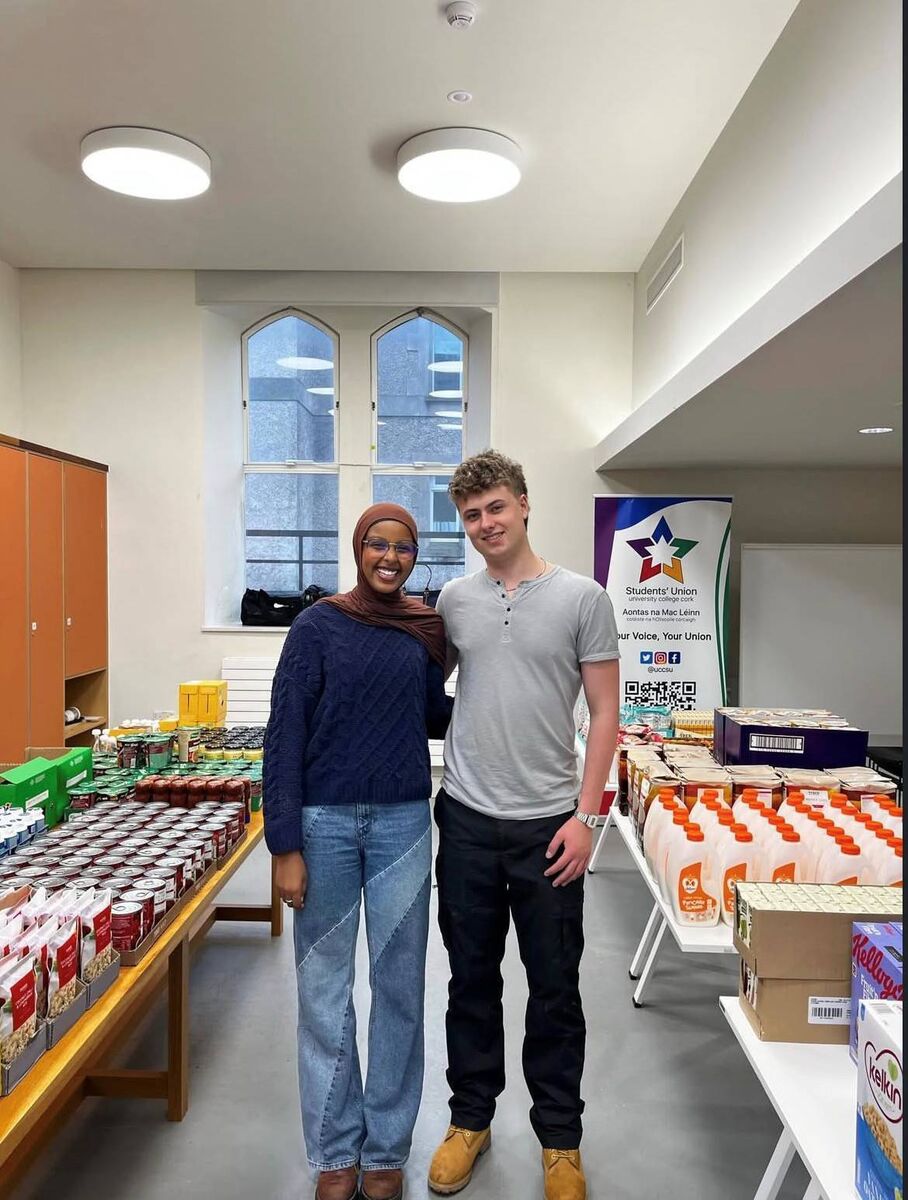
Cian and Sumaya at the UCCSU Food Pantry. Picture: Claire Keogh

It’s a bright, warm spring morning. Strolling past UCC’s iconic Aula Maxima, the quad is alive with the usual hubbub of student life.
The university’s student community is a microcosm of life outside these storied walls of the main campus. Young students rushing between lectures and library sessions mix with those celebrating PhD conferrals, decades of life in the achievement.

Flyers announce happenings, both cool and weird, hosted by any number of societies. Cork accents mingle with those from further afield, all here busy, laying the groundwork for their future.

It is this hedonistic side of student life that makes even seasoned heads like me wonder if I have another rodeo left in me, (I don’t, but I can still imagine). There is also another, much less hedonistic, side. One that is about the very real life challenge of juggling long intense hours of study and part-time work to cover bills, with just enough left over to enjoy something of the student experience.

In 2024, against a backdrop of rising rents and stagnated grants, UCC conducted a cost of living survey to understand where the pinch points were for students. In response, 27% said they were actively cutting back on food purchases, at a time in their lives when food is never more essential for fuelling both mind and body.

That same 2024 survey also showed a demand among students for meaningful ways to engage with climate action. A seed of an idea was planted: What if students could take climate action by connecting with a student-run service redistributing would-be food waste?

All of which leads me to here, walking towards The Maker Space at The Hub in the middle of UCC’s main campus.

Inside, a small team of students is working away, unpacking food sourced from food redistribution charity, FoodCloud. The room is airy and bright with large windows allowing the warm spring sunshine to flood in; a playlist is in full flow.

Were it not for the rows of tables with food meticulously laid out, you might not realise this is the UCC Student Union Food Pantry. Readying to open for their weekly food drive created by and for students, the atmosphere is collegiate in the truest sense – students working together for their fellow students.

Sumaya and Cian at the Pantry. Picture: Cian Walsh.jpg

The Pantry is open weekly, every Monday. Students purchase a €3 ticket for entry to the Pantry where they can browse the goods on offer at their own pace and make their own food choices from the selection available on the day.
Identifying a need for a student-supported food hub, Food Pantry was launched in 2025 by UCC students Cian Walsh and Sumaya Mohammed, both serving as Environmental and Sustainability reps at their Students’ Union.

“University campuses are uniquely placed to move food at a high volume and at a fast rate,” says Cian. “FoodCloud has three warehouses and, up until last year, Cork was the only one not connected to a student pantry. That was a huge motivator,” he says.

Having spent time volunteering with FoodCloud, Cian understood the environmental and social impact partnering with them could have. It also meant action on food and climate could be achieved through one solution: an on-campus student pantry. A perfect win-win scenario.

Ireland has a serious food waste problem with 835,000 tonnes of food going to waste every year and a major source of emissions. FoodCloud saves food that is good to eat but destined for landfill by redirecting it to one of three hubs – including their Cork base at Little Island. Food is then redistributed to community groups, charities and hubs who use it to support the needs of their service users.

My visit to Food Pantry coincided with International Zero Waste Day, highlighting one of the Pantry’s core values of reducing food waste. Every week, the Pantry will shift around 700kgs of food in a 1.5 hour window. Cian was right – universities are well placed to shift lots of food quickly.

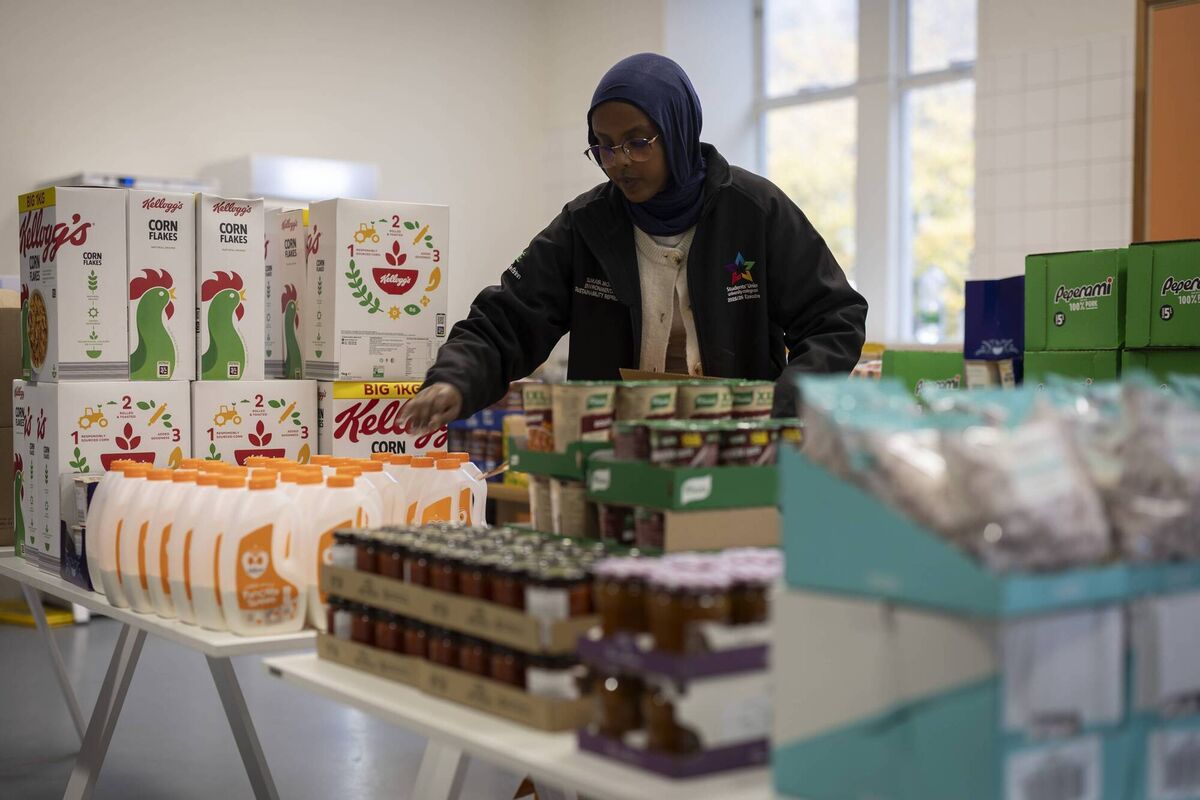
Sumaya’s team set up a traffic light system across the rows of food-laden tables. One item of each from the red table; two of each from the yellow table, and as many as you like from the green table. A fridge is filled with heat-and-eat soups, and today’s freezer item is air fryer chicken goujons.

Sumaya explains that most of the food in the Pantry consists of shelf-stable items that can be stored in a dorm room, or easy to prepare in a microwave, oven, or air fryer. Picture: Claire Keogh

“Most are shelf-stable foods that can be stored in a dorm room, or easy to prepare in a microwave, oven, or air fryer,” explains Sumaya.

Of course, it would be great to see fresh fruits and vegetables on offer, but student life is busy, access to a kitchen and equipment is not always guaranteed, and filling the belly is the primary objective.

The colour coding system is essential as some items are always more popular than others, but supply doesn’t always follow demand in this regard. Applying a few strategic nudges around selection ensures greater choice available for all students – not just the ones that arrive first.

“What the Pantry provides is agency to students to pick out what foods that they want the most,” says Cian. “The Pantry is designed to be a feelgood space; somewhere students can pick and choose the items that they want.”

Before this version of the pantry was launched, Cian and Sumaya led a pilot project which showed that there was demand.

“When we launched in October, we redistributed 460kg of food per week. Now, we regularly move 700-800kg of food per week with around 200 people using the service. Tickets go on sale every Tuesday and they usually all sell out,” says Sumaya.

“We don’t always know what we’re going to get until it arrives from FoodCloud,” she says.

“When we’re setting up on Monday morning, we see people staring in the windows to see what we have in! We open from 1.30pm until 3pm; there’s always a rush at the beginning, it quietens a bit, and picks up again as people finish lectures.

“We never want anything left over so, after we close, anyone who didn’t get a ticket can come in and pick from whatever is left.”

Cian, Sumaya, and all the volunteers are committed to freeing a service like this from any negative association. It is categorically not a food bank. It is a student pantry, and all are welcome without judgment.

By reframing perception around the Pantry, it has become a social space for students as well. Sometimes, housemates will come to together and select items for a house meal or use the space as a meeting place to catch up with friends.

“[The Pantry is] very sustainability-focused because we want students to feel like they’re doing something good, like they’re doing us a favour by taking the food,” says Cian.

“You shouldn’t have any students that are choosing between studying and eating, but there are students that come every week,” Cian says. “From research we did following the pilot run, about 77% of students said they would like to avail of the service every week.”

As well as partnering with FoodCloud, the Pantry’s other major support is UCC’s Alumni Fund.

Matt Hamilton is Head of Transformational Philanthropy, UCC Advancement. The department manages philanthropic donations from former UCC students to fund a range of transformational projects.

“2025 was the first year we put out a call for funding applications direct from around the campus: clubs, societies, students. The application could be for anything, but it had to fit with the fund’s ethos of enhancing the student experience,” says Matt.

“The Food Pantry was one of 12 projects that received funding because of its potential to create meaningful impact from both the student and donor perspective. The money allocated to the Pantry went into buying the fridge and freezer which expanded the range of food available and training on food handling and food safety.”

The fund acts like seed investment to get projects off the ground that normal grant funding would never meet.

“It helps students who run projects like the Pantry to learn other skills like project management, how to manage cash flow, build community and activation,” says Matt.

“Projects report back on metrics such as uptake and impact. It’s a small amount of money, but we’re looking for projects that can deliver big impact.”

Cian says the support received from the UCC Alumni Fund has been invaluable to the Pantry’s success.

“It has allowed us to have a full year where we can say this is the impact, this is the strength of the project, and build it up to a place where we can show to the university, to external partners, to the media, that if this project was to cease tomorrow, there would be outrage. After a pilot programme you might not have that, but the alumni funding is giving us the opportunity to deliver a really strong proof of concept which is a huge thing,” says Cian.

The figures don’t lie. Going from redistributing 100kg of food during the pilot to at least 700kg per week now shows there is a clear demand, that students want to engage, and the project is creating meaningful impact for those that regularly use the service.

But what of legacy? Both Cian and Sumaya are students themselves, and in a few short years their time at UCC will come to an end and they’ll move onto the next stage of their careers.

“The ambition for us is to improve the space - things like shelving, adding another fridge, and trying to create a sense of permanence around it with its own dedicated space long-term, although there are quite significant space constraints within the university,” says Cian.

“That would be the long the long-term ambition for here,” says Sumaya, “but we also hope that Food Pantry can be a template for other colleges to follow, too.”

While at Food Pantry, I was struck by the mutual care and concern between fellow students for each other’s welfare.

“It is about serving a community but it’s also looking beyond our time at UCC to make sure it keeps doing what it’s doing,” says Cian.

Cian and Sumaya have worked hard to get Food Pantry to where it is today, fitting it around their own studies. Now, they both agree that Food Pantry has gained enough momentum to live on beyond them.

“There is a personal legacy element, but really it’s the team that shows up every week and volunteers - that’s what’s most important, I think,” says Sumaya.

“Whereas we had to advocate strongly for Food Pantry, now it does its own advocating because people are aware of it and understand the goals and impacts of it,” Cian says. “I think everyone involved is proud of it now, and I’m sure it will continue for years to come.”

Read More

41820455;41823467;41824556/readmore]

More in this section

My Weekend: 'I feel like Hannah Montana..I live a few different lives' My Weekend: 'I feel like Hannah Montana..I live a few different lives'
Meet the fish-fluencers changing our plates Meet the fish-fluencers changing our plates
TV sport round-up: Ladies football final... and Grand National too TV sport round-up: Ladies football final... and Grand National too

Sponsored Content

AF The College Green Hotel Dublin March 2026 The College Green Hotel: A refined address in the heart of Dublin
SETU and Glassworks set to accelerate innovation SETU and Glassworks set to accelerate innovation
Driving Growth in Munster: How property finance is powering Cork’s future Driving Growth in Munster: How property finance is powering Cork’s future
Contact Us Cookie Policy Privacy Policy Terms and Conditions

© Examiner Echo Group Limited

Add Echolive.ie to your home screen - easy access to Cork news, views, sport and more