Cork firefighters who served Mount Melleray

The Mount Mellerary Fire Brigade, who were trained by a team from the Cork City Fire Brigade
The recent closure of Mount Melleray Abbey in Waterford was met with sadness by many, and it even had its own well-equipped fire brigade back in the day, provided by the Cork city firefighters, says PAT POLAND
“Pat! Stop running!” The stern command from my father echoed around the car park at Mount Melleray Abbey as, slipping from his grasp as soon as our Baby Ford came into view, I bolted towards the car. (Was there ever an eight-year-old in the history of the world who obeyed his parent’s command to stop running?)
Too late... the losing combination of (very) loose gravel connecting with a flying, headlong-rushing, boy’s sandals became all too evident.
Result: the saphenous flap covering my left knee completely lifted ‘all of a piece’, exposing the bone of the underlying kneecap.
Dad’s excellent skills as a ‘First Responder’ now came into their own. From the well-stocked first-aid box always kept in the boot of the car, Mercurochrome - then the latest panacea for cuts and grazes - was liberally applied, the wound cleaned, and neatly dressed in a roller bandage.
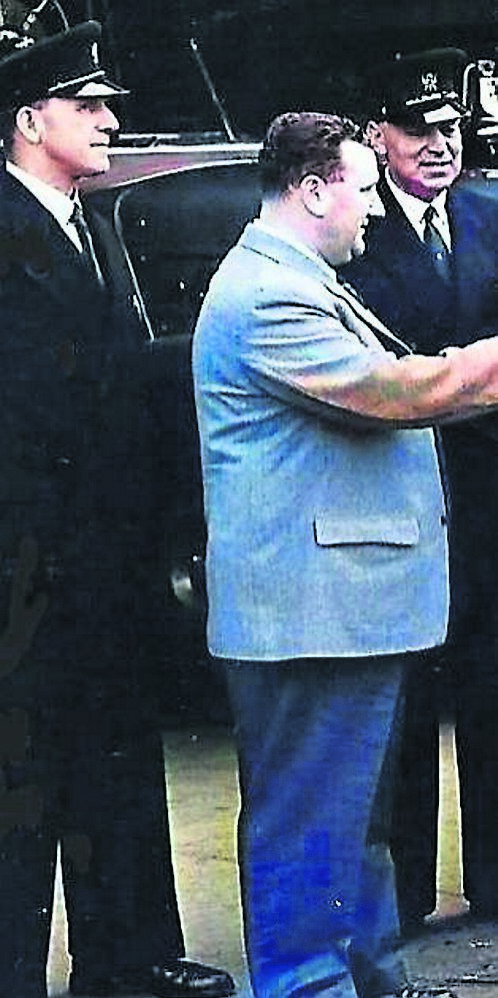
Oh, and a few soothing words from Fr Athanasius for a bruised ego didn’t go amiss.
Earlier, my parents and I had dined in the Guest House, visited the Gift Shop, and knelt in silent prayer in the chapel, lighting votive candles in remembrance of those who had gone before; all de rigeur activities on a visit to Mount Melleray in Co. Waterford
On arriving home, however, things didn’t quite look so rosy. A visit from our GP, Dr Christy, revealed that the treatment for such an injury (in 1954, at any rate) was confinement to bed for a minimum of six weeks with as little movement of the knee as possible. He would drop in regularly to keep an eye out for infection.
Six weeks! For an eight-year-old!
Such was my rather dramatic introduction to Mount Melleray Abbey more than 70 years ago. But my father, Matt, a fireman, already had form with the monks going back to the years after World War II.
******
“Animated with the desire to preserve our holy state… we at length rested like Noah’s Ark on a wild, barren mountain.”
So wrote Dom Vincent Ryan, the community’s first Abbot. Indeed, the ‘wild barren mountain’ was known to the locals, as Gaeilge, as simply that - Scrahan - ‘the coarse land’.
The monks were returning to Ireland after a forced exile of nearly 300 years. At the time of the Dissolution of the Monasteries by King Henry VIII in 1539, there were 34 Cistercian houses in the country.
But Ireland’s monasteries now lay in ruins (‘bare ruin’d choirs, where late the sweet birds sang’, in Shakespeare’s coded allusion) with their monks in exile on the Continent.
By 1830, Melleray Abbey in Brittany, France, housed 200 monks, nearly 70 of whom were Irish, including the Prior, Waterford native Vincent Ryan.
The Abbey’s School of Agriculture, with its avant-garde methods, had gained a reputation for excellence and was highly regarded. Its progressive outlook, however, proved its undoing.
Another wave of revolution was engulfing France, and some politicians, envious of the influence that the foreign monks with their cutting-edge technology were having on the farming community, ordered them to evacuate the monastery forthwith; an order reinforced by the presence of 600 soldiers under arms.
The monks arrived at Cove on December 1, 1831, and the quest for a site for a new Irish foundation began in earnest.
After viewing places in Mayo, Kerry and Galway (each of them abysmally worse than the other), Ryan eventually settled on a barren, windswept tract of land above Cappoquin, Co. Waterford, offered by Sir Richard Keane, a local, wealthy landowner.
On May 30, 1832, after walking the four miles from Cappoquin in the pouring rain, Fr Ryan unlocked the door of a derelict, rundown cottage devoid of any furniture, the only structure standing on the site, which he promptly named ‘Bethlehem’.
As he opened the door, he intoned in a loud voice, ‘In nomine Domine’. As he did so, a poor man, with barely enough food to feed his own family, appeared and offered him a basket of potatoes and some milk.
That same evening, a cheque for £100 (the equivalent of about €18,000 today) arrived from the Duke of Devonshire at Lismore Castle.
The foundation at Mount Melleray Abbey - named for its (now closed) French counterpart - was under way.
******
Over the years the Abbey gained a well-founded reputation for self-sufficiency, including its well-equipped infirmary, but as time went on it was evident there was one glaring omission in its safety arrangements, and that was in matters of fire safety training and fire prevention methods.
In 1940s Ireland, fire brigades were few and far between. Although cities and larger towns invariably had fire units, the County Fire Service organisation as we know it today was in its infancy.
Should a fire break out in any of the many buildings - including Retreat and Guest accommodations, the College, etc - at Mount Melleray, the nearest mobile fire units were based in Dungarvan - an appreciable 26 kilometres away.
After several near-misses (gorse, which grows in abundance around Mount Melleray, always posed a significant threat), the community thought it prudent to have their own firefighting equipment in situ.
So, one day, when Fr Athanasius was on business in Cork city, he called at the Central Fire Station on Sullivan’s Quay to see whether they could offer any advice. There he met Third Officer Jack Crowley, who in turn, introduced him to my father, Matt.
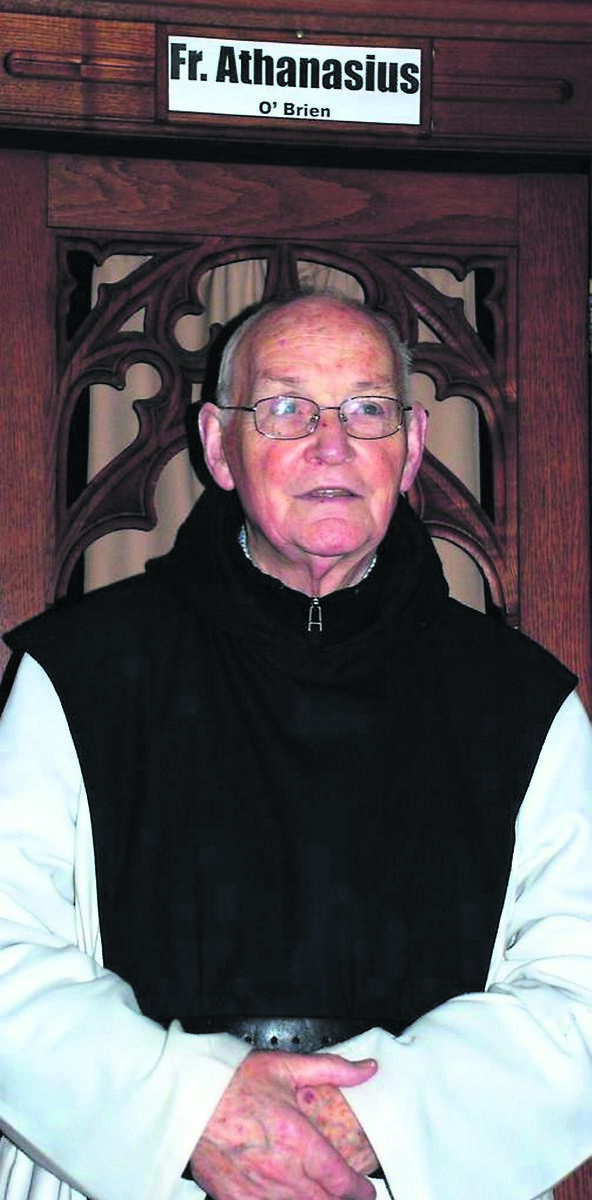
The two fire officers devised a plan of action. Not alone would they organise and train the proposed ‘Monks Fire Brigade’ in their off-duty time, but they would approach the City Manager, Philip Monahan, with a view to equipping the monks with surplus equipment.
This was shortly after the Emergency, and large amounts of protective clothing, steel helmets, etc, which had been used by the Auxiliary Fire Service (AFS) during the war, was now redundant.
With the City Manager on board, a fire pump was also acquired. In 1940, 17 trailer pumps had been allocated to Cork city by the Department of Defence for use by the AFS in the event of air raids on the city. (Although it may sound preposterous to modern ears, such an eventuality was ever-present. Many places in neutral Ireland were bombed by the Luftwaffe during the war, the most notorious of which was the Dublin attack in May, 1941, that killed 34 people).
The little Beresford-Stork trailer pump, a veteran of the London Blitz, was capable of pumping 180 gallons of water per minute, was self-sufficient, easily maintained, and could be towed behind any suitable vehicle to the scene of a fire. All in all, the ideal ‘starter kit’ for the fledgling community fire brigade.
******
Training duly began, the two Cork officers taking it in turns to make the trip to Melleray to put the (more than enthusiastic) monks through their paces.
As a small boy, I frequently accompanied dad on the 140-kilometre round trip to watch the monks being drilled. Afterwards, in the monastery kitchen, steaming ‘ponnies’ of tea and thick wads of still-warm home-made soda bread liberally slathered with the monks’ own churn-made butter and strawberry jam would be proffered to fortify us on our long journey back to the city.
The monks’ daily duties involved working in the fields and meadows, often at a significant distance from the Abbey, and, in an age before pagers or smart phones, an ‘alarm system’ to alert the fire crew in the event of an emergency had to be devised.
For hundreds of years in our cities and towns, in times of emergency churches would toll a reverse peal on their bells (‘ringing the bells backwards’) to alert the community to danger.
I believe that this system was introduced in Melleray to summon the monks to action; after all, the tolling of the bells could be heard for miles around - a simple, always available, cost-free, ready-made alarm system.
Upon the crew assembling in their ‘fire station’ in the Abbey farmyard, they would quickly dress in their personal protective equipment replete with steel helmets, hitch the fire pump to one of the community’s vehicles, and within minutes, be on their way to the incident.
Later, when the Cappoquin (just four miles away from the Abbey) fire unit was established under Station Officer James Mason, the men there took an active interest in the monks’ firefighting arrangements and Jack and Matt consequently ‘handed over the baton’ to their colleagues from the Déise.
Nevertheless, the special affinity begun between the two Corkmen and Mount Melleray and, in particular, with Fr Athanasius, endured for the rest of their lives and only ended when time took its inevitable toll.
Fr Athanasius O’Brien, OCSO, healer of renown, was, in 2010, the last to pass, at the venerable age of ninety-one.
Arguably, the Monks’ Fire Brigade’s ‘finest hour’ came in the early hours of Sunday, February 21, 1970, when the Concert Hall was maliciously set on fire by a homeless man.
As units of the Fire Service from Cappoquin and Lismore raced to the scene, the monks valiantly fought the flames that enveloped the newly-installed maple stage, curtains, props and hall. Many thousands of pounds worth of damage was caused to the building.
The firefighter-monks were later commended by a senior fire officer for their quick and courageous response, which helped to contain the blaze until the arrival of the public Fire Service.







 App?
App?


