Cork County Council urge public to have their say on Climate Action Plan
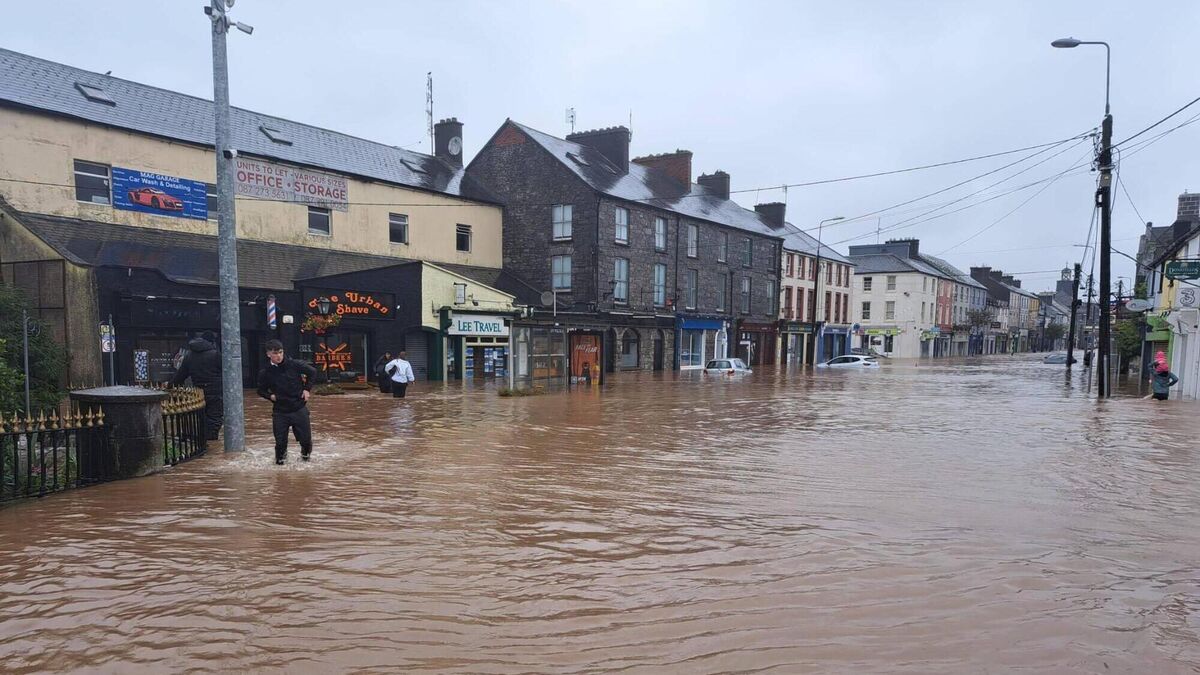
Flooding in Midleton during Storm Babet. Picture: Cork County Council
THERE is no doubt that climate change is one of the most pressing global issues facing the world today, and recent severe weather events in Cork are clear evidence of that.
The effects of climate change and global warming are becoming ever more obvious, presenting more frequent events and challenges with which we all have to contend as citizens, businesses and indeed public servants.
Climate change poses a major challenge for governments and in local government, Cork County Council has it at the forefront of our agenda, informing all of the work we do across every department.
Our draft Climate Action Plan has now been published and is at the public consultation stage.
An important, far-reaching document, it sets out how Cork County Council will improve energy efficiency and reduce greenhouse gas emissions both in our own buildings, fleet and operations across County Cork.
Among the priorities is the reduction of our carbon emissions by 51% and increasing our energy efficiency by 50% by the year 2030. This will not be easy, considering many of our assets will require significant upgrade and investment to achieve our targets, but we have a plan and are determined.
Our €180 million active travel programme is well underway in many locations across Cork County, with major projects coming to fruition soon, and many more in the pipeline thanks to Government funding, and the vision and work of our team in the Council.
New greenways, cycleways, blueways and walkways present far more than climate adaptation measures, they also offer health improvement, community, business, trade, reputational and tourism potential which the Council will also pursue in the years ahead.
Already, we have seen keen business interest from the areas that will benefit from these new developments in, and plans for, active travel projects. And so we are seeing that the benefits of taking action on climate change far outweigh the cost and effort of taking that action for everyone who lives, works, visits and invests in County Cork.

The Draft Climate Action Plan also sets out how we aim to make County Cork a more climate-resilient county. With engaged and informed citizens, we will continue to work with key stakeholders to influence and support carbon reduction initiatives right across the county at every opportunity. We are committed to supporting the Community Climate Action Programme (CCAP) funded by Government to build low carbon communities, which will allow for the application of grants enabling climate projects at the local level.
Our Plan focuses on interrelated themes and actions which provide a framework to support the transition to a more climate resilient county, which, considering our size, will contribute significantly to the national programme.
It contains defined goals, objectives and actions encompassing the themes of community, biodiversity, natural environment, heritage, land use, economy, transportation, the built environment and waste.
In addition, the Plan provides for the establishment of County Cork’s first Decarbonisation Zone in Macroom. We in the Council, together with other state agencies, business, community organisations and the people of Macroom, Baile Bhuirne and Baile Mhic Ire are primed now to take full advantage of the decarbonisation opportunities presented by the opening of the N22.
Over the coming years, we will identify and pilot community led projects to demonstrate how emission reductions can be realised in a targeted way. So much of the changes required will come from our citizens and communities, and history has shown us that they are never short of ideas and commitment to making worthwhile change happen. The objectives include examining a range of local measures in areas such as decarbonisation, green infrastructure, active travel, developing green areas, afforestation, raising citizen awareness and behavioural change.
As part of the Climate Action Plan, we published a Baseline Evidence Summary Report which examines how the climate of County Cork has changed in recent decades, while also showing the risks that further change may carry.
It shows that sea levels in the Cork Harbour area have risen by approximately 40 cms since 1842. Annual average rainfall at Cork Airport increased by 3% between 1981 and 2010 compared to the 29 previous years.
This may not seem like much, but it feels like a lot when rainfall occurs, because the weather systems are behaving differently, producing prolonged sustained heavy downpours much more frequently, overwhelming our rivers, water table and drainage systems. The average temperature in County Cork is expected to increase by between 1.1 and 1.5 degrees by 2050, resulting in a rise in drought probability and summer heatwaves. Coastal flooding and erosion could also increase in frequency, which is concerning in an island nation, and in a county that has 1,200km of coastline to protect and manage.
Since the Baseline Report was published, we have experienced a number of storms. Water levels in our rivers and streams remain high following a wet summer, and the ground is saturated leading to the ever-present risk of flooding. In Cork County Council, our staff have had to adapt to ensure we are always vigilant in advance of the next weather event, monitoring water levels, ensuring drains and gullies are maintained, stockpiling sandbags and tailoring our response to severe weather events, alongside the other agencies and communities with whom we work every day.
In that regard, I cannot write this without paying tribute to the teams in Cork County Council, who are on the ground when most of us are asleep, whose efforts to keep towns, villages and communities protected are trojan and unnoticed, and without whom people who trade and live in susceptible areas would fare far worse as a result of these severe weather events. They are true public servants who are rarely acknowledged. They too will benefit from any actions, collective and individual, that mitigate the risks presented by our changing climate.
We all need to work together to reduce the impacts that climate change is already having on the environment, the economy and the people of County Cork. It is vital that our citizens have their say on the draft Climate Action Plan. We encourage the public to view the plan and make submissions before 4pm on Monday November 27. Submissions can be made online by visiting CorkCoCo.ie
The third stage will involve considering all the submissions before the finalised Climate Action Plan is adopted by Council in January 2024. Cork County Council is then required by statute to adopt the Plan before February 24th.
Once adopted, we will track and monitor progress to deliver on the climate objective throughout the lifetime of the Plan, prepare an Annual Implementation Programme dealing with the specific projects to be undertaken and incorporate any new national developments that may emerge.
We look forward to seeing how the Plan will contribute to the development of Cork County over the next five years, as the benefits of taking action extend far beyond addressing climate change. This is our opportunity to bring together critical stakeholders from all communities and sectors to work towards a climate neutral future and make climate action a priority for everyone in County Cork.





 App?
App?


