Road policing under-resourced and recruitment not 'coming fast enough' says AGSI
Vivienne Clarke
Declan Higgins, the president of the Association of Garda Sergeants and Inspectors (AGSI), has warned that recent garda recruitment campaigns are “not coming fast enough”.
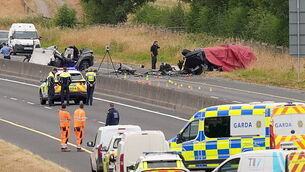
“We don't have enough gardaí on the ground. But when we see road deaths rising at the rate they have been over the last couple of years, we see horrific instances like this,” he told Newstalk Breakfast with Anton Savage in response to a question about the M9 crash at the weekend in which five teenagers died.
“This isn't the first time. I mean, if people remember back to 2021, on the M7, there was a similar incident where three young men were killed. And so this has been going on quite a long while these kinds of horrific instances.”
At the same time, there had been a decrease in Garda Traffic Corps numbers, he said. The lack of response was worrying, he said. Not only were garda numbers down, but equipment and resources were also down.
“If we go back to the core report that was published in 2025, even that made very clear criticisms of gardaí management regarding the equipment, the vehicles and the training that those members are getting.
“So not only have their numbers been dropping, but the quality of their training and equipment has also decreased to a significant level.”
The prosecution of gardaí for their actions during the pursuit of suspects has “a huge moral impact” on members of the force, said Higgins.
“There are 10 members of An Garda Síochána, I believe, at the moment before the courts facing prosecution. I'll go back to the incident in 2021, there's a member facing prosecution in relation to that. And this has a huge effect on morale within An Garda Síochána.
“And the lack of training for those members and the lack of support and the lack of backing from both government and from garda management for these gardaí out doing their job is of serious concern.
"When I first joined the job, there was confidence, I think, amongst gardaí that if you went out and did your job, and you could support and back up your actions, that you would get the support of garda management and the government and all the different agencies.
“Now we find ourselves in a position where gardaí, their ability to work is being chilled; that's the word the Commissioner used at one stage as well, the chill effect.
“They do not feel the confidence anymore. And that is reflected in these court cases, where they're going out doing their job to the best of their abilities, and they find themselves possibly facing criminal prosecution, where their own lives and their own driving licences and their families are all being affected by them trying to do their job. They're not being properly supported, they're not being properly protected to do their jobs.”
Shane Moynihan, Fianna Fáil TD for Dublin Midwest, Deputy Chair of the Oireachtas Transport Committee and party spokesperson on transport, speaking on the same show, acknowledged the need to increase garda visibility on roads.
Pursuit training was another issue he supported, and training was now in a position to commence such training. Every garda was now required to undertake roads policing as part of their general work, he said.
Moynihan said there was another question about values and why it was acceptable for young men and others to believe such behaviour was acceptable.
“That requires a conversation for us as a society, both in terms of political discussion, but also in terms of how we engage with the likes of social media companies about why this sort of behaviour has been glorified in some instances, why it's been lionised and why it's been kind of celebrated”.
The deputy general secretary of the AGSI, Kevin Bolger, later told RTÉ radio’s Morning Ireland that tangible actions were not being seen despite promises on issues such as pursuit training.
Assurances had been given earlier this year about pursuit training, and yet “here we are in the midst of another tragedy where the promises are still coming; we're not seeing any tangible actions.
“There needs to be an expedited response to this because things aren't getting better and this was flagged at the time that these robust responses needed to come quick and because we have members in control rooms, particularly we have sergeants and inspectors in control rooms who are in control of all these vehicles and they have to make decisions while pursuits are ongoing which it goes against every grain of their being as a police person to stand down members from a pursuit.”
The first step should be to properly resource existing roads policing units that have been depleted and under-resourced, he said.
“Resource them, fully train them, equip and protect them; they will start from the ground up of making the road safer because they will engage strongly permanently with all road users and try to change behaviors.”
'Legislative tweaks'
Meanwhile, David Staunton, a barrister specialising in road traffic legislation, has said there are “certain legislative tweaks” that could be made which would allow the gardaí to have certain immunities in certain situations such as “the legitimate pursuit” of people suspected of crimes.
Speaking on RTÉ radio’s Today show with regard to a promise by the Minister for Justice that legislation was being prepared to strengthen garda protections “when it comes to pursuit.”
“One of the great frustrations for the Gardaí is that obviously the level of training in terms of competency-based driving is sometimes limited to certain members of the force, but also if those members who are trained do engage in pursuits, they are at risk of being prosecuted in relation to dangerous driving offences, for example, or endangerment.
“There's a tension between the legitimate pursuit of people suspected of crimes and also then having to protect the public from the driving of a garda. So there can't be a free rein given to gardaí to drive in the manner they see fit.
“However, there are certain legislative tweaks that could be made which do allow for the gardaí to have certain immunities in certain situations.
“So, for example, at the moment there is a general immunity in relation to driving for specific offences where a garda would not be prosecuted for holding a mobile phone if there was, for instance, communications going back between other persons in respectable pursuit.
“But also at the moment, unfortunately, which is something I think does need to be looked at, gardaí can be prosecuted for dangerous driving in certain instances where they are pursuing.
“So, for instance, if gardaí are pursuing somebody who has left the scene of a burglary, or even in recent times, people using certain high-powered electric vehicles such as scooters and mopeds, there's an expectation by the public that these will be investigated and pursued by gardaí.
“However, gardaí at the same time are concerned that the tables will be turned and they will find themselves before the courts for fulfilling the duties that the public expect of them.”
Staunton said one thing that could be considered would be amending the legislation concerning dangerous driving. “At the moment, the more severe penalties up to 10 years in prison only arise if a person is involved in dangerous driving where death or serious bodily harm occurs to a third party.
“The legislation doesn't always encompass that driving at a higher level, which attracts more serious penalties. And consideration could be given to that.
“For dangerous driving, where there's no death or no serious bodily harm caused to a third party, the maximum penalty is a fine of up to €5,000 or six months in prison with a mandatory two-year disqualification."