DUP ‘anti-Irish’ and work against national identity, Michelle O'Neill claims
By David Young, Press Association
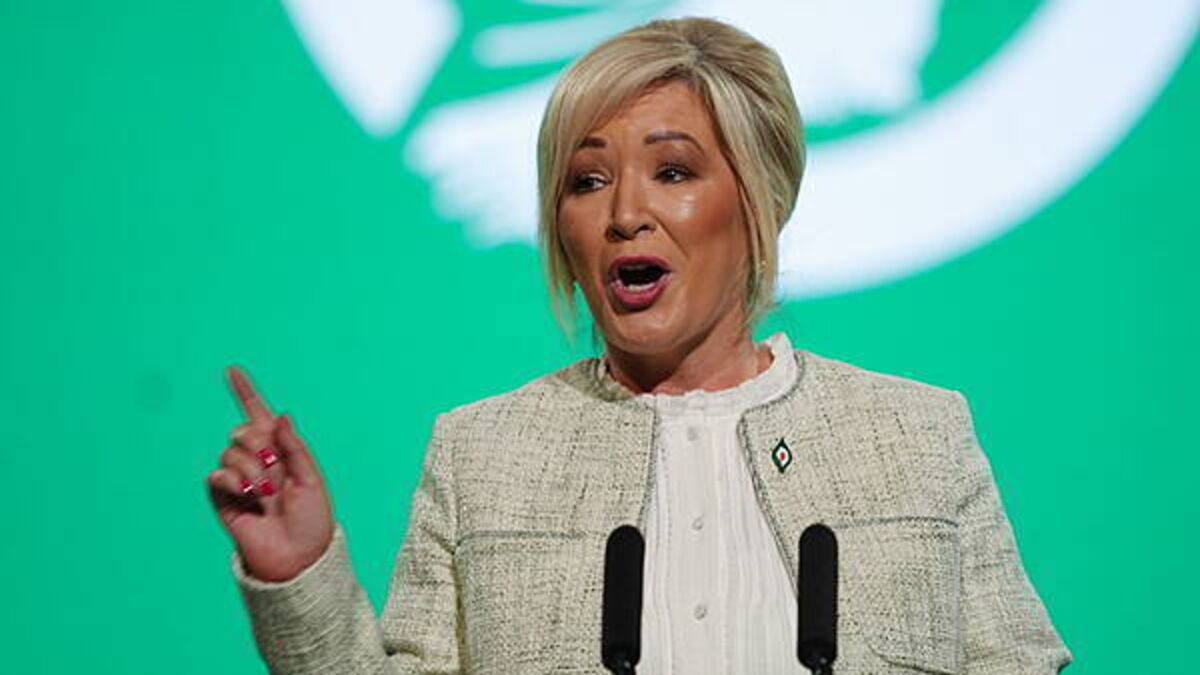
Michelle O’Neill has accused the DUP of being inherently “anti-Irish” and spending every day working against anything to do with Irish national identity.
The First Minister’s comments came as DUP deputy First Minister Emma Little-Pengelly claimed Sinn Féin was mounting a “concerted attempt” to target her party’s Stormont ministers and portray them as opponents of the Irish language.
The claim and counter-claim by the joint leaders of the Executive offered the latest evidence of increasing tensions within the Sinn Féin/DUP-led powersharing administration in Belfast.
Both O’Neill and Little-Pengelly, who spoke to the media separately at the Balmoral show near Lisburn on Friday, suggested recent fractious exchanges between their parties were more significant than the sort of political jousting that might be expected 12 months out from an Assembly election.
The ministers were asked about the scenes that unfolded at the Assembly’s Communities Committee on Thursday when DUP minister Gordon Lyons was involved in a robust question-and-answer session with Sinn Féin committee members about funding uncertainty around a street signs translation project.
The clashes played out as Lyons appeared before the committee to give evidence on the future of the Northern Ireland Place-Name Project.
The academic initiative based at Queen’s University researches the origins of street names across the region and also provides councils support in translating English street names into Irish.
Sinn Féin MLAs have accused Lyons of refusing to renew funding for the project this year.
However, the minister has rejected that, accusing Sinn Féin of “fabricating” the claim as part of a “co-ordinated attack” on him.
This week it also emerged that Lyons’ department will not implement a planned Irish language strategy for Northern Ireland before the end of the current Assembly mandate next year.
Asked about the controversies involving the Irish language, Sinn Féin vice president Ms O’Neill told reporters that the DUP’s “track record speaks for itself”.
“Nobody will be fooled by the DUP’s bluster,” she said.
“The DUP are anti-Irish. The DUP work every day against everything to do with Irish national identity.
“This is a communities minister (Lyons) who’s responsible for delivering a language strategy, yet he’s taken another minister to court in relation to the Irish language (Lyons is involved in a legal challenge against Sinn Féin infrastructure minister Liz Kimmons’ decision to install Irish language signs at Belfast’s Grand Central Station).
“So whether it comes to cuts for Líofa grants to funding for children to learn Irish (decision to cut Líofa grants was taken by DUP minister Paul Givan in 2017 but later reversed), whether it’s the place names project, whether it’s anything else to do with Irish language, the DUP have form, and they will never change that form.
“That’s the reality. But people understand that. My job in the Executive is to try to make politics work, to deliver for people in the here and now, but very alive and very alert to the fact that the DUP are anti-Irish in their approach.”

She added: “This isn’t a recent development. This isn’t an election issue that the DUP have just turned their face against Irish national identity.
“They have form, long form for many, many years, decades fighting against Irish language. They’ve done that with the Irish Language Act. They’ve done it with petty nonsense like cuts on Liofa grants. They’ve done it on every turn.
“So, people won’t be surprised to hear this rhetoric from the DUP. For them, perhaps they feel like they’re appealing to their electorate, but I think that that is so short-sighted.
“What we should be doing here is actually accommodating each other, finding ways that everybody has their identity respected and cherished and nurtured. That’s certainly my approach.
“Unfortunately, the DUP, I don’t believe, will ever have that approach. They will always be opposed to everything to do with Irish national identity.
“But that doesn’t stop me doing what I do. I’m here to try to do my best for people, turn up for people every day, whilst making a case for something better that moves beyond the limitations of the Assembly and the Executive.”
Little-Pengelly accused O’Neill’s party of trying to “spin” an “agenda” against the DUP.
“I think there is a concerted attempt at the moment to target DUP ministers,” she said.
“I believe that’s because DUP ministers have been delivering and I think it is to distract and deflect from the lack of delivery within some other departments.
“So, I do think that this is part of an agenda to try to spin that somehow the minister (Lyons) is not supportive in certain particular issues.
“I would say that, of course, for a (Irish language) strategy to be meaningful, there has to be funding behind that as well.
“There’s been a number of other developments in relation to Irish language. There’s a significant amount of investment right through from the broadcast fund to Irish medium education.
“And, indeed, we have an Irish language commissioner, a commissioner that I had appointed jointly with the First Minister.
“So, of course, there have been a number of things that do take place, a huge amount of investment in that sector.
“So, therefore, I strongly disagree with that attempt by Sinn Féin to paint a narrative that has no connection to fact.”
Referencing the Sinn Féin criticism of Lyons at the committee hearing, she said: “I don’t think it’s something that we should just expect in the run-up to an election, I think it was completely inappropriate.”
The DUP MLA added: “We need to have grown-up politics where people do get on, they try to deliver within their own departments.
“And, in fact, that there is that civilised exchange between the members and ministers when we give them that information.”
Little-Pengelly said she was in her job because she wanted to “deliver for people”.
“I believe our DUP ministers are delivering well and I want other ministers to get on and do what they need to do within their own departments, and not to be trying to cause distraction by blaming others for perhaps a lack of delivery within their own departments.
“My job is very much about working with everybody across that executive, building those relationships.
“I’ve always said there will always be issues where we disagree and, of course, we will call those issues out publicly in the Assembly or in the Executive, but there’s much more that we can agree on, and we do need to get on with that work as well.”