Breakthrough as fingerprints now visible on fired bullets
Ottoline Spearman
Fingerprints can now be recovered from fired weapons, thanks to a new test developed by scientists from Maynooth University.
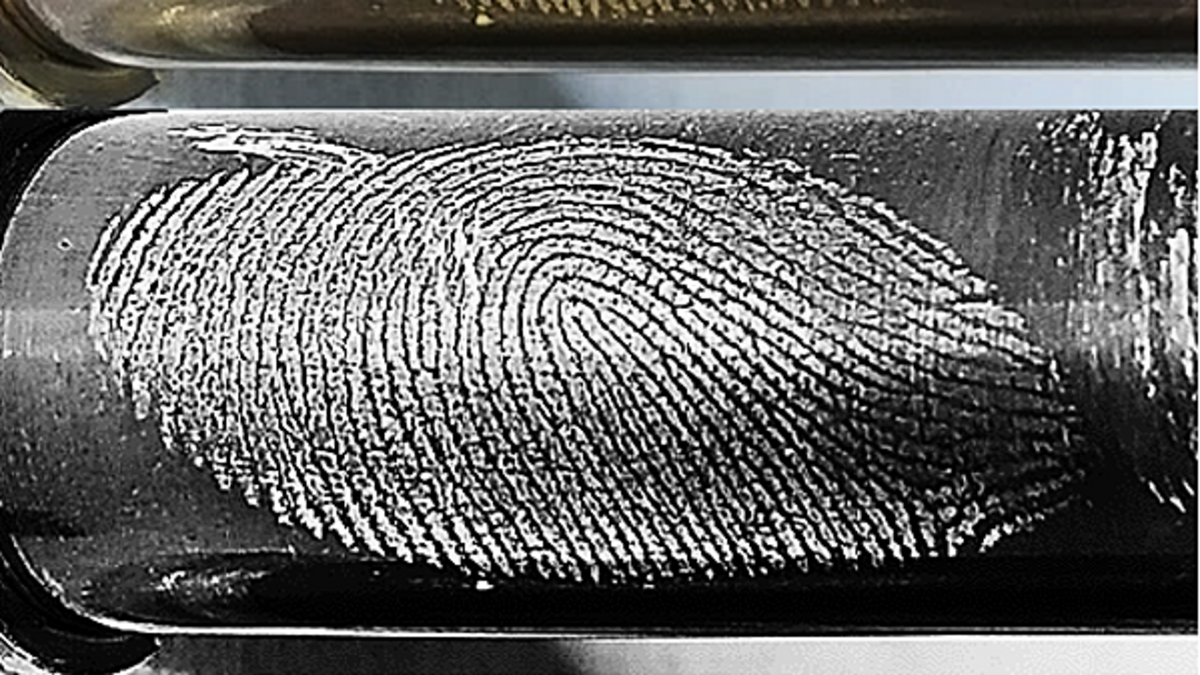
The electrochemical method allows fingerprints to be seen on brass ammunition casings - even after they have been exposed to the high temperature conditions experienced during gunfire.
In what was once considered impossible, this is a breakthrough for forensic and criminal investigations.
Dr Eithne Dempsey, who carried out the tests with Dr Colm McKeever, described this as the "Holy Grail in forensic investigations".
For decades, investigators have struggled to recover fingerprints from weapons because any biological trace is usually destroyed by high temperatures, friction and gas released after a gun is fired. As a result, criminals often abandon their weapons or casings at crime scenes, confident that they leave no fingerprint evidence behind.
The team found they could coat brass casings with a thin layer of specialised materials to make hidden fingerprint ridges visible.
Unlike existing methods that require dangerous chemicals or high-powered equipment, this uses readily available non-toxic polymers and minimal amounts of energy to reveal prints from seemingly blank surfaces.
The casing is placed in an electrochemical cell containing the substances, before a small voltage is applied. Chemicals in the solution are attracted to the casing's surface, coating the spaces between fingerprint ridges and creating a clear, high contrast image of the print.
The fingerprint appears within seconds as if by magic.
"Using the burnt material that remains on the surface of the casing as a stencil, we can deposit specific materials in between the gaps, allowing for the visualisation,” said Dr McKeever.
Tests showed that this technique also worked on samples aged up to 16 months, demonstrating remarkable durability.
The research has significant implications for criminal investigations.
"Currently, the best case of forensic analysis of ammunition casings is to match it to the gun that fired it,” said Dr McKeever. “But we hope a method like this could match it back to the actual person who loaded the gun.”
The team focused specifically on brass ammunition casings, the most common type of material globally, but they believe it could be adapted for other metallic surfaces - expanding its range of potential forensic applications to arson.
The technique also uses a device called a potentiostat to control voltage, which is small and portable, making it possible to create a compact forensic testing kit.
While promising, the new technology faces rigorous testing and validation before it can be adopted by law enforcement agencies. The research, funded by Research Ireland and Maynooth University, is published in a forensic science journal, and has significant implications for global policing.