Cork Views: So proud to fly flag for the Northside as Scholar
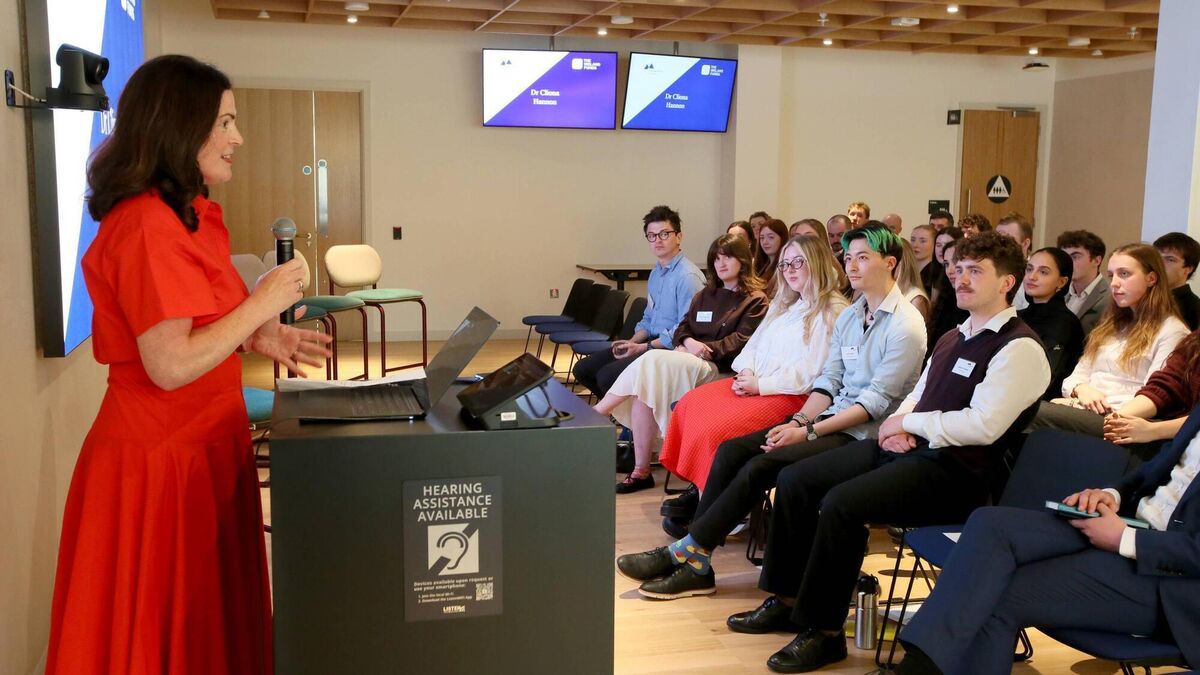
Attendees at the scholarship celebration event. Picture: Mark Stedman Photography
“You’d probably know it as the place that The Young Offenders was filmed in’’
It’s the go-to line any young Cork Northsider has learned to use when non-Corkonians have never heard of Hollyhill, Blackpool, or Gurranabraher.
Whilst the show has served me well in that regard, I like to think that the next generation of Northsiders entering the world will shake up the time-old narrative and characterisation of our community that the show was built on.
Being chosen as a 2026 George Moore Scholar, a programme of The Ireland Funds that supports talented students to pursue postgraduate study abroad, traces back to my Mum and Dad going along with my notions at ten years old to move to Gaelscoil Pheig Sayers, the Northside’s DEIS Irish-medium primary school, from an English-speaking school.
Older friends that were going into secondary school in our terrace would talk about how Gaelcholáiste Mhuire - the A.G. - was how you could get into the ‘highest school’ (college). In my little head, moving schools would then get me to “the UCC” as my mum still slags me off for calling it.
To this day, I fail to explain just how beautiful my two years at Gaelscoil Pheig Sayers were without getting emotional. The teachers treated us with such respect, patience, and love: because contributing to reviving a language naturally creates a community, not just an educational institution. It is this very community that has shaped who I am today.
In 2016, I left my Peig Sayers classroom with seven fellow students. By the time my sister left in 2022, she had 32 in hers. The numbers speak for themselves. An urban area recognised as being ‘socioeconomically deprived’ has now begun to host a new generation of Irish-speakers. Irish-medium education is shaping and transforming disadvantaged communities, and I believe that myself and my peers, and kids on the come up, are living proof of that.
Working as a Teller in my community, the most meaningful memories have been when both me and the member, through conversation, have realised unexpectedly that the other had Irish, and we got to carry out the exchange, and conversation through the language.
My years in UCC outside of academics (which I devoured) were spent involved in the wider community: in radio, in magazine production, and in language and cultural initiatives like Barr na gCnoc, which is supporting the grassroots momentum of Irish in the Northside by pushing it along with UCC’s backing.
Entering my final year of Irish and History in UCC, the college sent out an email regarding the George Moore Scholarship. The programme supports all the needs of Irish-students pursuing a Master’s degree abroad who hope to address global challenges in their lifetimes and aim to give back to society. The scholarship was established in memory of the late Dundalk-turned-States businessman and philanthropist, George Moore, a child of a shoemaker from a large family, who received a scholarship that changed the trajectory of his own life.
I distinctly remember resonating with Moore’s story and the ethos of the scholarship, but yet thinking to myself ‘I don’t think I’ll apply - why would I be chosen?’. It’s only when I told my Mum about it, and she said ‘but why not you?’ that I knew I would take her thinking onboard.
I knew that my passion for minority language survival and for pushing socio-economically disadvantaged communities forward aligned with the scholarship’s mission, but I did not allow myself to imagine progressing further than what I had in each round throughout the five months.
The morning I found out I was selected as a 2026 George Moore Scholar, I wept down the phone to my Mum, Dad and older sister in the library of UCC. My family, the Northside community, and especially my references had fought for me to believe in myself - but I felt they were obliged to be supportive. Yet here was The Ireland Funds and George Moore Scholars team, giving me the biggest vote of confidence that one could receive.
It meant that a dream to continue with my passion for history and research is delivering me to Glasgow this September: an opportunity that simply put, I would have never had access to without George Moore Scholars.
The scholarship celebration event is an evening that will truly stick with me for life. I couldn’t comprehend that morning that two days beforehand I was walking past all the dereliction on North Main Street to get the bus home from work, but yet that morning I was walking to the event in the company of Dublin’s Georgian architecture alongside the Grand Canal.
George’s wife, Angela Moore, a philanthropist and businesswoman, left us with a sentiment which I knew I needed to commit to memory: we believe in you, both as individuals, and as a cohort.
The 2026 cohort of George Moore Scholars is the largest to date, with up to 81 scholars supported this year. I felt extremely proud to not only represent the Northside, but also to be one of this year’s three Scholars to represent Cork specifically.
Someone had asked me in a conversation that evening, ‘where in Cork are you from?’, which brought the biggest smile to my face: the accent had announced itself before I managed to myself.
Two words have been instilled into us, which will be what we carry forward with us as we represent the Northside when we leave it every day to head to the city centre, to Dublin, to the UK or the States (or, in my case, Glasgow): meas agus iarracht, respect and effort.
I hope that my nephews and nieces’ generation, and even my future children, will be provided with the same opportunities that my own generation are beginning to have access to, such as the George Moore Scholarship. I hope in years to come, Northsiders will no longer be limited to The Young Offenders as their geographical marker. I hope that they’ll have the choice to use our urban-Gaeltacht as such instead.






 App?
App?


