Christy O'Connor on Cork v Kerry: John Cleary's side must be clinical to have any chance
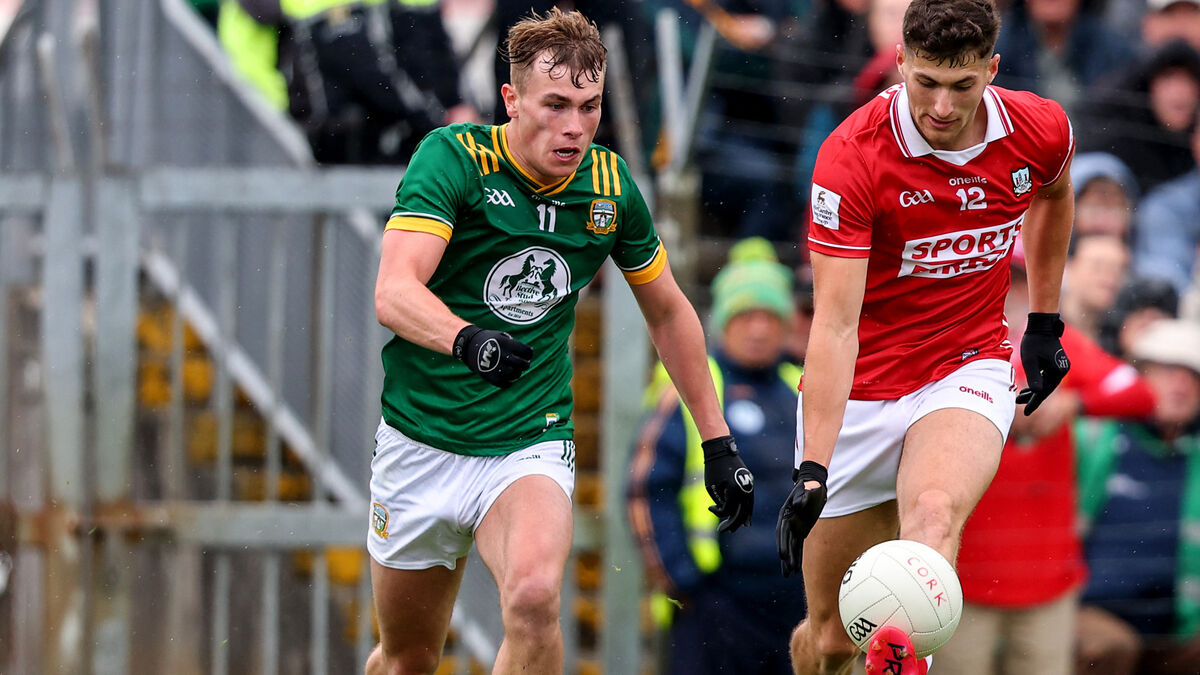
Meath's Ruairí Kinsella tracks Seán McDonnell of Cork. Picture: INPHO/Ben Brady
When former Meath captain Shane McEntee spoke on the Irish Examiner Gaelic Football Podcast on Monday about the Cork-Meath match last weekend, McEntee focused on two areas to outline what he felt was a clear difference in football ability between the teams.
McEntee said that Cork’s kickouts – that long-standing Kevin Walsh tactic of overloading pods on one side of the field - were too predictable, and too limited, with a lack of variety not providing enough options to keep Meath guessing. In McEntee’s opinion, Meath’s greater technical ability was also decisive, especially in such wet and greasy conditions
“Meath could handle the ball in pressure situations,” he said. “Cork did not seem to have the same ability to execute under that pressure.”
The numbers didn’t exactly suggest that Meath were slicker and more economical but those figures also have to be taken into consideration with the volume of possession Meath had in comparison to Cork.
Cork’s conversion rate was better - 47% to Meath’s 42%. But Meath had 12 more shots.
Cork had more kickouts because Meath had more shots. But Meath were able to generate more shots because they were able to secure more possession off Cork’s restarts.
Meath have loads of big men around the middle of the field but Louth obliterated them on kickouts in the second half of the Leinster final. Of Louth’s total of 3-14 in that final, they sourced 3-7 off kickouts.
Cork weren’t able to physically compete with Meath in the same way they that they were able to match up against Kerry. Was that more to do with the Cork players having a much greater knowledge of the Kerry players, and how they match up to them, than a Meath side Cork are far less familiar with?
Possibly, but shading the kickout battle when Cork played Kerry in April was one of the chief reasons Cork got so close to Kerry that night. Cork secured 60% of their own restarts and 47% of Kerry’s.
When Cork struggled early on in that game, Kerry’s platform had come from the Cork kickout, when winning five of Micheál Aodh Martin’s first nine restarts. An injury to Kerry goalkeeper Shane Ryan in the second quarter did help switch that momentum back to Cork on the Kerry kickout.
But Kerry have a more formidable look around the middle third now with Diarmuid O’Connor’s return from injury and Joe O’Connor’s continued good form. And that will make them harder to crack on kickouts.
Kerry completely dominated Roscommon on kickouts two weeks ago, especially in the second half when sourcing 3-5 from restarts.
That is a challenge for Cork, but so is dealing with Kerry’s increased running power through the middle since the sides’ last meeting in late April.
With Paudie Clifford not even in the match-day squad against Roscommon because of injury, Kerry have far more options across their midfield and half-forward line now.
The Paudie Clifford sending off was the critical turning point in that last Cork-Kerry match. Yet, similar to how Cork had got back into the game in the second quarter, another couple of two-pointers at the start of the fourth quarter turned the game back in Cork’s direction again.
John Cleary remarked in his GAA+ post-match interview afterwards about Cork’s confidence in scoring two-pointers.
That ability, and willingness to have a go, from distance was probably overlooked beforehand when compared with Kerry’s reluctance to take on two-pointers. Cork had kicked 25 two-pointers in league and championship, with Brian O’Driscoll responsible for nine, whereas Kerry hadn’t raised any orange flags in their previous three matches. And Kerry only raised one orange flag against Cork in that meeting in late April.
However, Cork’s conversion rate from two-pointers that night was still only 43%, as they missed eight attempts. Kerry missed two attempts but they only took three, focussing instead on getting the ball to a shooter in a better position.
In the end, Kerry’s greater efficiency was decisive to the outcome, with Kerry’s conversion rate coming in at 62% to Cork’s 50%.
The three green flags Kerry raised against Roscommon added to the haul of 21 goals Kerry had already scored in their previous nine games. Their conversion rate that afternoon in Killarney was an impressive 78% too.
Kerry look in better shape now than they were in late April. After the fright of their last meeting, Kerry will be on guard more than ever now too.
On the other hand, Kerry always look in better shape than Cork anytime they meet them. There has always been that constant fear that Kerry can drill Cork if they really put their minds to the task.
Those fears are always close to the surface, but Cork have still proven in recent meetings that they can still match up to Kerry better than almost any other side.
The challenge for Cork now, especially after the setback of last weekend, is to get their kickout numbers up, and to increase their conversion rate.
The odds are strongly against them again now but if Cork can improve on those figures, if they start well and get the home crowd behind them early, Cork may never get a chance to beat Kerry.




 App?
App?


