Munster chief Leddy feels tightening of calendar would benefit provincial champions
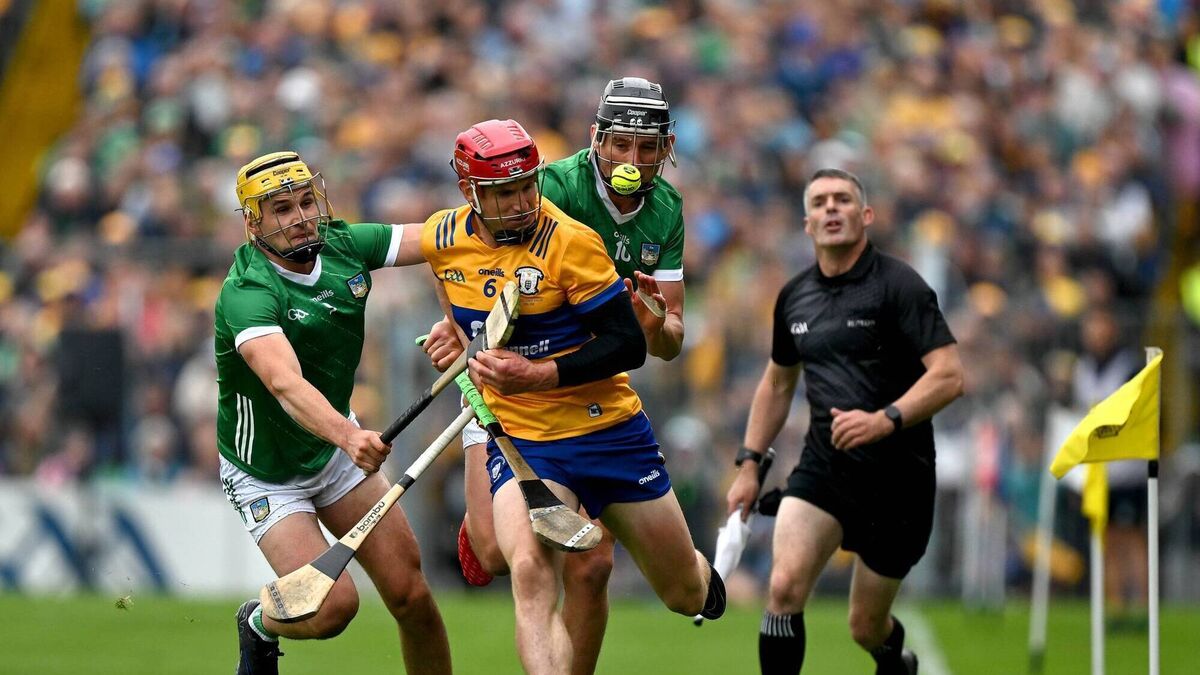
John Conlon of Clare in action against Cathal O'Neill and Gearóid Hegarty of Limerick in last year's Munster SHC final in Thurles. Picture: Brendan Moran/Sportsfile
Munster Council secretary/CEO Kieran Leddy has suggested narrowing the gap between the All-Ireland SHC quarter-finals and semi-finals to a single week, as a way of avoiding provincial champions being disadvantaged.
The annual Munster convention takes place on Friday night at Ballygarry Estate Hotel and Spa in Tralee, Co. Kerry. In his wide-ranging report, Leddy gives attention to fixture scheduling.
Noting that, while provincial final replays could result in an extra €1m of revenue, Leddy makes the point that they are rare occurrences and that, if a weekend was set aside in the event of one being needed, it would result in the province’s senior hurling champions having a five-week gap to the All-Ireland semi-final in a ‘normal’ year.
He would be more inclined to reduce such a time-frame.
“Advantage should always follow the team that wins a championship,” he writes.
“Take our U20 hurling championship, for example. The team that finishes top of the group qualifies for the final and this takes place two weeks after the last round of games in the round-robin.
“The second- and third-placed team qualify for the semi-final, with the second-placed team having home advantage, regardless of which team was at home in the group-stage tie. Therefore, the advantage followed the team that finishes top, followed by the team that finishes in second place.
“As I have already stated, as things stand, a four-week gap could be seen as being on the ling side. Maybe a solution to address the current four-week gap is for the All-Ireland semi-finals to follow a week after the quarter-finals, and the All-Ireland preliminary quarter-finals to take place the week after the provincial final.
“That would mean the team that finishes third in Munster and reaches an All-Ireland semi-final plays three weekends in a row, while the provincial final runner-up has a two-week break to the quarter-final, with the semi-final the week after.
“The provincial winner has a three-week gap to the semi-final, which is probably the perfect gap. Therefore, the most advantageous position falls to the team that wins the provincial championship. The position of least advantage is third place, because of the potential of playing three weeks in a row.”

Leddy also addressed misgivings around penalty shootouts and feels that, in the absence of a better way, they currently serve as the fairest way of finding a winner when a game is tied after extra time.
“While this is not a topic that will appear of major concern,” he writes, there has been commentary throughout the year about removing them in cases where teams are level after extra time and replacing them with an alternative system, such as a golden-score competition.
“In such a tight calendar, one thing is clear and that is we must have a way of separating teams that are level after extra time.
“We know that replay dates are too disruptive to fixture calendars. The great advantage of the penalty-taking competition is that it is far to both teams. Both have five shots, and more if required, and all shots take place into the same goals. Weather conditions or referee opinion play no part in these.
“However, by introducing a golden score or some other form of extended play, factors such as the direction of the wind, the opinion of the referee on what was a free or not, comes into play.
“The fact that the penalty-taking competition is borrowed from soccer is no reason to dispense with it. The method of separation must be as fair as possible to both teams and the use of the penalty-taking competition is fair.”







 App?
App?


