Cork GAA: Goals per game stats in club matches shows how hurling is evolving
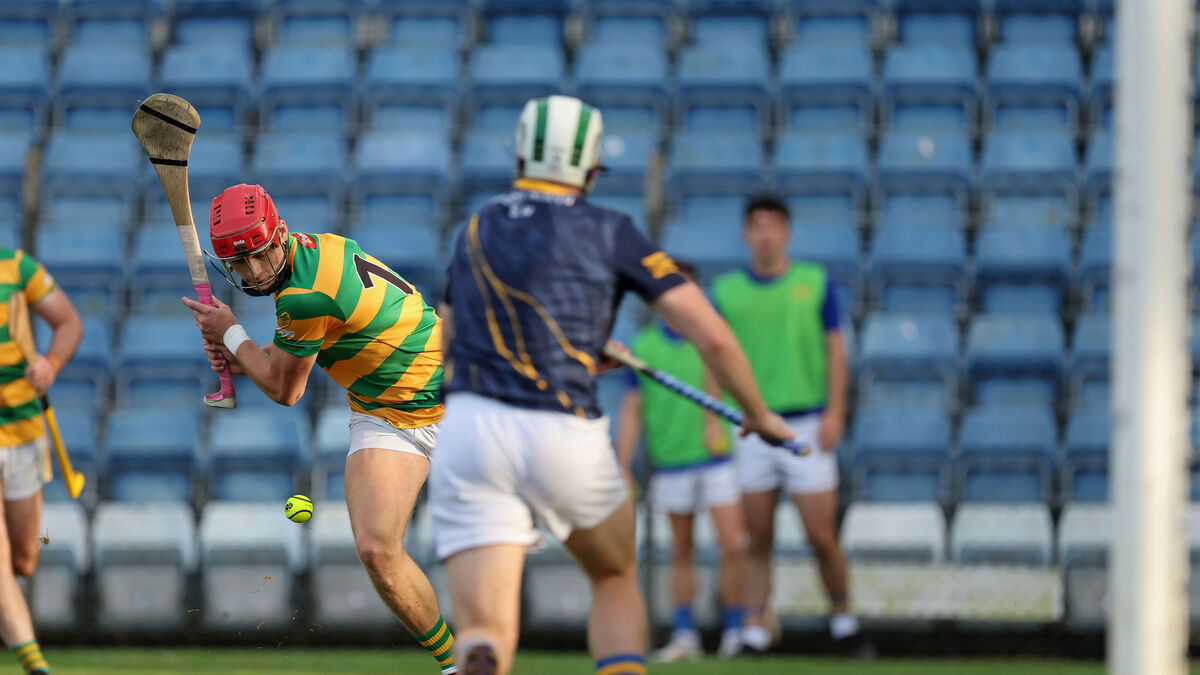
Alan Connolly, Blackrock, strikes to score Blackrock's second past Shane Hurley, St Finbarr's goalkeeper. Picture: Jim Coughlan.
There are hopeful signs that the 2024 Cork Hurling Championships could feature more goals than previous editions. No doubt Pat Ryan would approve.
So far this term, 189 green flags have been raised in the top five grades as we reach the midway point of the club season. By now 65 games have been played, 61 remain, barring any relegation or county final replays.
Between the introduction of the group-stage structure in 2020 and last year, the rate of goals per game hovered around the 2.5 mark.
It was that first year of Covid, in 2020, which registered the highest proportion of goals in the top grades. The lockdown restrictions – notably the limited access to training, challenge games, and group meetings – perhaps factored into the looser play.
Since then, the number of goals per game had plateaued.
To take the Premier Senior Championship, there were 2.89 goals per game in 2020. It declined to 2.66 in 2021, stabilised at 2.69 in 2022, before tumbling to 2.18 in 2023.
The trend holds at Senior A, with a similar 3.25 goals per game, Premier Intermediate, with a modestly improved 2.67 goals per game, and Intermediate A, with 3.08 goals per game.
Only Premier Junior has lagged back with a contradictory drop to 2.08 goals per game. Even then, the average across the board still lands at 2.91.
These evolutions don’t happen in a bubble.
At inter-county level, there has been a goal-scoring revival. Cork manager Pat Ryan set out his stall from the outset: "If we want to be successful this year, we’ll need to be scoring three or four goals."
Galway won an All-Ireland in 2017 without scoring a goal apart from the opening round. Their record of four goalless wins out of five was matched by Limerick in 2020. They didn’t need them.
In 2024, the two best goal-scoring teams met in the All-Ireland final and goals carried the day.
The black-card penalty has undoubtedly played a sizeable role at county level but it doesn’t apply in the club game. Instead, tactical developments and appetites to risk have filtered down.
Denis Walsh wrote earlier this year: “When sweepers were in vogue in the middle of the last decade – in their original designation as a seventh defender – that role was primarily designed to cut out goals...
“But teams worked out how to circumvent extra defenders. In response to that, the sweeper, as it was originally conceived, blended into more fluid defensive systems. He was no longer camped on the D, like a bouncer.
“Coaches realised that there wasn’t enough to be gained from under-resourcing their attack to over-load their defence.”
Before the turn of the century, the only Cork senior hurling final to end without a goal was all the way back before the turn of the previous century; when St Finbarr’s beat Redmonds in 1899.
Since 2000, five finals have ended goalless including three in a row from 2003 to ‘05. Sarsfields’ victory over Midleton last year saw no goal chance of note created until the Magpies’ stoppage-time Hail Marys.
Newtownshandrum have hit eight in two games with Ronan Geary’s pace supplementing Jamie Coughlan’s nous. Alan Connolly and Robbie Cotter have netted five of Blackrock’s six.
Intermediate A heavy-hitters Lisgoold have scored nine and conceded five, led by Izaak Walsh, Liam O’Shea, and James O’Driscoll.
While the Premier Senior sides scored eight fewer goals in round two than round one, all the grades below yielded at least five more on the second weekend.
Scoring rates can sometimes fall off in the knockout rounds when it’s all wheat and less chaff. But if the top-tier goal ratio holds above three come county-final day, it would be the first championship to do so since 2013.








 App?
App?


