Summer soccer in Cork poses big questions: How will smaller clubs cope with GAA clashes?
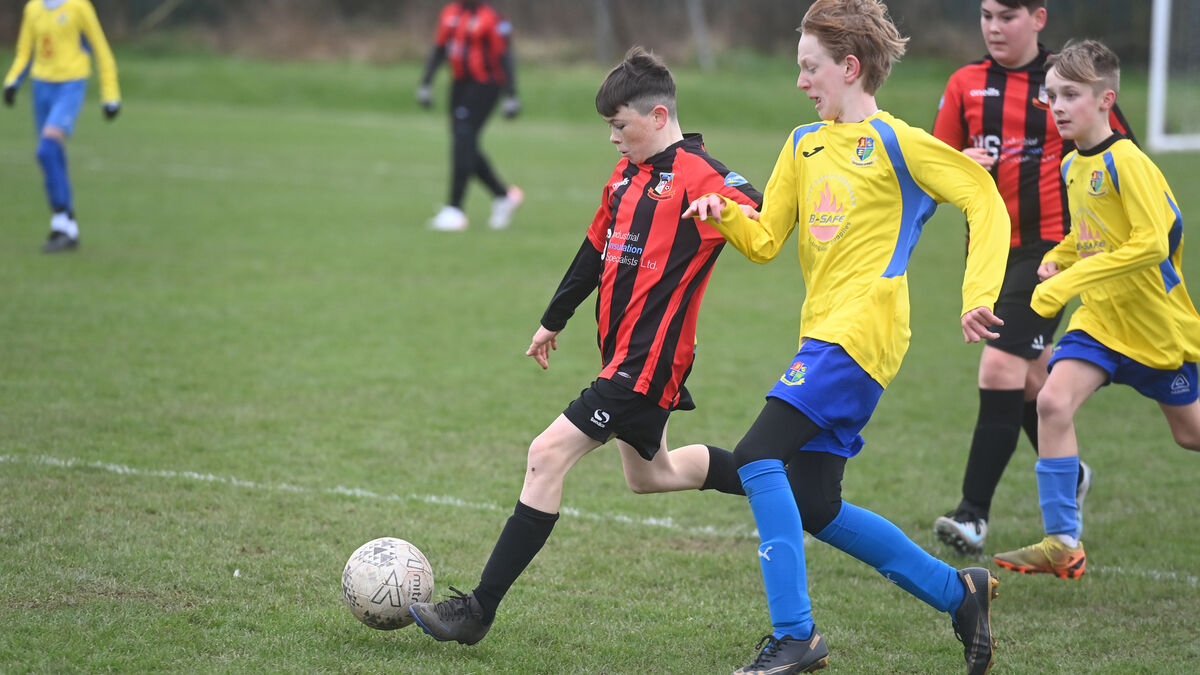
Fionn Coleman in action for Ringamahon A against Carrigaline United A. Picture: Larry Cummins
IRISH football is set for a complete overhaul, with the very structures the game is built-on set to be torn up so amateur leagues can align with the League of Ireland.
This means all levels, and all different age groups, will play through the warm months of summer instead of ploughing through the winter before returning for preseason in July.
This isn’t the first time that something like this has happened in Ireland. 20 years ago, the FAI adjusted the League of Ireland calendar so it ran through the summer, in a bid to get teams ready for Europe.
It paid off, despite a messy period that saw two league and FAI Cup champions crowned in 2003, with Shelbourne becoming the first Irish team to reach the Champions League play-off round in 2004 and Cork City got to the quarter-finals of the Intertoto Cup that same year.
Rockmount lived this dream in 2004 when they got to the FAI Cup quarter-finals, and they were controversially denied a famous win over Waterford United at the RSC. The last team who has some claim to an achievement like that is Crumlin United, and they were beaten by Bohemians at the same stage of the competition in 2018.
This disparity, and gulf, is just one reason as to why the governing body for association football in Ireland wants a closely aligned calendar. The idea is to create a unified pyramid, as opposed to two conflicting models of operation.
Almost everyone could benefit from this, with intermediate teams in-season for cup matches as opposed to having their first competitive against a full-time outfit with a studded squad looking for a potential double or treble.
Rockmount were affected by this back in 2022 when they reached the semi-finals of the Munster Senior Cup as defending champions.
Eddie Kenny’s side were at the tail end of a dream season when they got to the final four, and that created a fixture pile-up as they tried to balance the FAI Intermediate Cup and two other cup competitions.
The semi-final was eventually played in the middle of the summer and a rusty Rockmount side went down 4-0 at home to Cobh Ramblers.
Amateur teams won’t be the only ones to benefit. League of Ireland sides will be able to effectively loan young players out to intermediate clubs so they can get game time as they make the transition from U20s to senior football.
This has sort of been the case for a number of years now, with players going from the Underage National Leagues to the Munster Senior League. Sean McLoughlin is the most high profile, given his trophy-laden spell with UCC, and now there’s Oran Crowe, who recently returned to Turner’s Cross after a brief stint at intermediate level.
It’s not all positive, and a win-win for both sides of the ecosystem.
Like most things in football, the idea works in theory but there are a number of issues that can affect practical implementation.
The weather is the obvious thing. Everyone knows the conditions during the autumn and winter make a stretch of games next to impossible, and clubs without a full-sized astro will struggle to complete fixtures, which creates a backlog towards the end of the season.
Cork City’s male and female teams felt the full wrath of it towards the end of 2023, with games regularly called off over the condition of the pitch at Turner’s Cross. There’s only so much the surface can take, and now local cup finals will have to be considered alongside League of Ireland matches.
The Cork Women’s and Schoolgirl Soccer League will also be called into question, given that runs through the summer months.
Will clubs with only one or two pitches be able to facilitate that much football, even with a break planned so players can take a holiday?
Before all of this can happen, there’s the question of how. Will an intermediate season be cut short, or will football be stopped for almost a year to facilitate the alignment?
How will small teams cope with GAA matches, and will this favour sides from the city with bigger squads and a bigger catchment area?
But this is Ireland, a country working with more or less the same physical infrastructure since the 1990s. Change is slow and almost non-existent.
The only thing that really matters is the here and now.









 App?
App?


