Ladies football grows beyond recognition with 120,000 new members in 20 years
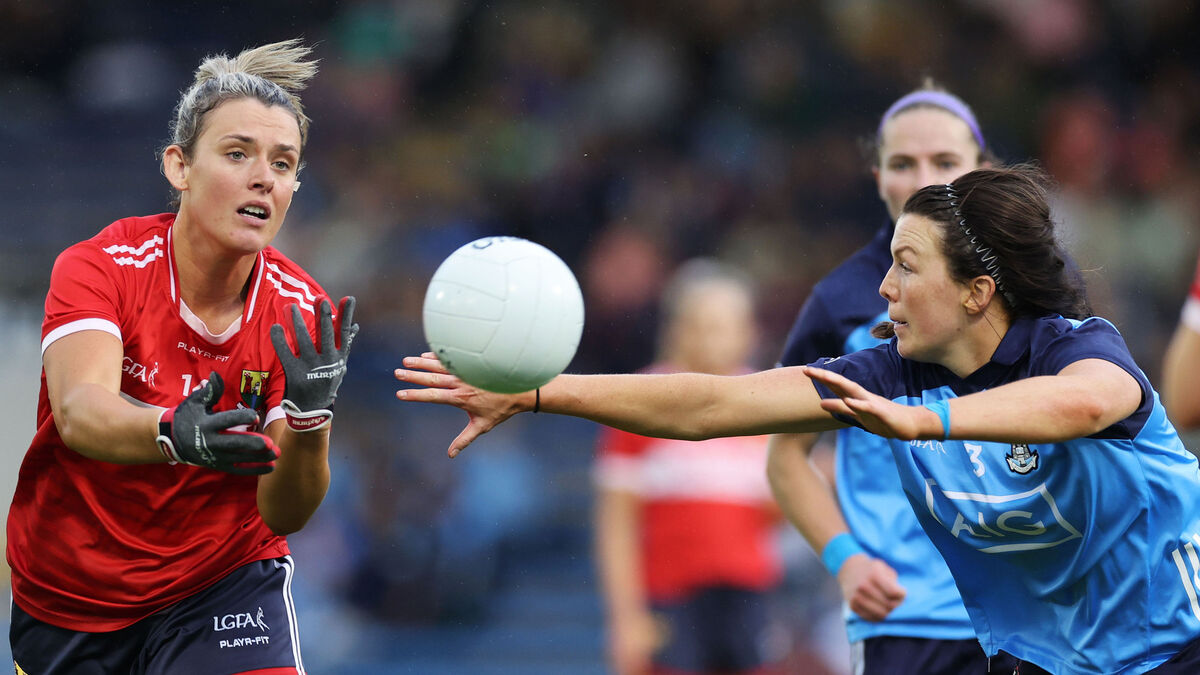
Dublin's Leah Caffrey and Doireann O'Sullivan of Cork in the All-Ireland. Picture: INPHO/Lorraine O’Sullivan
IN Ireland in the 1960s, when local carnivals and festivals were commonplace around the country, organisations were always on the look-out for novel ideas to raise finance.
Ladies Gaelic football fell into that category. In little pockets around the country, games were organised.
South Tipperary and north Waterford were the first oasis in a barren desert, which saw ladies football matches organised in the late 1960s and early 1970s.
The game gradually began to grow. Seven-a-side matches were popular in Roscommon.
The game was taking off in Offaly. And at the outset of that decade, Cork ladies footballers began to get in on the act.
Knockskavane, Ballydaly, Banteer, Newtownshandrum, Freemount, Boherbue and Buttevant began to play each other - and the spectators started to respond.
Cork began with a divisional championship in 1973. The final was played at Banteer on the 2nd of September, with Knockskavane beating Ballydaly on a scoreline of 3-4 to 2-3.
Across the border in Kerry, teams also started to organise and start playing each other.
A carnival week held in Banteer saw Cork take on Kerry in a game that attracted a crowd of 2,000 spectators.
The game was refereed by Denny Long, who had won an All-Ireland senior title with Cork just a couple of weeks earlier. Kerry won on a narrow margin of 5-10 to 4-11.
Ladies football was still in its infancy but it was finally about to gain a whole new identity.
With several county boards set up by the end of 1973, a meeting was called in south Tipperary with a view to setting up a national association.
After another meeting in Hayes Hotel in Thurles in July 1974, the Ladies Gaelic Football Association was officially founded.
Eight counties - Roscommon, Laois, Offaly, Galway, Kerry, Cork, Waterford and Tipperary – took part in the first championship. Tipp and Offaly met in the first final that October, which Tipperary won.
Last year, historian Hayley Kilgallonspoke at the Sidelines, Tramlines and Hemlines - Women in Irish Sport conference about the emergence of ladies' football and the LGFA.
When she later joined Myles Dungan on RTÉ Radio 1's History Show to talk about some key events in the evolution of the sport, Kilgannon began by highlighting a letter to The Sunday Independent in 1967.
"This farmer wrote to the Sunday Independent, calling on the GAA to ban women from attending the upcoming All-Ireland finals,” said Kilgannon.
"He said that women would take up valuable space in Croke Park. But he went a bit further, saying that the sight of women, outside the home, up in the city for fun and enjoyment, was revolting and unnatural to him."
The backlash was rightly loud and clear, with all the responses published by the paper a week later, all of which argued against the farmer’s viewpoint.
With the respondents both men and women, the general theme was that if the GAA was a male-only organisation, as he said, then match attendances and gate receipts would be much lower.
During her research Kilgannon didn't find any motivation from the women who were playing Gaelic football to do so out of a feminist agenda.
They were just looking for an active social life outside of the home, and that was their main driving factor to play Gaelic football.
Look at how far the ladies game has come now, especially in the last two decades? In 2001, the LGFA had in the region of 80,000 members. By 2020, that number had risen to 192,873. Now, it’s over 200,000. There are over 1,000 clubs, with numbers rising all the time.
Around the turn of the millennium, the All-Ireland final was the only game that was shown live on TV. Now?
Every inter-county game this year was either shown on TG4 or streamed on Facebook or YouTube.
The LGFA’s link with TG4 was a game-changer, especially when such huge TV exposure has made it easy to attract big sponsorship.
The LGFA’s link-up with Lidl has presented the sport to the public in a way they never imagined before this. Last year, the LGFA and Lidl announced a four-year partnership extension until 2025, which will represent an investment of €10 million over 10 years.
In 2022, TG4 also announced a five-year extension of their sponsorship of the inter-county championship, which was a redoubling and intensification of TG4’s most important sporting partnership.
The Association now has nine huge sponsors, most of which are massive brands, ranging from Lidl to TG4 to Sports Direct to AIG to Yoplait Ireland.
The LGFA still needs to answer some hard questions as to how it treats its players, setting aside the ongoing issue of integration between the GAA, the LGFA and Camogie Association.
That’s a whole different debate but nobody can deny how popular the game has become.
On Sunday, Kerry and Dublin meet in the 50th All-Ireland final in the history of the LGFA.
It’s the first time both counties have met in the final, which could see the record attendance of 56,114, which was set in 2019, surpassed.
Ladies football has certainly come a long way from that first All-Ireland final played on a sloping pitch in Durrow in October 1974.






 App?
App?


