Traveller suicide crisis: 'Many will go to a holy well or Marian Shrine before they'll go to counselling'
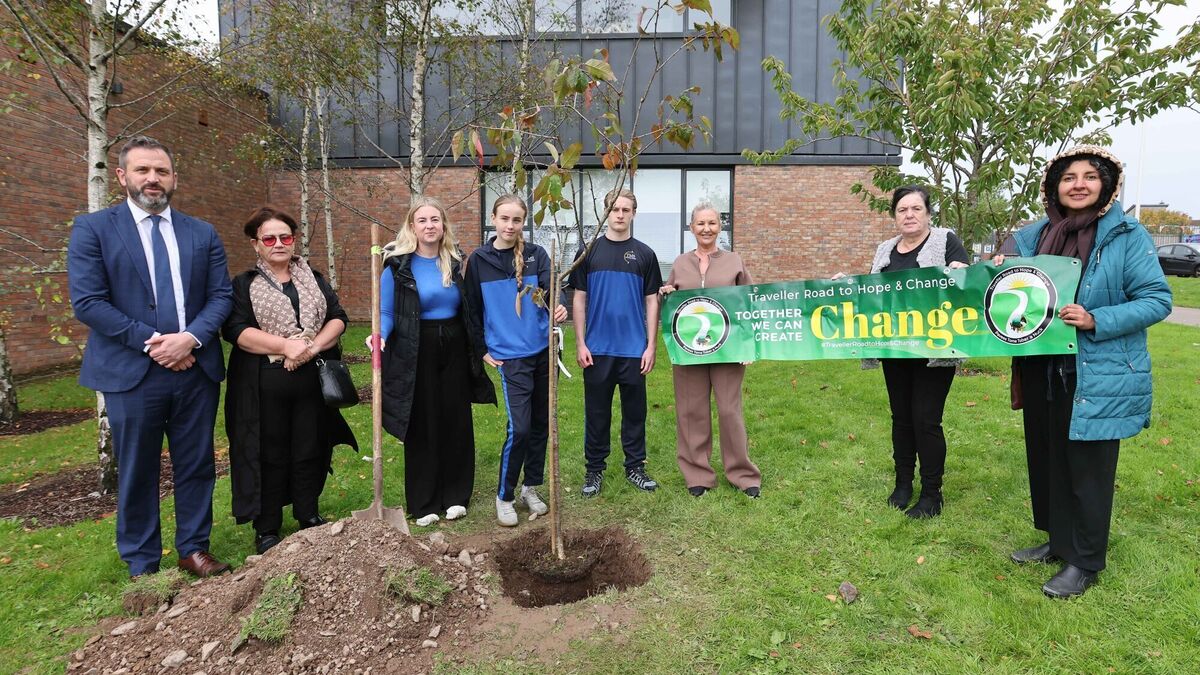
David Newman, deputy principal, Terence MacSwiney Community College with Jean O'Donoghue, Traveller Visibility Group, Amy O'Riordan, Terence McSwiney Community College teacher and traveller support teacher; first year student Katie-Anna O'Driscoll; sixth year student Darren Stewart; Mandy O'Riordan, English and behavior and learning/literacy at Terance MacSwiney Community College; Biddy McDonagh, Traveller Visibility Group, and Tehmina Kazi, Traveller health co-ordinator at the Traveller Visibility Group, at the tree planting at Terence MacSwiney Community College in Knocknaheeny.
Jean O’Donoghue still feels the pain of that day – when the trees they had planted honouring fellow Travellers lost to suicide were ripped from their roots in a disturbing act of vandalism.
The incident raised an important question for the Cork TVG Traveller community health worker, and her colleagues Eileen Burke and Biddy McDonagh, about the compounding part racism has to play in a community rocked by mental health issues and suicides.
“It must be around six years since the trees were destroyed but it was like they were never there,” Ms O’Donoghue said. “The ground was manfully fixed. It had to be a professional job. The trees were destroyed in Mahon and close to Spring Lane. It was a clear act of discrimination which we see a lot. It’s just something we are used to as a community.”
The advocates were touched to see another “tree of hope” planted by staff and students of Terence MacSwiney Community College in Hollyhill to mark Traveller Mental Health Day and remember those who lost their lives to suicide.
For Eileen, Biddy and Jean, it wasn’t the loss of the previous trees that cut emotionally deep, but what they represented. Just five years ago Eileen lost her niece – a 21-year-old mother-of-one – to suicide. It followed the death of her brother-in-law, who had taken his own life years before that. Biddy can also personally identify, having lost her brother to mental health issues four-and-a-half years ago.
The three were among hundreds of travellers who recently attended the annual Traveller Mass at Knock Shrine to mark National Traveller Mental Health Day. Many of those in attendance had dedicated their pilgrimage to loved ones lost to suicide.
Eileen, Biddy and Jean are calling for more awareness around the issue and an update to the All-Ireland Traveller Health Study. Published by the UCD school of public health, physiotherapy and population science for the Department of Health and Children, the study published in 2010 highlighted the health status, needs, and living conditions of the Irish Traveller community across Ireland.
It reported that 11% of all Traveller deaths are due to suicide. The findings also shone a light on how perceived and experienced discrimination can result in a lack of trust in mental health services.
This is something community health worker Eileen Burke has seen first-hand through her work promoting positive mental health strategies among travellers across Cork.
“The All Ireland Health Study Health study was done in 2010 so it’s very outdated now,” Eileen told .
“We could really do with updating those studies because we believe these statistics are even higher now. It’s still very there hard to get a lot of travellers to attend counselling services. A lot of people will go to a holy well or Marian Shrine before they will go to counselling.
"I know everyone has different ways of dealing with their feelings and their mental health but religion is one of the ways that travellers cope. They may not be big mass goers, the same as in the wider community, but they never lost the tradition of going to holy wells and shrines.”
Eileen, Jean and Biddy are currently promoting TVG’s Bags of Hope initiative which sees them distribute bags containing symbolic items such as candles representing a light during dark times and a tea bag reminding people about the importance of conversation. The initiative is aimed at traveller families struggling through difficult times.
Biddy spoke about the predominant issues contributing to mental health issues in the traveller community.
“We carry a lot of trauma from our past that is now manifesting in our young people due to discrimination,” she said.
"The reality is that there are a lot of travellers who are not getting jobs because of who they are. Then there are the ones who are in employment, but who are afraid to reveal their true identity. We have people who are working as gardaí and nurses who won’t tell anyone they are travellers in case of a backlash. We spoke to one GP who told us that if he identified as a traveller he would have no patients in the morning.”
That stigma can often creep into the social lives of those affected.
“After Christmas when everyone comes back here to work the conversation is always around how many places they were turned away from. Many travellers just don’t get into places. Getting a premises for birthday parties is impossible. Until discrimination is stopped in this country and people are held accountable then I can’t see anything changing.”
Eileen said life can be particularly difficult for travellers within the LGBQT community.
“There are still difficulties for people coming out in our community. It’s a double edged sword because not all families are going to be accepting of a loved one who is gay. There is still a chance they might be excommunicated from their own community and family because of it.
"We have travellers that have come out who talk about what they are going through. Each one of them will tell you that their mental health has been affected because of their sexuality.
"We also have a huge problem with online bullying. There are a lot of young people who have taken their own lives as a result of being bullied on social media.”
Eileen is urging anyone who finds themselves in a dark place not to give up hope.
“There is so much support available now. Even in the schools we visit the students are opening up about what their families are going through. The awareness is there and we are trying to support as many people as possible.”
Meanwhile, Jean said that mental health awareness has come a long way since she was a child.
“When I was a child we were always told to hush up. You couldn’t talk about suicide or anything like that. People were superstitious and were convinced that if you spoke about something awful out loud it would come true. People, particularly the older generation would get very angry but lately, they are noticing the benefits of talking about mental health. Before they believed that if you didn’t talk about something it would just go away but the older generation are on board now and that’s a very positive change.”
- If you are affected by any of the issues raised in this article, please click here for a list of support services.







 App?
App?


