City Council: 'Our roads aren't melting because we use superior material to the County Council'
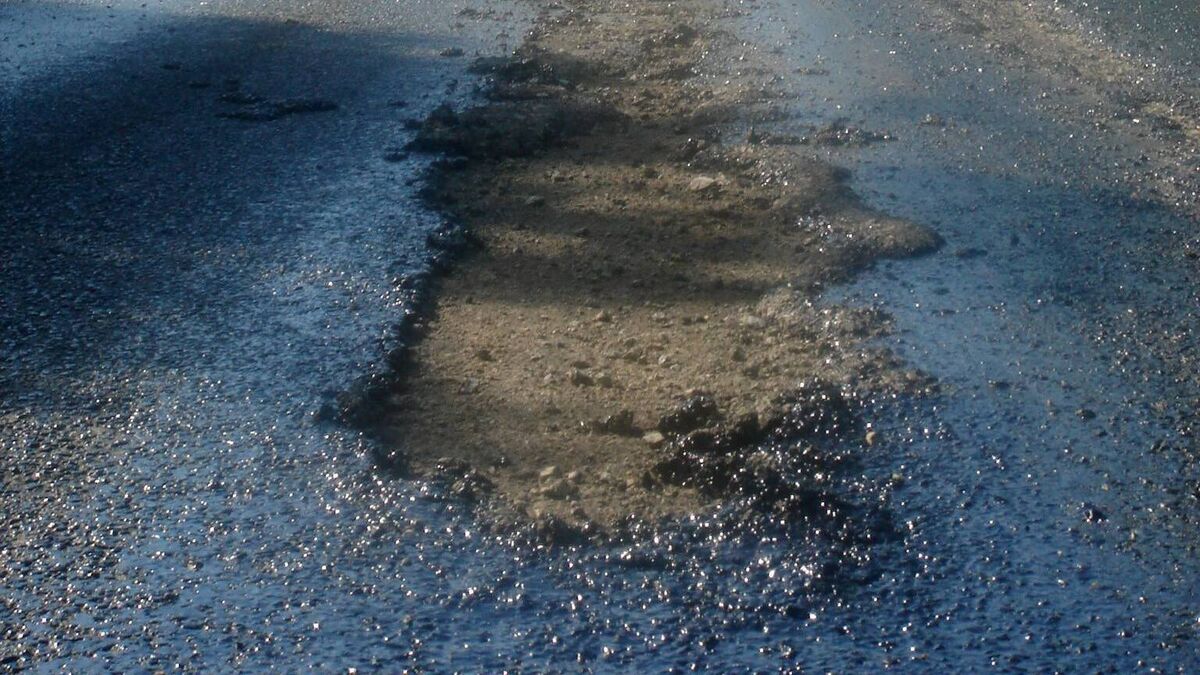
Melting tar can lead to cars skidding as the tar softens and oil rises to the surface. It can also cause damage to tyres. Picture: Brian Lynch
Cork City Council has said that the materials it uses for roads has a higher melting point than the standard tar used by Cork County Council, where damage has been reported.
Numerous ‘Status Yellow’ high temperature warnings have been in effect in Cork in recent weeks, as temperatures neared 30 degrees in parts of the county.
The high temperatures led to damage to many roads, as the dark road surface absorbed heat, leading to surface temperatures rising to 50 degrees, the melting point for standard tarmac.
Melting tar can lead to cars skidding as the tar softens and oil rises to the surface. It can also cause damage to tyres.
Surface temperatures over 40 degrees were reported on numerous Cork county roads on Friday by Transport Infrastructure Ireland (TII), with the N72 Fermoy reaching 51 degrees, while the N71 in Leap outside Skibbereen was 49 degrees, with the M8 in Mitchelstown at 47 and the N20 in Charleville hitting 46 degrees.
On Sunday morning, surface temperatures remained high, with TII reporting 37 degrees on the N72 Fermoy, 36 degrees on the N71 at Leap, 34 degrees on the M8 Mitchelstown, and 29 degrees on the N20 Charleville.
Asked by The Echo why Cork City Council was not experiencing the same melting issues as Cork County Council, a city council spokesperson said that the material used for city roads had a higher melting point than that which was commonly used on more rural roads.
They said: “The melting of roads is not a significant issue in Cork city as the vast majority of our roads and streets are surfaced with stone mastic asphalt or hot rolled asphalt, which has a higher melting point than a thin tar layer on surface-dressed roads.”
Padraig Barrett, Cork County Council’s director of roads and transportation, said last week that the local authority may need to look at a more expensive material for its roads.
Council crews have had to treat numerous roads across the country with sand and grit as tar is melting as a result of the ongoing warm weather.
Mr Barrett said that, as the frequency of roads being damaged by heat increases, and given advice by scientists that temperatures will continue to rise, they should look to move away from standard cationic bitumen to a material called ‘premium polymer modified emulsion’ (PPME) to surface roads.
PPME can withstand road temperatures from -15 to 60 degrees, but it costs up to 20% more than standard materials.
This would mean significantly more road funding would be needed, as there are 12,200km of roads in Cork county, which is the largest road network of any local authority. Cork County Council has repeatedly said that it receives one of the lowest allocations per kilometre, nationally.
Keep up-to-date with the top stories in Cork with our daily newsletter straight to your inbox.
Please click here for our privacy statement.
Have you downloaded your FREE
App?

It's all about Cork!
Add Echolive.ie to your home screen - easy access to Cork news, views, sport and more