New book recalls heroic rescue in treacherous waters off the Cork coast
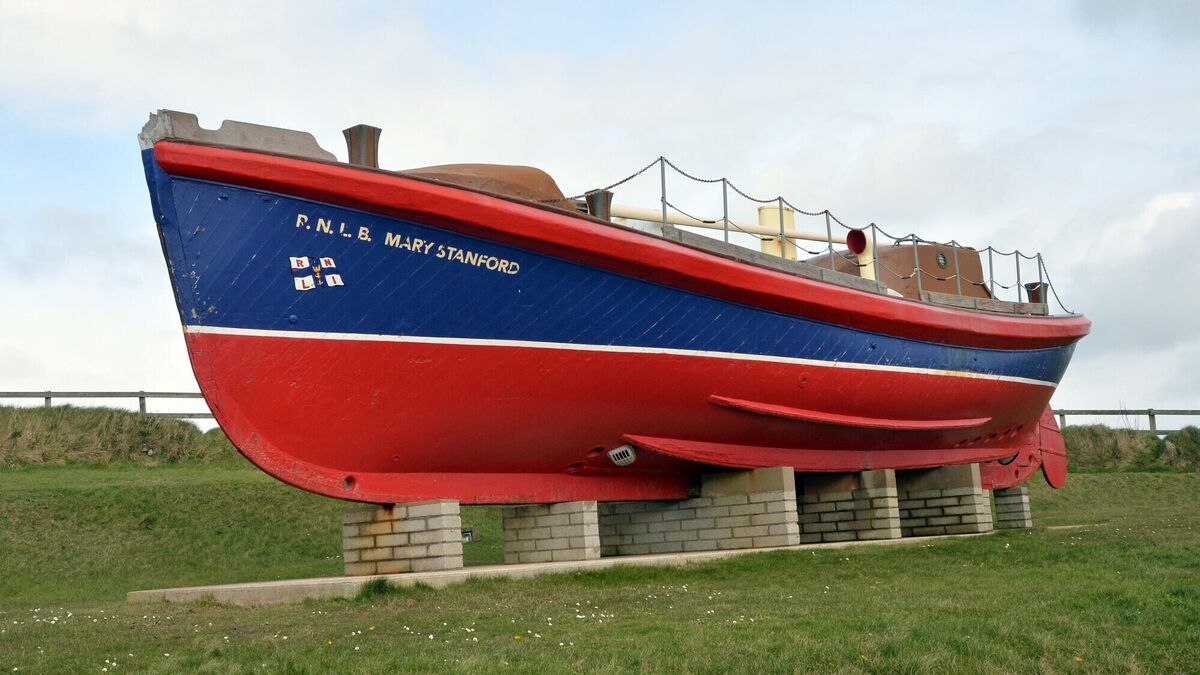
The restored Mary Stanford lifeboat on display in Ballycotton, Co Cork. The vessel retired from active service in 1959, where it was a reserve lifeboat for another decade. Picture: Denis Minihane.
A new book, marking the 90th anniversary of a heroic sea rescue off the Cork coast, will be launched next month, with all monies raised going toward the maintenance of the lifeboat which completed that mission.
The RNLB (Royal National Lifeboat) Mary Stanford served for three decades as the Ballycotton lifeboat, between 1930-1959, performing 41 rescues — known as ‘shouts’ — saving 122 lives in the process.
The Mary Stanford’s most famous rescue was that of the Daunt lightship LV (lightvessel) Comet, in February 1936.
A lightship is a vessel which acts as a lighthouse in areas deemed unsafe for the construction of proper lighthouses. Traditionally they are heavy, sturdy vessels.
Daunt Rock, a submerged reef located five miles south-west of the coast of Cork, off Fountainstown at the entrance to Cork Harbour, has for centuries been considered a deadly hazard to ships.
In 1864, following the wrecking of The City of New York on the rock, the Irish Lights Board stationed the LV Puffin at Daunt Rock. The Puffin vanished in a gale on October 8, 1896, and its wreck was not found until a month later.
The remains of the eight-man crew were never recovered, and local legend says they remain at their posts on the ghost ship Puffin, appearing to warn sailors of impending danger.
Forty years later, early on the morning of February 11, 1936, the volunteers of the Ballycotton lifeboat received an SOS call.
Hurricane
In the teeth of a ferocious hurricane, the eight-man LV Comet had broken from her moorings at the rock. Adrift in mountainous seas, her heavy build made her a hazard to other vessels.
Not waiting for orders, coxswain Patsy Sliney took the seven-man Mary Stanford out and found the Comet riding at anchor in crashing waves a quarter of a mile from the rock. Under the 1921 Anglo-Irish Treaty, Cork Harbour was still a base for the Royal Navy, and the destroyer HMS Tenedos was at hand but in mutinous seas, dared not come too close.
Time and again the crew of the Mary Stanford tried to get a steel cable to the Comet so the Tenedos could tow it home, but time and again the heaving waters bore them apart and the cable snapped. The B&I packet Innisfallen joined the Tenedos to render assistance, but conditions remained treacherous.
At nightfall, the Mary Stanford went to Cobh for stronger cable. Famished and exhausted, the crew grabbed a bite to eat, a change of clothes, and three hours sleep.
The lifeboat returned to the scene early the next morning, but the storm raged unabated and a thick fog descended, rendering a rescue impossible. The Tenedos departed and was later replaced by the Irish Lights vessel Isolde. The Mary Stanford stayed in position for the next 24 hours, warning other vessels away.
By 7am on the third morning, the Mary Stanford had to return to Cobh for fuel; but despite exhaustion, seasickness, and injury, the crew returned again after a short rest.
Daunt Rock
The storm worsened throughout the day, and by nightfall, the wind shifted —threatening to blow the Comet onto Daunt Rock.
With the Comet drifting ever closer to the rock, Mr Sliney decided their only hope was to draw the Mary Stanford alongside the stricken vessel and urge the crew to risk drowning by jumping to the lifeboat.
On their first attempt, one man made it across, but a second pass proved fruitless. On the third attempt, five men made it across, leaving only two aboard the Comet. A fourth attempt failed, with the Mary Stanford damaged in the effort.
With the remaining two crewmen clinging to the Comet’s rails, too exhausted to jump, a fifth pass also failed.
As a last, desperate resort, some of the lifeboat crew stood on the bow of the Mary Stanford as the sea roiled beneath them, and physically hauled the two men across. Both of the rescued men were injured in the effort, but they were saved.
The Mary Stanford brought the rescued crew of the Comet to Cobh, and then returned to Ballycotton on the morning of February 14, St Valentine’s Day, arriving home 79 hours after they had first departed.
The volunteer crew of the Mary Stanford were honoured by the Royal National Lifeboat Institution (RNLI) for their rescue of the crew of the Daunt Rock lightship, with Mr Sliney awarded the RNLI gold medal; John Lane Walsh and Thomas Sliney the silver medal; and Michael Coffey Walsh, John Shea Sliney, William Sliney, and Thomas Flavin Walsh receiving the bronze medal.
Four decades later, An Post celebrated the 150th anniversary of the RNLI by issuing a commemorative stamp based on Bernard Gribble’s painting depicting the rescue.
Pirate radio station
Miraculously, the Comet survived, going on to host the pirate station Radio Scotland from 1965 to 1967.
Mr Sliney retired in 1950, having helped to save 114 lives and having been awarded the RNLI’s gold, silver, and bronze medals.
The Mary Stanford retired in 1959, serving as a reserve lifeboat for a further decade, before being sold to the Limerick harbour commissioners, where she served as a pilot launch boat until the mid-1980s.
She was later among the vessels acquired for a proposed floating nautical museum at Dublin’s Grand Canal Docks, but when those plans fell through, she spent years languishing in a docklands backwater.
In 2014, a Ballycotton group was formed to bring the Mary Stanford home. After restoration work, she was put on permanent display overlooking Cork Harbour.
At 7pm on February 11, a new local history book, Cloyne in the Great War 1914–18, will be launched the library of the Garryvoe Hotel, marking the 90th anniversary of the rescue.
Written by historian Gerry Kearney, the book documents the lives and service of 267 men and five women with links to the greater Cloyne parish who served during the First World War.
The book records service with the lifeboat services, as well as service with the Merchant Navy, the Coastguard, and the Red Cross.
The war service of two of the men who would later serve on the Mary Stanford, Mr Sliney and Mr Flavin Walsh, is recorded in the publication.
The book will be available for purchase at the event and locally at Ballymaloe Shop, Brodericks, Shanagarry, Centra Cloyne, the Midleton Bookshop, and online via https://www.kennys.ie.
All proceeds will go to the ongoing maintenance of the Mary Stanford.


 App?
App?


