NCT testers found more than 17,000 Cork vehicles were dangerously defective last year 
Broken down into individual Cork test centres, NCTS data showed that Macroom had the highest ‘fail dangerous’ percentage rate at 8.45%.
NCT testers found more than 17,000 Cork vehicles were dangerously defective last year 

Of the 219,331 inspections undertaken at the six NCT centres across Cork in 2025, almost one in two cars failed on the first attempt.

More than 17,000 vehicles in Cork that underwent an NCT inspection last year were deemed to be dangerously defective, National Car Testing Service (NCTS) data has shown.

Of the 219,331 inspections undertaken at the six NCT centres across Cork in 2025, almost one in two cars failed on the first attempt.

Of these, 17,019 were described as ‘fail dangerous’ and 90,610 ‘failed major’. This represents an overall failure rate of 49.7%, with 7.75% of those deemed dangerously defective.
A ‘fail dangerous’ designation means that a vehicle has a defect that poses a direct or immediate risk to road safety.

A ‘fail dangerous’ designation means that a vehicle has a defect that poses a direct or immediate risk to road safety.

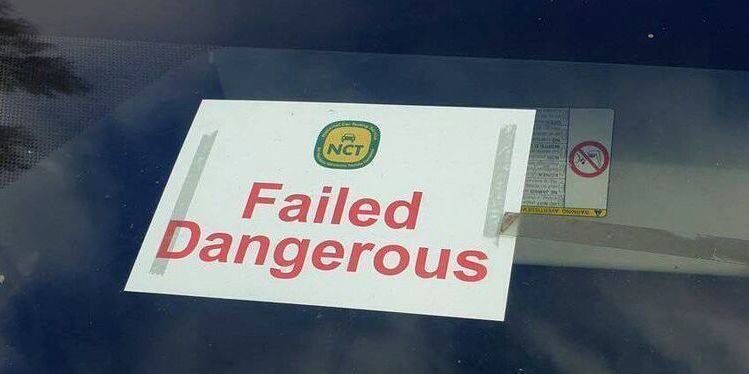
In such a scenario, the NCTS puts a ‘failed dangerous’ sticker on a driver’s vehicle, and it is illegal to drive that vehicle with a dangerous defect away from the test centre.

A tester will advise that the vehicle be towed off the premises. 

Should a person drive that vehicle away from the centre, the NCTS will inform gardaí. If a motorist continues to drive the vehicle and is subsequently stopped by gardaí, they may incur penalty points or be summonsed to appear in court.


The vehicle must be repaired and must be re-inspected by the NCTS within 30 days. If it passes, the vehicle will then be issued with a valid NCT certificate.

Highest rate

Broken down into individual Cork test centres, the NCTS data showed that Macroom had the highest ‘fail dangerous’ percentage rate at 8.45%, with 1,928 of the 22,811 vehicles tested falling into the category.

Skibbereen had the next highest rate, with 1,845 of the 21,856 vehicles tested (8.44%) deemed to be unroadworthy at the first attempt. 

This was followed by Charleville at 1,738 of the 21,717 vehicles tested (8%); Little Island, with 6,205 of 78,923 tested (7.86%); Blarney, 3,722 of 51,112 (7.28%), and Youghal, 1,581 of 22,912 vehicles tested (6.9%).

Nationally, 132,964 cars received a dangerous fail in an NCT test on the first attempt during 2025.

This is an increase on the figure of 128,548, or 3.4% on the previous year.

The NCT centre at Little Island emerged as the facility with the highest pass rate in Cork for the roadworthiness test on vehicles during 2025, at 53.4%.

Lowest rate

This is followed by Blarney (51.08%), Youghal (51.03%), and Macroom (49.77%). Skibbereen recorded the lowest pass rate at 46.62%, with Charleville slightly ahead at 47.06%.

The test centre with the highest NCT pass rate in Ireland during 2025 was Deansgrange in Dublin at 57.28%.

This is followed by Tullamore (56.19%), Ballinasloe (54.82%), and Cahir (54.28%).

Little Island is ranked fourth nationwide in terms of the highest pass rate, followed by Waterford (52.95%), Derrybeg (52.76%), and Limerick (52.29%).

Read More

Implementation of BusConnects will address local traffic concerns, says Cork City Council

More in this section

Man with 12-year driving ban caught driving illegally on Cork roads five times in one year Man with 12-year driving ban caught driving illegally on Cork roads five times in one year
NTA to publish Cork active travel infrastructure index  NTA to publish Cork active travel infrastructure index 
Row of new built houses in england uk More than 750 homes approved for social housing in 2025 in Cork city

Sponsored Content

Turning risk into reward: Top business risks in 2026 Turning risk into reward: Top business risks in 2026
Top tips to protect Ireland's plant health Top tips to protect Ireland's plant health
River Boyne in County Meath, Ireland. Water matters: protecting Ireland’s most precious resource
Contact Us Cookie Policy Privacy Policy Terms and Conditions

© Examiner Echo Group Limited

Add Echolive.ie to your home screen - easy access to Cork news, views, sport and more