The light and dark past of the Good Shepherd site and Cork's unofficial Saint

Good Shepherd Convent, artist's impression of student campus
On Sunday, February 2, 1908, a four-year-old girl who was suffering from profound disabilities died in a convent in Sunday’s Well in Cork. Three years later, Pope Pius X declared the child a sign from God and lowered the age of first communion across the Catholic world from 12 to seven.
That little girl was born Ellen Organ in Waterford city on Monday, August 24, 1903, the youngest of four children born to William Organ (a variation of Horgan) and Mary Ahern. When Nellie — as she was known to all — was a baby, her babysitter dropped her to the ground, causing severe spinal injuries which left her in constant pain.
When Nellie was aged two, her father, a soldier in the British Army, attached to the Royal Garrison Artillery, was transferred to Spike Island in Cork Harbour, bringing with him his family. Their cottage still stands there.
It was while living on Spike Island that Mary, a deeply religious woman, fell fatally ill with tuberculosis (TB). Throughout her illness, she carried Nellie everywhere, constantly telling the sickly infant stories of ‘Holy God’.
When Mary died, in 1907, William struggled to raise his four young children, all under the age of nine, and they were eventually placed in care. Nellie, then aged four, was sent with her sister to the industrial school run by the Sisters of the Good Shepherd in their convent in Sunday’s Well. Nellie was in the care of the nuns there for eight months and she spent most of that time in the infirmary.
The little child had by then contracted TB, and as well as suffering severe spinal injuries, she also had whooping cough and caries, a rotting disease of the mouth which eventually caused her jaw to disintegrate.
A precocious child, Nellie impressed the Good Shepherd nuns with her religiosity, her devotion to the Child of Prague, and her belief that ‘Holy God’ was present in the tabernacle of the convent’s chapel.
The nuns successfully petitioned the then-bishop of Cork, Thomas Alphonsus O’Callaghan, to grant her the sacrament of confirmation, and then, two months later, communion, a sacrament then reserved for children who were over the age of 12.
Nellie's Death
When Nellie died — on the feast of the Purification of Mary — at the age of four years, five months and eight days, she was buried in St Joseph’s cemetery in Turner’s Cross. Nineteen months after her death, the Good Shepherd nuns had Nellie’s body exhumed from St Joseph’s to be re-buried on their Sunday’s Well property. They claimed that when they opened her coffin, her body was perfectly preserved, and all signs of decay had disappeared.
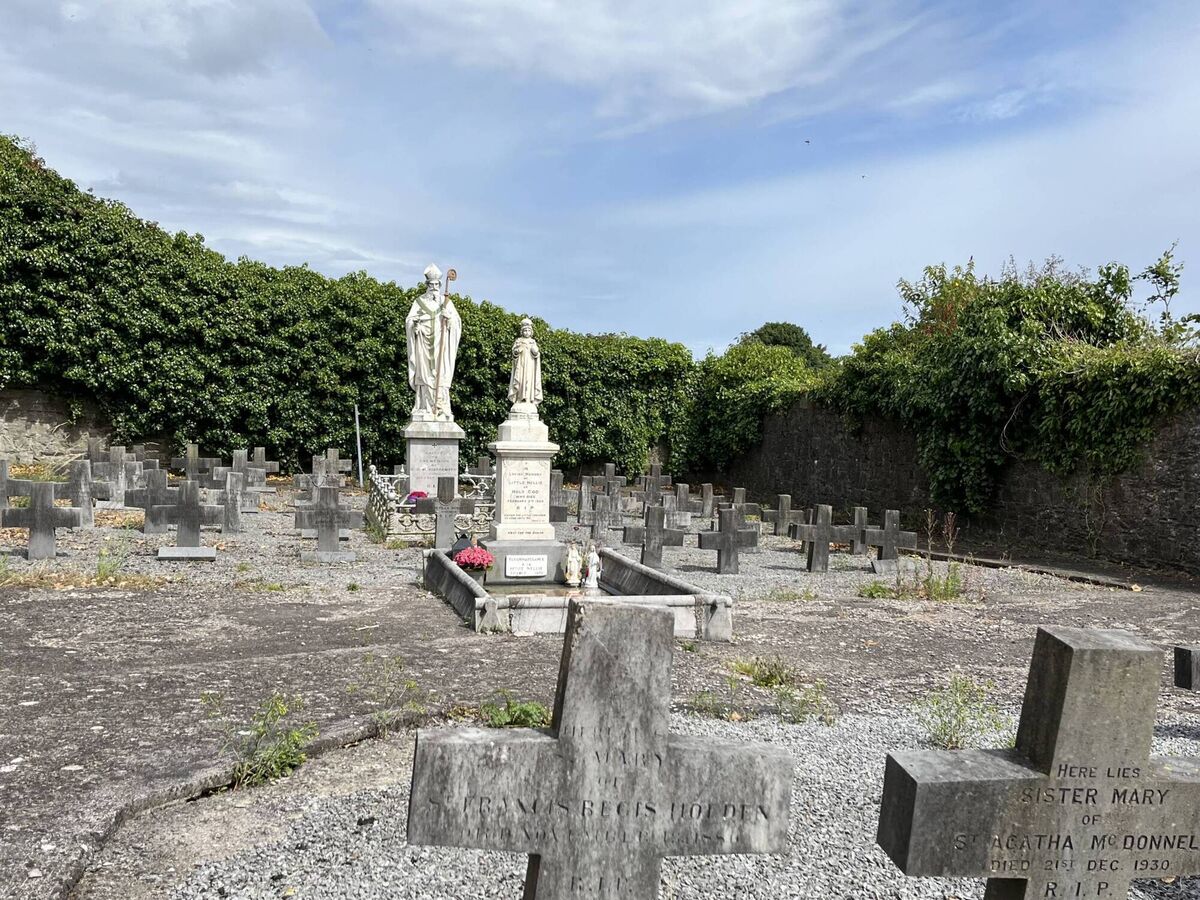
Nellie was re-interred, in the nuns’ graveyard on the north-eastern corner of the Good Shepherd grounds, among the neat stone crosses and memorials which, by the end of the 20th century, would mark the resting places of 110 brides of Christ.
Soon the new grave became a place of pilgrimage, and people with disabilities visited in their droves, some claiming cures which they attributed to Little Nellie’s intercession with God.
Tales of her piety spread to Rome, and Bishop O’Callaghan began promoting the case for Little Nellie’s beatification. Pope Pius X, born Giuseppe Sarto, asked for a lock of her hair.
The pope was reputed to have great affection for children, carrying sweets in his pockets to give to street children. A traditionalist who proclaimed holy communion “the shortest and safest route to heaven”, he had long contemplated lowering the age of first communion from 12 to what was called the age of discretion, seven, when the Catholic Church said children could tell right from wrong.
The pope believed that earlier communion would spark greater devotion among families, although many in the church feared the opposite might occur, worrying that, with first communion out of the way, parents might withdraw their children from Catholic schools at the age of seven.
Seeing in Nellie Organ an opportunity to best his opponents, the pope declared her a sign from God and decreed that the age of first communion be lowered to seven.
Pius died in 1914, aged 79, and Bishop O’Callaghan in 1916, aged 77, and with them so too died Little Nellie’s most immediate pathway to sainthood. However, her Sunday’s Well grave has remained a pilgrimage site ever since, the centrepiece of the nuns’ graveyard, beneath a white marble plinth and a statue of the divine infant Jesus.
History of the Good Shepard Site
The Good Shepherd convent was established in Sunday’s Well in 1870 and was completed in 1881, and it operated until 1977. During that century, the convent also served as a Magdalene laundry, an orphanage, and an industrial school, and thousands of women and children were kept inside its red-brick walls.
Newspaper records show courts sending women there well into the 1970s. In one case, in 1932, the courts sent a woman to the laundry for the concealment of a birth for two years. She remained there for 46 years and is believed to be buried in a mass grave in the overgrown and almost inaccessible Magdalene plot in Sunday’s Well.
Burial records show that at least 188 women died while in the care of the Good Shepherd Sisters in Cork, and many are believed to be buried in that mass grave.
High up on the north-western end of the former convent site, above and behind Cork Gaol, a vandalised cross bears the names of 30 Magdalene women. The grave was unmarked until the late 1990s, when the order agreed to erect a headstone, following a campaign by a former resident of the laundry.
Thirty names are recorded on the memorial, with the earliest name that of Ellen Lynch, who died in 1876, and the latest being that of Clare O’Connor, who died in 1989. However, as reported by Conall Ó Fátharta in the Irish Examiner, four of the women named on the stone are also recorded as being buried, in two separate mass graves, in St Joseph’s Cemetery.
One of those graves was only discovered by Justice For Magdalenes Research (JFMR) in 2012, when they also found a grave in Kilcully Cemetery. That grave appears to contain later burials from both the Good Shepherd and Peacock Lane laundries.
One woman who has spoken of her time in Sunday’s Well is Mary Harney. Born in the Bessborough Mother and Baby Home in 1949, she spent the first two-and-a-half years of her life there with her mother, before being fostered to a family in Cork city.
Neglected and abused there, she was removed from the foster home at the age of five and sent to the Good Shepherd, where she was made to stay until she was 16.
In 2020, Ms Harney told Órla Ryan in TheJournal.ie that from around the time she received her First Holy Communion at the age of seven, thanks, in part, to Little Nellie, she and other children “were polishing floors on our hands and knees, cleaning the headstones in the graveyard with wire brushes so that our knuckles were bleeding”.
“One of the things we had to do was what was called teasing a mattress. So, bear in mind that many of the children were emotionally and mentally disturbed, and they wet the bed.
“When we were assigned to work on these chores, one of the things we had to do was to slit open the horsehair mattress and take all the stuffing out of it. And we were in a room where there were no windows,” she recalled.
“These mattresses that were urine soaked, we had to tease the stuffing in them, the dust in them went up our noses. We would have to tease it from one side of the room, put it in the other side and then re-stuff the mattress with dry horsehair-type stuff.
“We had black snot for weeks after … nowadays, it would be considered a crime to make a child do that.”
She said children also had to wash some of the nuns’ headdresses and repair shoes.
“We repaired our own shoes, we cut the leather, we sewed the shoes ’til our fingers were bleeding with the wax thread. And that was considered normal, nobody considered that to be a problem.”
The site today
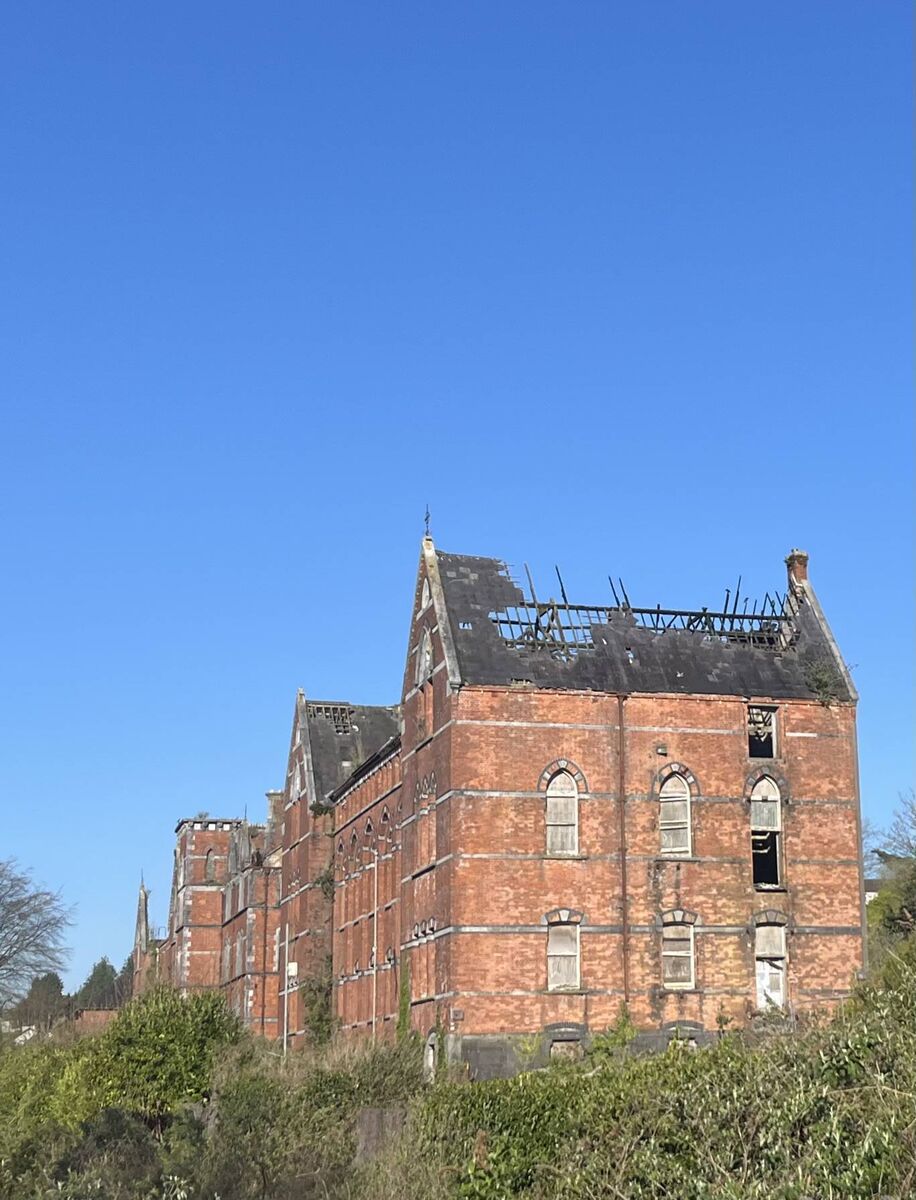
The convent closed in 1977, and in the years since then, the building and its lands were sold for development. First purchased by UCC in 1995, the eight-acre site was subsequently bought by developer Pat Hegarty, who sold it in 2011 to the Frinailla group for €20m at market peak. When the site went on sale in May 2016, agents Savills noted its suitability for residential development, a private hospital, retirement home or nursing home. It was purchased by its current owners, Dundalk-based and Dublin-registered Moneda Developments Limited, in late 2016, reportedly for in excess of €1.5m. In December of 2017, Moneda secured planning permission with the provision that its proposal for 234 apartments at the site be reduced to 182. The company also had to make a number of changes to their plans in the interest of the area’s visual and residential amenities.
At the time, local residents lodged more than 30 objections against the proposed development, insisting that the area would not be able to cope with an influx of hundreds of additional residents in an area already prone to chronic traffic congestion. In the event, nothing was done, and planning permission for the site expired in December of 2023.
The Good Shepherd site has been on Cork City Council’s derelict sites register since February of 2019 and has an estimated current market value of €1.85m. Over the years, multiple suspicious fires have reduced the site’s buildings to ruins.
In November, An Coimisiún Pleanála upheld a decision by Cork City Council to grant planning for a 274-apartment, 957-bed development for student accommodation at the former Good Shepherd convent in Sunday’s Well.
Survivor group Justice For Magdalenes Research (JFMR) has claimed An Coimisiún Pleanála failed to address its concerns about the planned development by Bellmount Good Shepherd Limited, owned by developer brothers Pádraig and Séamus Kelleher.
JFMR had asked that multiple conditions be attached to planning, including a forensic, victim-centred archaeological search of the site for human remains.
The group said there was an “urgent need to repair, maintain, and provide access to the Magdalene graveyard adjacent to the development”, saying the development as proposed would leave it “in its current state of inaccessibility and neglect, thereby perpetuating the marginalisation of the women and girls interred there”.
It also raised concerns at proposals to establish an “exhibit space” at the site’s former Bake House to “display information relating to the site’s history as an orphanage and Magdalene laundry, and place of burial for Little Nellie”.
JFMR said proposals to “connect spaces intended to acknowledge the abusive history of Sunday’s Well with the final burial place of members of the religious order who perpetrated these abuses (were) unethical, insensitive to survivors ... and further (marginalised) the Magdalene women and girls buried at the opposite end of the site”.
Little Nellie's Legacy
Decades after the convent closed, and years after the buildings have fallen to fire and ruin, the faithful continue to visit Little Nellie’s grave, even now that the site is largely inaccessible.
Similarly, her original gravesite in St Joseph’s is still visited, and it has become popular with some members of the Travelling Community.
In 2015, the then-Bishop of Cork and Ross, Bishop John Buckley, called for Little Nellie’s exhumation, with a view to moving her remains from the closed-off Good Shepherd site to a more accessible venue.
“As devotion grows to Little Nellie, we should ensure that maybe her remains are exhumed again, and placed in a more public place, where people could come and pray to her,” he said.
Pressed by survivors, Bishop Buckley said he fully supported calls for the Magdalene mass grave to be made accessible.
“I would support calls to make the other graves there accessible to those who wished to visit and pray there and would also support calls that the graves would be maintained appropriately and reverentially,” he said.
The bishop also condemned acts of vandalism at the grave and said he hoped that the matter had been reported to the gardaí.
“Respect for the dead, their place of burial, and religious sites are fundamental to a civilised society and are fundamental aspects to our Christian belief,” he said.
A decade on, Little Nellie remains in the nuns’ graveyard, the Magdalene women’s grave remains inaccessible, and no garda investigation into the vandalisation of their grave has ever occurred.
An Coimisiún Pleanála and Bellmount Developments have been asked for comment. The Echo was unsuccessful in attempts to contact Moneda Developments.






 App?
App?


