Cork scientists to lead new biosensor development in UCC
The project will aim to detect pollutants increasingly found in our environment and pose serious risks to human health and ecosystems.
Cork scientists to lead new biosensor development in UCC

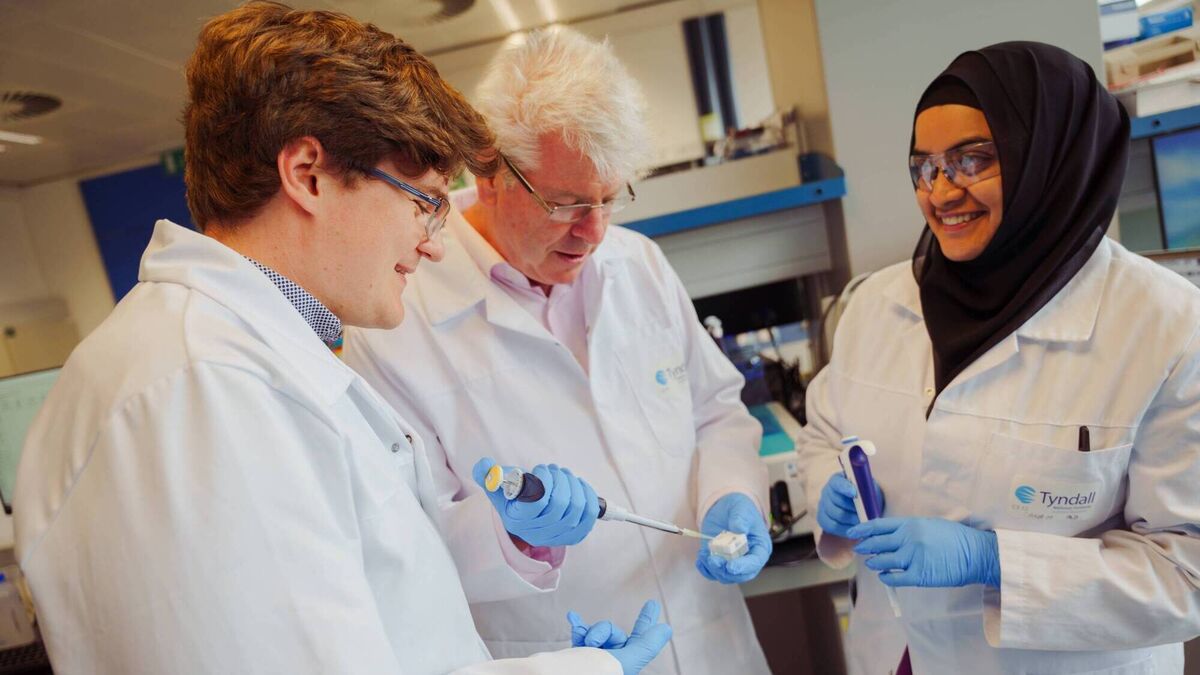
Dr Richard Murray, postdoctoral researcher, Sana Muzaffar, PhD Student, and Professor Alan O’Riordan, head of the precision electrochemical nanosensor research group at Tyndall National Institute


A new EU-funded project, led by Tyndall National Institute, based at University College Cork, is developing cutting-edge ‘biosensors’ that use bacteria to detect harmful ‘forever chemicals’ in the environment.

‘Forever chemicals’, including a group of persistent pollutants known as PFAS (per- and polyfluoroalkyl substances), are increasingly found in our environment and pose serious risks to human health and ecosystems.

Used in everyday items like cookware, cosmetics, and food packaging, PFAS resist degradation and can remain in soil and water for decades.

These chemicals fall under the broader category of contaminants of emerging concern (CECs), which also includes pharmaceuticals, microplastics, and endocrine-disrupting pollutants.

Their presence threatens the integrity of natural resources and has been linked to cancer, high cholesterol, reproductive issues, hormonal disruption, and weakened immunity.

Funded by the European Commission, the BIOSENSEI project brings together 10 partners from across Europe to create real-time, multiplexed, end-to-end biosensors that will detect ‘forever chemicals’ in the environment. These sensors will be deployed in real-world settings, marking the first time cellular biosensors are used outside laboratory environments.

BIOSENSEI is developing scalable biosensors for water and soil applications. These sensors will use adapted microbes to detect pollutants. The cellular responses will be captured by silicon chip-based transducers, enabling highly sensitive and reliable detection.

Professor Alan O’Riordan, head of the precision electrochemical nanosensor group at Tyndall, said: “This is an exciting new chapter in the development of sensor technology here at Tyndall.

“The partners involved in this project represent world domain experts in their field and it is a privilege to be working with them on such an important development, which will protect future generations.”

more #Cork - News articles

Sloppy Winter Snow Ice and Road Salt on Car Exterior Met Éireann issues snow and ice alert for Cork as entire country under at least one warning
Cannabis ready to roll Cork man charged with money laundering and drug dealing
Cork murder trial accused told gardaí his partner's last words were: 'This was not your fault' Cork murder trial accused told gardaí his partner's last words were: 'This was not your fault'

More in this section

Cork councillors call for extra funding to maintain greenways and active travel routes   Cork councillors call for extra funding to maintain greenways and active travel routes  
Action group calls for delivery of world-class library for Cork city Action group calls for delivery of world-class library for Cork city
UK-Ireland Summit Gardaí warn of traffic disruption as UK PM Keir Starmer visits Cork

Sponsored Content

The power of the G licence The power of the G licence
Happy couple receiving new house keys from real estate agent Time to get to grips with changes in rental laws
Boatbuilder turned engineer proves alternative paths can lead to success Boatbuilder turned engineer proves alternative paths can lead to success
Contact Us Cookie Policy Privacy Policy Terms and Conditions

© Examiner Echo Group Limited

Add Echolive.ie to your home screen - easy access to Cork news, views, sport and more