UCC honours Innti poets in new publication, Inside Innti
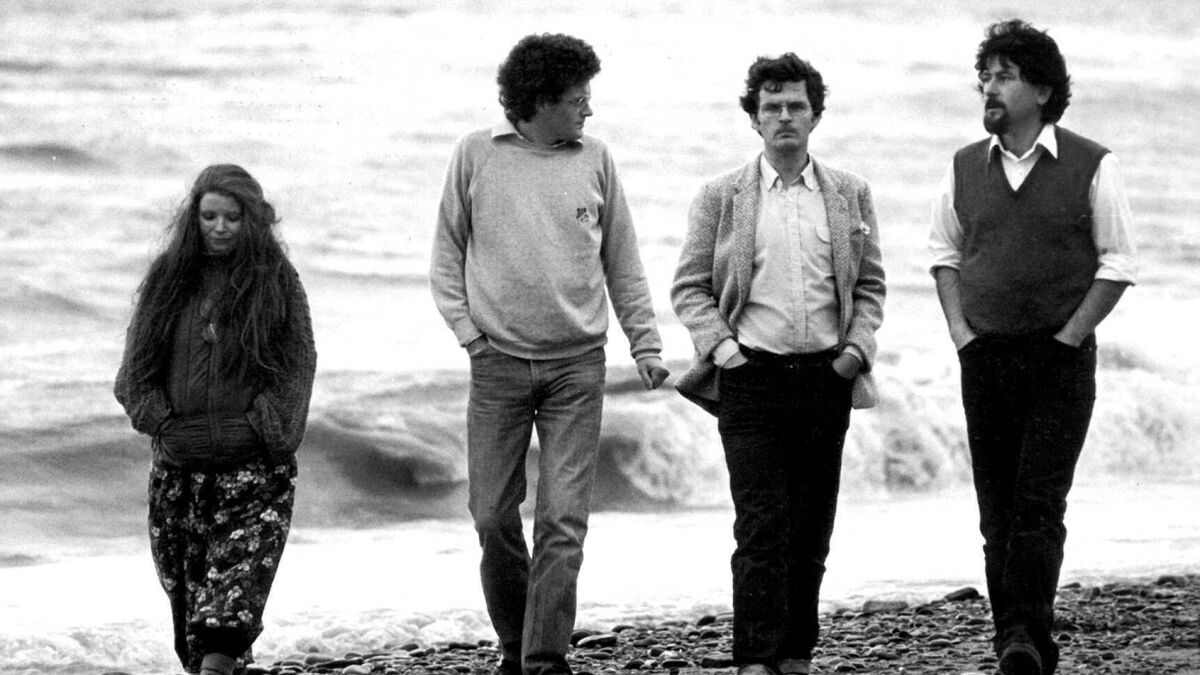
The Innti poets pictured by Bill Doyle in the early 1970s. From left to right, Nuala Ní Dhomhnaill, Michael Davitt, Gabriel Rosenstock and Liam Ó Muirthile.
FOR generations of schoolchildren who studied Irish poetry, it was about “Cúl an Tí” [the back of the house] or the stony walls of the Aran Islands.
But a generation of new young poets came along in the early 1970s and brought with them poetry infused with the free-living spirit of the era and plenty of sex, drugs, and rock‘n’roll.
This radical departure for Irish language poetry had its launching pad in UCC and the pilot poets of that generation were Cork’s Liam Ó Muirthile and Michael Davitt, Nuala Ní Dhomhnaill who was born in Lancashire, England but lived her life in Ireland between Corca Dhuibhne in West Kerry and Nenagh in Tipperary, and Limerick man Gabriel Rosenstock.
This generation of poets, and those who came in their wake such as Louis de Paor and Colm Breathnach were known as the Innti generation, in recognition of the poetry journal they published during their years in UCC and are being recalled in a book of essays recently launched in the college which proved to be the launching pad for their fame and a pivotal turning point in the progression of Irish language poetry.
Inside Innti is a Cork University Press publication jointly edited by UCC Irish language lecturer Aibhe Ní Ghearbhuigh and Tristan Rosenstock, literary editor of the Irish language magazine Comhar and a RTÉ RnaG broadcaster.
Its contents page is a who’s who of Irish language poetry, literature and criticism including Alan Titley, Clíona Ní Riordáin, and Caitríona Ní Cléirchín.
At the same time as the Innti generation was igniting in Cork, Belfast was also alive with poetry through the likes of Seamus Heaney, John Hewitt, Derek Mahon, and Michael Longley who wrote in the English language.
The launch event in the staff common room next door to the UCC Aula Maxima was well attended and heard Prof Patricia Coughlan, who confessed to being a contemporary undergraduate during those heady “Innti” years, give some interesting insights into the time.
In her remarks, UCC lecturer Ailbhe Ní Ghearbhuigh, now a UCC lecturer and award-winning poet, said that attending first-year lectures about Irish language poetry which featured the Innti poets “changed the course of her life”.
“I had intended on taking a degree in English literature but in that year I was charmed by another way.
“It’s a great honour for me to play homage to a generation of poets who exerted such a massive influence on a great number of people, the ethos behind Innti was inclusive before ‘inclusivity’ became a box-ticking exercise,” she said.
“You didn’t have to be from the Gaeltacht to be considered or you didn’t have to write a certain type of poetry, male, female, straight or gay, what we find in the pages of Innti is a chorus of diverse voices who all believed in the Irish language as a language of artistic merit, a social language, they believed in the future of the language and its capacity to put contemporary life into words.”
While sex has always been a preoccupation of Irish language poets, no less than poets in English or French, it really didn’t come out of the closet until the Innti generation arrived.
Poetry about sex, drugs and rock ‘n’roll is, according to Nuala Ní Dhomhnaill, what they wanted to write and that was to do with their youthful vigor and enthusiasm but also to do with openness, honesty, and irrepressible opinions.
While they were brimful of energy, there was also a guiding or, supporting, hand at work, that of the then professor of Irish at UCC, Seán Ó Tuama, who was also a recognised poet and writer.
The evening was brought to a conclusion by recitations of the poems of the Innti writers, two of whom, Liam Ó Muirthile and Michael Davitt are no longer with us, by the new generation of UCC students of Gaeilge.
Who knows what they will infuse the language with it for generations to come and whether their work will have the impact of the Innti generation.

App?