UCC breakthrough on dinosaur evolution
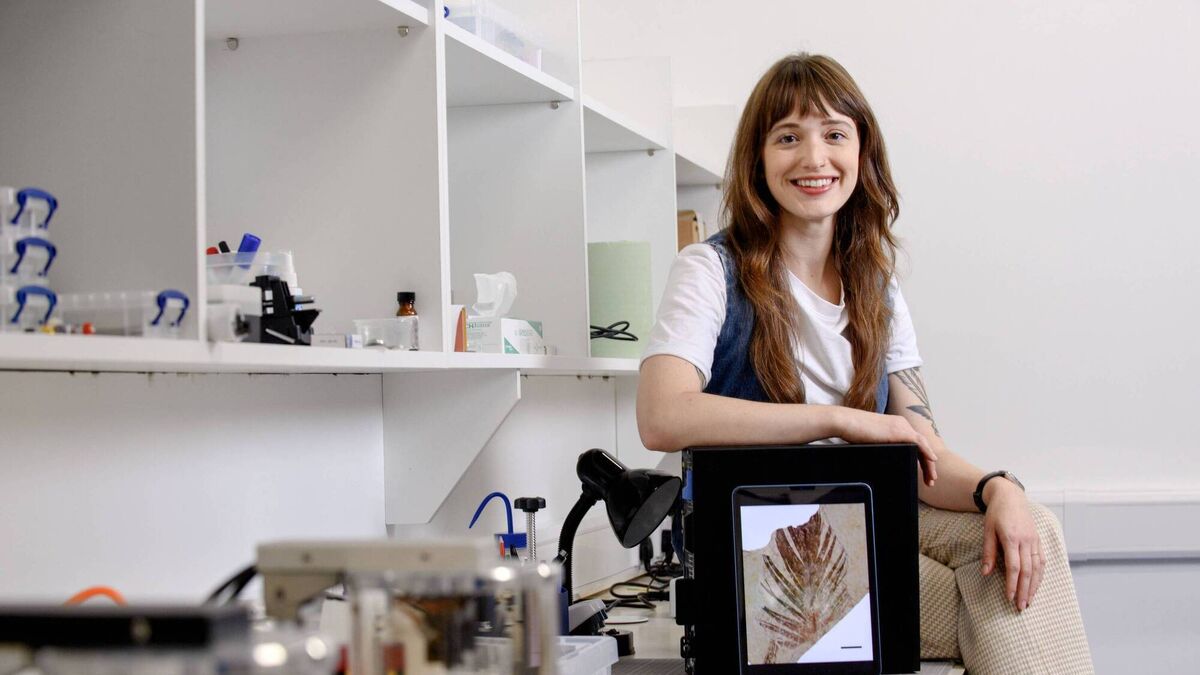
Dr Tiffany Slater pictured at the School of Biological, Earth and Environmental Sciences at University College Cork. Pic Daragh Mc Sweeney/Provision
Palaeontologists at University College Cork (UCC) have discovered groundbreaking new evidence about the evolution from dinosaurs to modern birds.
They found X-ray evidence of proteins in fossil feathers that reveals that modern-day feathers and those found in dinosaurs and early birds are more similar than palaeontologists believed.
Previous studies suggested that ancient feathers had a different composition to those of birds today. The new research, however, reveals that the protein composition of modern-day feathers was also present in the fossil analysed, confirming that the chemistry of feathers originated much earlier than previously thought.
The research, published in Nature Ecology and Evolution, was led by palaeontologists Dr Tiffany Slater and Prof. Maria McNamara of UCC’s School of Biological, Earth, and Environmental Science, who teamed with scientists based at Linyi University (China) and the Stanford Synchrotron Radiation Lightsource (USA).
The team analysed 125-million-year-old feathers from the dinosaur Sinornithosaurus and the early bird Confuciusornis from China, plus a 50-million-year-old feather from America.
To help interpret the chemical signals preserved in the fossil feathers, the researchers ran experiments to help understand how proteins break down during the fossilization process, developing a new method using X-rays and infrared light to detect traces of ancient feather proteins.
UCC’s Dr Slater explained: “Modern bird feathers are rich in beta-proteins that help strengthen feathers for flight. Previous tests on dinosaur feathers, though, found mostly alpha-proteins.
“Our experiments can now explain this weird chemistry as the result of protein degradation during the fossilization process. So although some fossil feathers do preserve traces of the original beta-proteins, other fossil feathers are damaged and tell us a false narrative about feather evolution.”
“It’s really exciting to discover new similarities between dinosaurs and birds,” she added.
As well as bringing this to light, the research also helps answer a long-standing debate about whether feather proteins can preserve in fossils.
Prof. Maria McNamara, senior author on the study, explained: “Traces of ancient biomolecules can clearly survive for millions of years, but you can’t read the fossil record literally because even seemingly well-preserved fossil tissues have been cooked and squashed during fossilization.
“We’re developing new tools to understand what happens during fossilization and unlock the chemical secrets of fossils. This will give us exciting new insights into the evolution of important tissues and their biomolecules."







 App?
App?


